




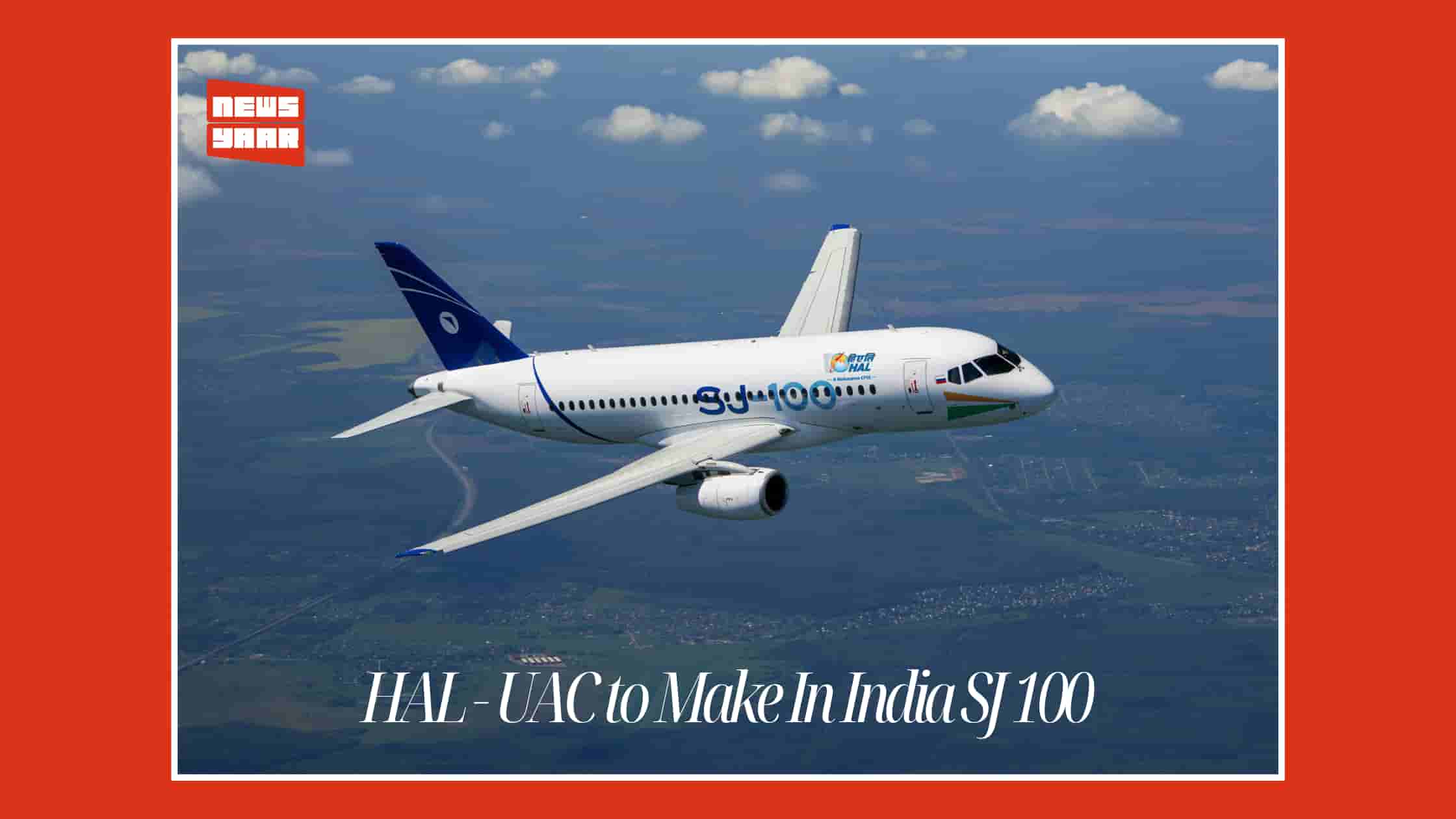
Hindustan Aeronautics Limited (HAL) has entered into a strategic aviation partnership with Russia’s United Aircraft Corporation (UAC) to manufacture the SJ 100 regional jet in India, marking a significant expansion of HAL’s footprint into the civil aviation sector. The move was announced on the sidelines of the Wings India 2026 aviation exhibition held at Begumpet Airport in Hyderabad, where the collaboration was formally unveiled amid industry attention.
The pact — which builds on a Memorandum of Understanding (MoU) signed on October 28, 2025, in Moscow — provides HAL with a licence to produce the twin-engine SJ 100 commercial aircraft in India for domestic customers, including local assembly, component manufacturing and maintenance support, alongside technical and consulting assistance from UAC.
What Is the SJ 100 and Why It Matters
The Yakovlev SJ 100 (often referred to as Sukhoi Superjet 100) is a twin-engine, narrow-body regional passenger jet designed to seat between 87 and 108 passengers, with a range of around 3,000 km, tailored for short- to mid-distance routes. The aircraft is already in service with airlines in Russia and abroad, with over 200 units produced and operated by multiple carriers.
The SJ 100 is capable of operating from smaller airports and shorter runways, making it particularly suitable for India’s expanding regional network under initiatives such as the UDAN (Ude Desh ka Aam Naagrik) scheme, which aims to improve connectivity to underserved and tier-2/tier-3 cities.
Strategic Shift for HAL
HAL — traditionally focused on military aerospace manufacturing (including fighters, trainers and helicopters) — is now actively diversifying into civil aviation manufacturing. Civil platforms currently contribute only about 4–5 per cent of HAL’s revenue. The SJ 100 partnership is a cornerstone of HAL’s strategy to increase this share to about 25 per cent over the next decade, according to HAL Chairman and Managing Director D.K. Sunil.
Sunil explained at Wings India 2026 that HAL plans a phased approach to aircraft introduction. Initially, HAL aims to lease about 10–20 fully assembled SJ 100 aircraft from Russia to Indian operators to familiarise them with the aircraft and validate performance and support infrastructure under Indian operating conditions.
Timeline and ‘Make in India’ Ambition
The partnership foresees several key stages:
- Short term (next 18 months): Leasing of fully built SJ 100 jets to Indian operators.
- Medium term (around three years): Commencement of semi-knocked-down (SKD) assembly in India, utilising HAL’s existing facilities at locations such as Nashik and Kanpur.
- Long term (by late decade): Full domestic manufacture capability with enhanced localisation and “Make in India” content, aligning with national goals of reduced import dependence and broader industrial development.
This would mark the first time since the production of the AVRO HS-748 ended in 1988 that a complete passenger aircraft will be manufactured in India, making it a milestone for the country’s civil aviation manufacturing base.
Broader Industry and Policy Context
The HAL-UAC collaboration highlights deeper Indo-Russian aerospace cooperation, historically rooted in military aircraft production, now extending to civil aircraft. It also dovetails with government measures designed to attract and scale aircraft manufacturing in India. The Union Budget 2026 removed basic customs duty on aircraft components, significantly lowering the cost of establishing manufacturing lines for regional aircraft such as the SJ 100, potentially boosting both HAL’s and other manufacturers’ plans in the civil aviation domain.
Industry observers note that HAL’s entry into regional jet production addresses a long-recognized gap in India’s aviation ecosystem: the absence of indigenous passenger aircraft manufacturing. India is among the world’s fastest-growing domestic aviation markets, with demand for short- to medium-haul aircraft projected to remain strong over the next decade. Local assembly and production of the SJ 100 could help airlines bridge capacity needs more cost-effectively while supporting domestic aerospace supply chains.
Technology, Certification and Future Prospects
Under the agreement, HAL will assist UAC in gaining type certification for the SJ 100 in India, a critical step before domestically produced jets can enter commercial service. In exchange, HAL obtains manufacturing rights and support for establishing production infrastructure, quality control systems, and maintenance ecosystems.
Experts see this collaboration as a key step toward building India’s aircraft manufacturing competencies. While HAL’s primary strength has been in defence platforms, working with UAC on a complex regional jet programme is expected to transfer valuable design, production, certification and lifecycle support expertise.
Officials and industry executives involved in the pact have described the arrangement as mutually beneficial: it enhances HAL’s capabilities and helps Russia sustain civilian aircraft exports in the face of geopolitical and sanction-related challenges, while opening a new avenue for aerospace collaboration between the two countries.
What This Means for Passengers and Airlines
If the phased plan succeeds, airlines operating within India could have access to the SJ 100 as an alternative to turboprops and larger narrow-body jets for regional routes. The regional jet segment (90–100 seats) is seen as crucial for balancing operational economics with demand on short-haul sectors, particularly under government connectivity programmes.
Leasing a small fleet in the initial phase also allows airlines and HAL to build operational familiarity with the SJ 100 without requiring immediate large capital commitments, potentially encouraging broader adoption in India’s growing domestic market.
Conclusion
HAL’s partnership with Russia’s United Aircraft Corporation to manufacture the SJ 100 regional jet in India represents a significant step in diversifying India’s aviation industry and strengthening its manufacturing base. By combining Russian aerospace experience with HAL’s production capabilities and India’s burgeoning aviation market, the collaboration aims to deliver regional aircraft solutions tailored to national connectivity needs while advancing the government’s Make in India and civil aerospace ambitions.
About the Author
 Business Reporter




Comments
Leave a Comment
No comments yet. Be the first to comment!