




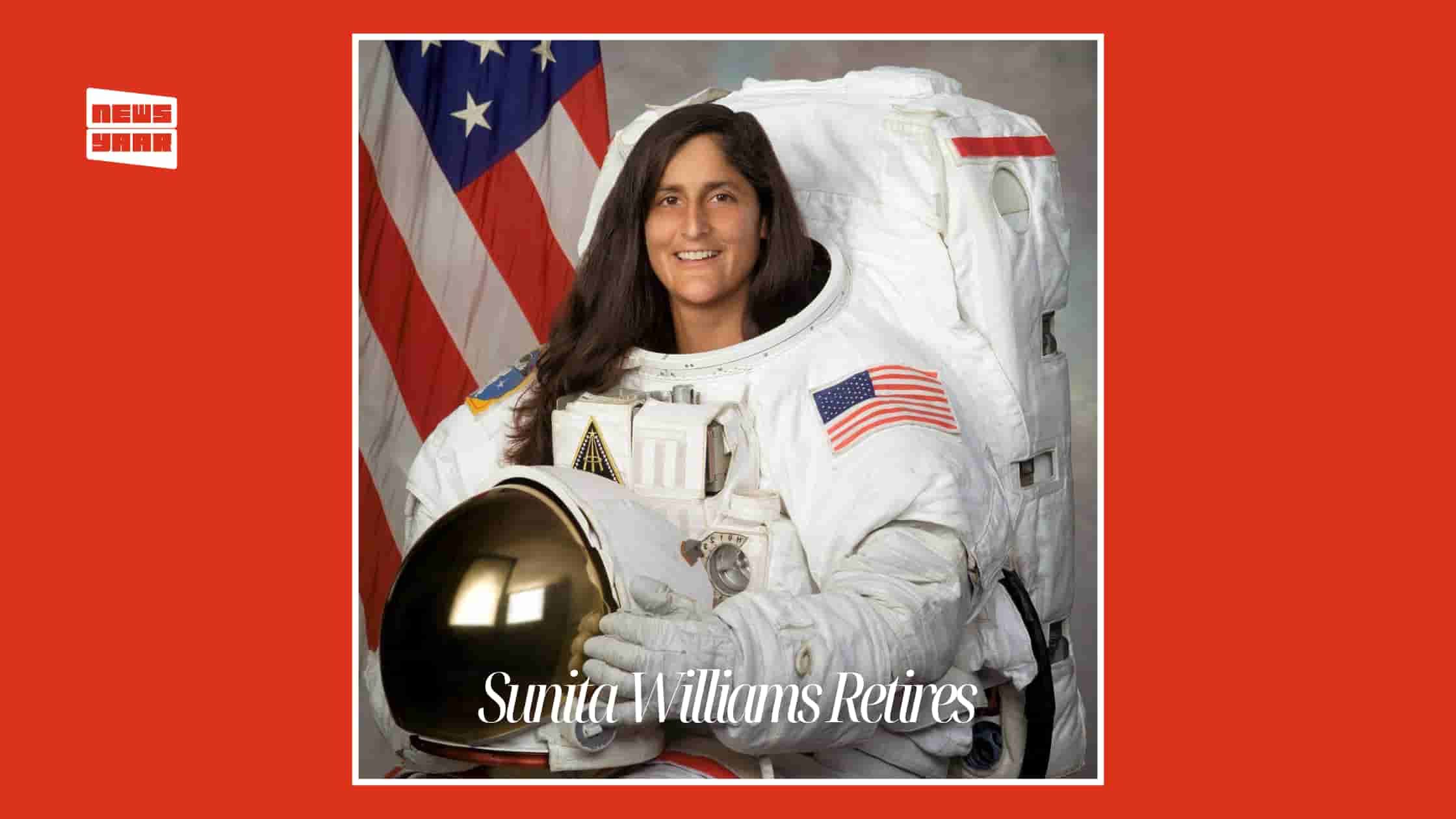
NASA astronaut Sunita “Suni” Williams has formally retired after a distinguished 27-year career with the United States space agency, closing a chapter that spans some of the most significant phases of modern human spaceflight — from the Space Shuttle programme to the International Space Station (ISS) and the emergence of commercial crew missions.
NASA announced her retirement in late 2025, acknowledging Williams’ extensive contributions to space exploration, mission leadership, astronaut training and long-duration human spaceflight operations.
Early Life and Professional Background
Born on September 19, 1965, Sunita Williams is of Indian-Slovenian descent and grew up in the United States. She graduated from the United States Naval Academy with a degree in physical science and later earned a master’s degree in engineering management from the Florida Institute of Technology.
Before joining NASA, Williams served as a commissioned officer in the US Navy, where she became a helicopter pilot and later a test pilot, flying more than 30 aircraft types. Her operational and technical experience in aviation played a key role in her selection as an astronaut.
Selection as NASA Astronaut
Williams was selected as part of NASA’s 1998 astronaut class, one of the agency’s most competitive intakes. She underwent extensive training in spacecraft systems, robotics, spacewalks, Russian language and survival operations — a reflection of NASA’s increasingly international mission structure at the time.
Her training coincided with the early assembly years of the International Space Station, positioning her at the forefront of long-duration orbital missions.
Space Missions and Time in Orbit
Over the course of her career, Williams flew on three space missions, spending a cumulative 608 days in space, making her one of NASA’s most experienced astronauts in terms of time spent in orbit.
Her first spaceflight came in 2006 aboard Space Shuttle Discovery (STS-116), where she joined Expedition 14 and later Expedition 15 aboard the ISS. During this mission, she played a major role in station construction and systems maintenance.
Williams returned to the ISS in 2012 as part of Expedition 32, later assuming command during Expedition 33, becoming one of the few astronauts — and one of the few women — to lead the orbiting laboratory.
Record-Breaking Spacewalks
One of Williams’ most notable achievements was her contribution to extravehicular activity (EVA). She conducted nine spacewalks, accumulating over 62 hours outside the ISS — a record for the most spacewalk time logged by a woman astronaut at the time.
Her spacewalks involved complex tasks such as station assembly, repair of external systems, installation of scientific instruments and upgrades to power and cooling infrastructure critical to ISS operations.
Leadership and Scientific Contributions
As Commander of the ISS, Williams was responsible for crew safety, operational coordination, scientific mission execution and liaison with ground teams across multiple countries. Her tenure coincided with an intensive research phase aboard the station, with experiments spanning human physiology, material science, fluid dynamics and Earth observation.
NASA officials have consistently cited her leadership style, operational discipline and technical proficiency as instrumental in sustaining continuous human presence aboard the ISS.
Role in Commercial Crew and Training
In the latter part of her career, Williams supported NASA’s transition toward commercial crew programmes, contributing to astronaut training, mission evaluations and operational readiness planning. Her experience across different spacecraft platforms made her a valuable resource during this transitional period.
She was also involved in mentoring younger astronauts and supporting mission simulations, ensuring continuity of institutional knowledge within NASA’s astronaut corps.
Retirement and Post-Service Benefits
Williams retired at the age of 60, making her eligible for federal retirement benefits based on years of service. According to public disclosures, retired NASA astronauts receive pensions under standard US federal employee retirement systems, along with healthcare and post-service benefits.
While she has not announced formal post-retirement plans, retired astronauts often continue contributing through education, public engagement, advisory roles, research collaborations and private-sector aerospace initiatives.
Legacy and Impact
Sunita Williams’ retirement marks the end of a career that bridged multiple eras of US space exploration. Her achievements place her among the most accomplished astronauts in NASA history, particularly in the areas of long-duration missions, spacewalk operations and international cooperation aboard the ISS.
Her career has also held symbolic importance for aspiring scientists and engineers worldwide, particularly in India and among the global Indian diaspora, where her achievements have long been followed with pride.
As NASA prepares for future missions to the Moon, Mars and beyond, Williams’ contributions remain embedded in the operational foundations of long-duration human spaceflight.
About the Author
 Science Reporter





Comments
Leave a Comment
No comments yet. Be the first to comment!