




Fractal Analytics IPO Debuts Muted: Shares List at 2.7% Discount, Close Day 1 Down 6% Amid AI Hype Fade
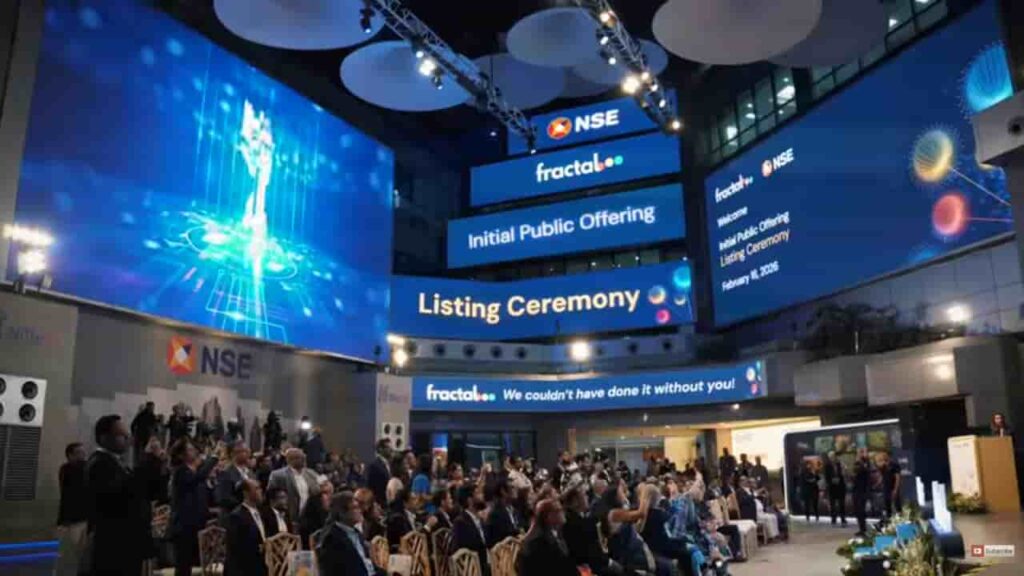
BUSINESS Fractal Analytics IPO Debuts Muted: Shares List at 2.7% Discount, Close Day 1 Down 6% Amid AI Hype Fade Mumbai, February 16, 2026 – AI-driven analytics firm Fractal Analytics made a tepid stock market entry today, listing at ₹876 on NSE (2.7% below the ₹900 IPO price) and flat at ₹900 on BSE, before closing the first day down 6%, signaling investor caution despite 2.66x oversubscription. With a listed market cap of ₹15,061 crore, the debut underscores market demand for execution proof over “AI buzz,” as grey market premium (GMP) flipped negative at -₹10 (-1.11%). IPO Snapshot and Subscription Breakdown The ₹1,526 crore IPO (Dec 9-11, 2025; price band ₹857-900; lot size 16 shares) drew solid institutional interest (4.05x) but tepid retail/non-institutional bids (~1x). Allotment finalized Feb 12; trading commenced Feb 16 post-approvals. Promoters: Srikanth Velamakanni, Pranay Agrawal, Chetana Kumar, Narendra Kumar Agrawal, Rupa Krishnan Agrawal. GMP swung from +₹180 high to -₹10 low, forecasting ₹890 listing, mirroring sentiment. Key Metric Details Issue Size ₹1,526 crore Subscription 2.66x overall Listing (NSE/BSE) ₹876 / ₹900 GMP (Feb 16) -₹10 (-1.11%) Mkt Cap (Listing) ₹15,061 crore Post-listing P/E: 65.6x FY25 profits (down from 67.37x at IPO); 109.1x annualized H1 FY26, premium to Nifty 50 (~22x), pricing in growth but vulnerable to misses. Funds Utilization: Growth Bets with Risks Net proceeds target: Prepay Fractal USA borrowings. Laptops, new India offices, R&D/sales/marketing via Fractal Alpha. Inorganic growth (≤25% cap), general purposes (≤35% total).Unappraised by banks; three-year deployment. No variation without shareholder nod (special resolution). Risks: Delays, overruns, alternative funding needs (debt/accruals). Key Risks from RHP: Execution Hurdles Fractal flagged multiple red flags: Operations: All 24 offices leased (non-renewal risk); 78.2% PPE insured (gaps/exclusions). Growth: Regulatory delays, hiring woes; client concentration (top 10: 54.2% Fractal.ai revenue); US reliance (64.9%). Financials: Employee costs 72.2% revenue (H1 FY26); cash lags possible. Compliance/Tax: Anti-bribery/sanctions exposure; Finance Bill 2025 uncertainties; LTCG 12.5% (>₹1.25L, >12mo hold), STCG 20%. Governance: Concentrated post-IPO holding (Apax, OLMO, TPG, promoters); PFIC risk for US investors; internal controls critical.Anchor lock-ins: 50% till Mar 13, 2026; rest May 12—potential volatility triggers. What to Watch: Investor Triggers Q4 FY26 Results: Validate FY25 ₹220.6 crore profit; margin stability amid people costs. Client Metrics: 122 MWCs (Sep 2025); sticky revenue vs. headcount bloat. Cash Flows: Receivables quality in a project-heavy model. Peers: Premium tech-services+AI valuation; execution > narrative. Analysts eye partial profit-taking for allottees; long-term hold if margins/client base expand. Fractal’s AI analytics pitch met reality check, market demands quarterly proof amid fading hype. Track live at indmoney.com/ipo/fractal-analytics-ipo. Valuation: Premium Pricing, Execution Squeeze Listing P/E 65.6x FY25 (109x H1 FY26 annualized), steep vs. Nifty (~22x), peers. ROCE 13%; per-unit spend ₹0.93/Rs earned FY25. GMP crash (-₹10) reflects fading AI buzz; 2.66x subscription (QIBs 4x, retail ~1x) shows selective appetite. Mkt cap ₹15,061 Cr at list; anchor lock-ins (Mar/May 2026) loom as supply risks. Bull vs. Bear: Balanced Risks Bulls: AI platforms scale margins (45.9% gross); enterprise wins (Google, Wells Fargo); IPO funds inorganic growth (25% cap), offices, R&D. Services-to-subs shift boosts repeatability. Bears: People-heavy (72% costs); unappraised proceeds; leased ops (24 sites); tax/compliance/PFIC risks; no cash flow details signal receivables lag potential. Q4 FY26 must sustain margins amid salary inflation. Investor Playbook Traders: Eye ₹900 resistance; sell on lock-in spikes. 6-12 Months: Hold if Q4 confirms profit stability, client diversification. Long-Term: Bet on AI embedment if subs >20% mix, US demand holds. Partial exits prudent; track cash flows, top-client stability over hype. Fractal’s story hinges on proving scalable profitability, not just “AI-first” labels, in a crowded analytics field.
Omnicom Completes IPG Acquisition, Creating World’s Largest Advertising Group
ADVERTISING Omnicom Completes IPG Acquisition, Creating World’s Largest Advertising Group Omnicom Group has officially completed its acquisition of Interpublic Group of Companies (IPG), finalizing a deal that creates the world’s largest advertising holding company and marks a major shift in the global agency landscape. The stock-for-stock transaction, valued at approximately $8.9 billion, closed on November 26, 2025. With the merger, Omnicom moves to the top of the global agency rankings, reporting $26.4 billion in combined worldwide revenue for 2024, ahead of Accenture Song, WPP, and Publicis Groupe. Omnicom Chairman and CEO John Wren, along with senior leadership, described the merger as a strategic move focused on scale, technology, and operational efficiency rather than expansion for its own sake. Creative Networks Restructured As part of the integration, Omnicom confirmed it will retire three legacy creative networks, DDB, FCB, and MullenLowe. FCB will be consolidated into BBDO, while TBWA will absorb both DDB and MullenLowe. McCann will remain the sole surviving IPG global creative network, selected for its strong international presence and brand recognition. The move reflects a broader industry trend toward fewer, globally scalable agency brands. Media Agencies Largely Unchanged Unlike the creative restructuring, Omnicom’s media operations will remain largely intact. The combined company will continue to operate five global media agency brands, with no immediate plans to eliminate any of them. Technology at the Core Omnicom executives positioned the deal as a technology-driven merger, highlighting the company’s AI-powered intelligence platform, Omni, and an expanded agentic framework designed to unify data, identity, and activation across the organization. Leadership said the combined entity now holds one of the strongest data and technology foundations in the advertising industry. Workforce Impact The merger will result in significant job reductions. Omnicom expects its global workforce to total approximately 105,000 employees, down from a combined 128,200 at the end of 2024, implying around 23,200 job cuts worldwide. A Giant Reborn As Omnicom enters this new chapter, it stands taller, leaner and more technologically ambitious than ever before. Built on the foundations of BBDO, McCann and TBWA, the company is betting that clarity, scale, and data-driven creativity will define the next decade of marketing. The merger doesn’t just create the world’s largest agency holding company, it redraws the rules of what an agency is expected to be. About the Author Business Reporter Share via Copied Comments Post Comment