




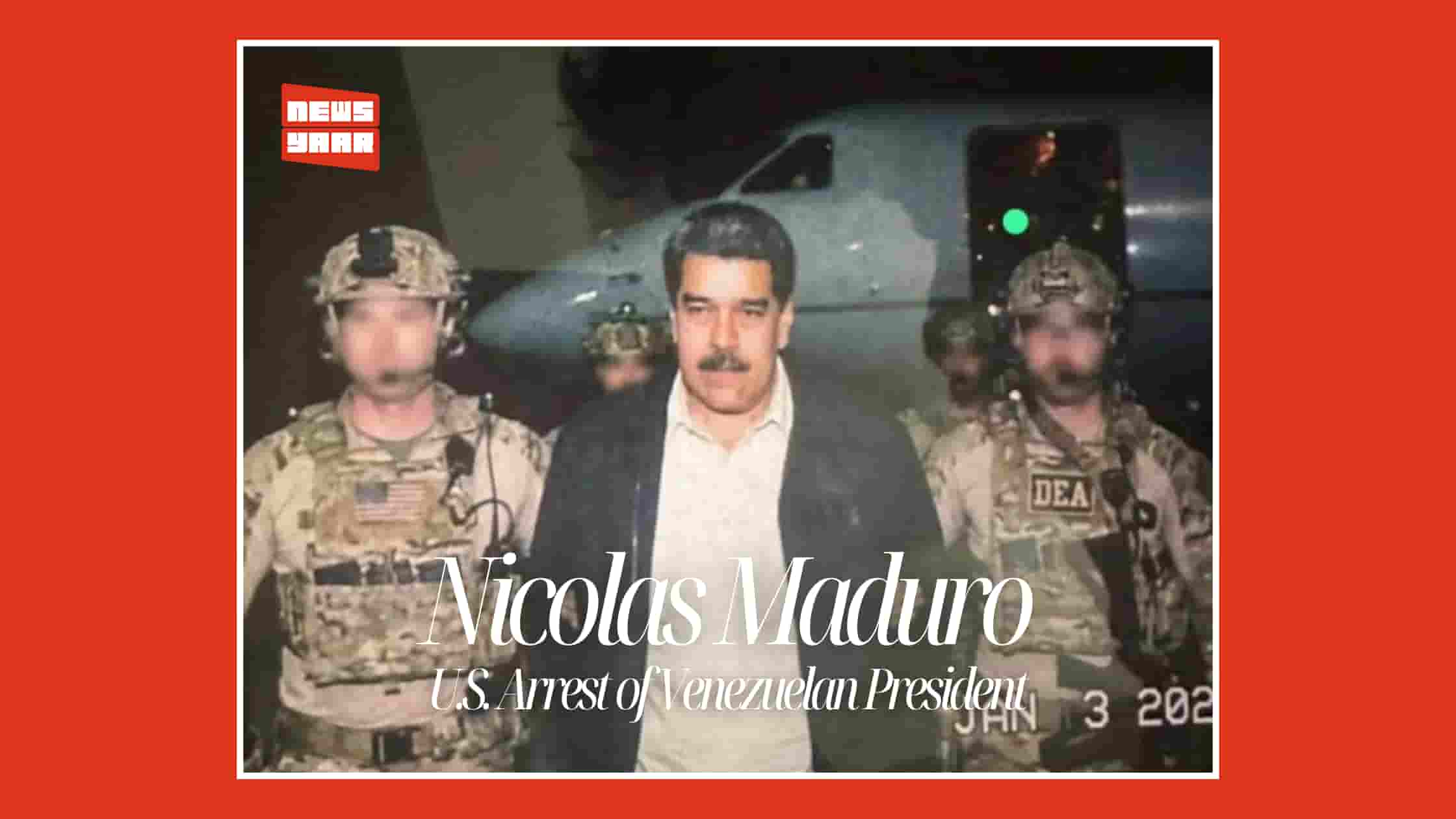
In one of the most dramatic international developments of 2026, the United States military captured Venezuelan President Nicolás Maduro in a large-scale operation on January 3, 2026, removed him from power, and brought him to the United States to face criminal charges. The operation has had far-reaching political, legal and diplomatic implications for Venezuela, the United States, and global geopolitics.
What Happened and When
In the early hours of January 3, 2026, U.S. forces launched a major military operation in Caracas, Venezuela’s capital, known as “Operation Absolute Resolve.” Using air strikes and special operations units, U.S. troops seized President Nicolás Maduro and his wife, Cilia Flores, in what Washington described as the execution of arrest warrants related to drug trafficking and narco-terrorism.
Maduro and Flores were transported to the United States, where they appeared in federal court in Manhattan, New York, on January 5, 2026, and pleaded not guilty to multiple serious charges, including leading a corrupt government and involvement in extensive drug trafficking.
Why the U.S. Acted
The Trump administration has long accused Maduro’s government of corruption, human rights abuses and facilitating large-scale drug trafficking into the United States. The U.S. Department of Justice had prosecuted Maduro in absentia on these charges and the U.S. issued a series of increasing bounties for information leading to his arrest. In November 2025, Washington designated the shadowy criminal network linked to the Venezuelan regime — often referred to as the “Cartel of the Suns” — as a Foreign Terrorist Organization, amplifying pressure on the Maduro government.
A detailed U.S. government timeline shows the operation followed months of military buildup off the Venezuelan coast, where warships, aircraft and strike groups were deployed, signaling escalating tensions and intent.
How It Happened
According to experts and official accounts, the operation involved:
- U.S. Army and special forces units engaged in strikes and capture operations in Caracas.
- Initial detainment aboard a U.S. Navy ship before transfer to New York.
- Charges brought in a federal court linked to narcotics trafficking, weapons, and narco-terrorism.
The Trump administration framed the seizure as a law enforcement action supported by military force, although critics argue it constitutes a direct intervention in a sovereign state.
Legal Charges and Court Proceedings
Maduro and his wife were charged with multiple federal crimes in the Southern District of New York. These included:
- Narcotics trafficking
- Conspiracy to import large quantities of cocaine
- Narco-terrorism and organized crime offenses.
In court, Maduro maintained he was still Venezuela’s legitimate leader and repeatedly insisted on his innocence, describing himself as a victim of U.S. political action rather than a criminal defendant.
Who Is Nicolás Maduro?
Nicolás Maduro first became president of Venezuela in 2013 after the death of Hugo Chávez and consolidated power through increasingly authoritarian measures. His rule has been marked by widespread economic crisis, allegations of election manipulation, suppression of opposition, and mass migration from Venezuela.
Despite winning a third term in a disputed election in July 2024, recognized by Maduro’s government but denounced as illegitimate by many nations, criticism of his leadership and accusations of corruption and repression continued.
Immediate Aftermath in Venezuela
Following Maduro’s removal, Venezuela’s Supreme Court appointed Vice President Delcy Rodríguez as interim president for 90 days. Rodríguez has sought to consolidate power amid internal factional tensions. Various military and political elites remain influential, notably Interior Minister Diosdado Cabello, who has not been detained despite prior U.S. warnings.
Rodríguez, a long-time Maduro ally, has moved quickly to reorganize government leadership while maintaining resistance to U.S. intervention. Her rise has intensified internal political divisions and raised concerns about stability.
International and Regional Reactions
The operation elicited a wide range of reactions:
- Supporters: Some U.S. lawmakers and allied leaders hailed the capture as a victory against corruption and narco-terrorism.
- Critics: Many Latin American governments and international legal experts condemned the U.S. action as a violation of international law and Venezuelan sovereignty, arguing the U.S. had no legal justification without Security Council authorization.
Countries like Russia explicitly criticized the operation as destabilizing, while some regional governments warned of broader geopolitical consequences.
Impact on Oil and Economy
Venezuela sits atop some of the world’s largest proven oil reserves, and control of these resources has long been a major strategic focus. Following Maduro’s ouster, the U.S. has moved to sell Venezuelan oil assets, starting with a $500 million sale aimed at benefiting both U.S. and Venezuelan citizens while stabilizing markets. The U.S. plans further sales with revenues held under U.S. oversight.
This shift underscores the interplay of energy strategy with geopolitical goals and highlights the economic stakes involved in the crisis.
Legal and International Law Debate
The U.S. Department of Justice released internal memos asserting that international law compliance was not required for the operation, given domestic authority — a position sharply criticized by legal scholars who argue a foreign head of state’s forcible capture violates the United Nations Charter prohibitions on use of force without Security Council approval.
Humanitarian and Domestic Concerns
Venezuela’s population has endured a profound humanitarian crisis for years, with severe shortages of food, medicine, and basic services, resulting in one of the largest migrations in the Western Hemisphere in recent history. The removal of Maduro has sparked mixed reactions domestically — some Venezuelans see it as a hopeful moment, while others fear renewed instability and uncertainty about future governance.
What’s Next
- Maduro’s next court date is scheduled, keeping international attention on his criminal case.
- Political transition plans remain unsettled, with Rodríguez’s interim leadership drawing scrutiny.
- U.S. involvement in Venezuelan governance, including oil and economic reconstruction, is likely to continue to be a major issue in diplomatic and regional politics.
International opposition and legal challenges could shape the broader geopolitical fallout of the operation.
About the Author
 World Reporter




Comments
Leave a Comment
No comments yet. Be the first to comment!