

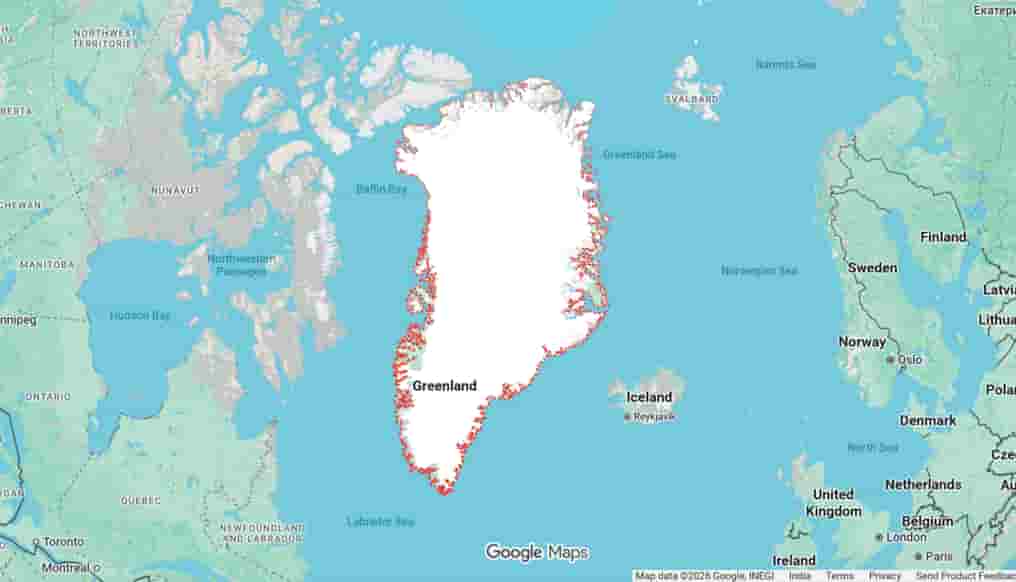
In a development that has attracted international attention and debate, the United States’ proposal to acquire Greenland — an autonomous territory of the Kingdom of Denmark — has re-emerged as a subject of strategic and geopolitical significance. Although the plan has not advanced to a formal purchase or agreement, the discussions reflect broader shifts in global power dynamics, Arctic geopolitics and resource competition in the High North.
Background: What Is Greenland and Why It Matters
Greenland, the world’s largest island, is an autonomous territory within the Kingdom of Denmark. It has a small population of around 56,000 people, predominantly Inuit, and exercises internal self-government, with defence and foreign policy matters managed by Copenhagen. The island’s geopolitical importance has grown dramatically in recent years due to its strategic location in the Arctic Circle, potential natural resources, and its role in global climate science.
The Arctic region — long seen as remote and marginal — has become a theatre of international competition as climate change reduces sea ice cover, opening new shipping routes and access to untapped natural resources such as hydrocarbons, rare earth minerals and critical metals.
The U.S. Proposal and Renewed Discussions
The idea of the United States acquiring Greenland first entered public consciousness in 1946, when Washington offered to purchase the island from Denmark — an offer Denmark rejected. More recently, in early 2025, the topic resurfaced in official remarks tied to U.S. strategic assessments in the Arctic region.
On January 9, 2025, comments by U.S. officials sparked media attention by reiterating the historical suggestion of an acquisition and linking Greenland to contemporary strategic priorities. The U.S. reiterated that maintaining security, stability and freedom of navigation in the Arctic was critical, given increasing interest from global powers including Russia and China. However, no formal acquisition negotiations have taken place, and no treaty or transaction is under legal consideration.
Why the Idea Has Re-Emerged
There are several factors that explain why the Greenland acquisition proposal has resurfaced:
- Strategic Location
Greenland’s location astride key North Atlantic and Arctic approaches gives it enormous strategic value. Military and intelligence establishments see relevance in monitoring and controlling northern sea lanes, especially as ice melt accelerates. - Resource Potential
The island is believed to hold significant reserves of minerals, hydrocarbons and rare earth elements — materials crucial for advanced technologies, clean energy transitions, and defence manufacturing. Many of these resources remain largely undeveloped. - Arctic Competition
As Arctic ice retreats, the region is attracting investment and geopolitical interest from Russia — which already operates extensive military infrastructure in the Arctic — and from China, which has described itself as a “near-Arctic state” and has increased scientific expeditions and commercial interest in the region.
In this context, a secure Arctic partnership is viewed by some U.S. policymakers as a way to check rival influence and reinforce alliances in the North Atlantic.
Denmark and Greenland’s Response
Officials in Denmark and Greenland have objected to the notion of a territorial sale. Both Copenhagen and Nuuk (Greenland’s capital) have emphasised that any talk of acquisition is not under active negotiation and that Greenland’s autonomy and right to self-determination are paramount.
Danish leaders have reiterated that Greenland is not for sale, and the notion of transfer of sovereignty to any other country is not on the diplomatic agenda. Greenland’s government has also emphasised its constitutional status and the importance of cooperation with external partners on mutually agreed terms rather than unilateral transactions.
Domestic Debate in the United States
Within the U.S., the comments on Greenland have sparked discussion rather than policy action. Some defence and foreign policy analysts argue that the notion is symbolic rather than practical, serving as a reminder of strategic priorities in the Arctic rather than a concrete acquisition plan.
Others point out that the U.S. already maintains strong strategic access to Greenland through Thule Air Base, a critical component of North American aerospace defence. Located in northwest Greenland, the base is integral to early-warning radar systems and missile tracking, and its presence reflects existing U.S. strategic interests without the need for sovereignty.
International Reaction
International observers, including strategic analysts and Arctic nations, have largely regarded the acquisition proposal as speculative rather than imminent. Canada, Russia and other Arctic Council members traditionally work through multilateral forums to address security, environmental protection and indigenous community rights in the region.
Global media coverage has framed the idea as more of a strategic talking point than an actionable policy initiative, emphasising that any shift in sovereignty would require consent from Denmark and Greenland, constitutional changes, and a fundamentally altered approach to international law.
Legal and Constitutional Considerations
Under international law, the transfer of territory requires clear consent from the governing state and, increasingly, the affected population. Greenlanders themselves have expanded roles in their own governance under the 2009 Self-Government Act, which affirms that decisions about significant changes to sovereignty would necessitate consultation and approval from Greenland’s parliament and people.
Additionally, Denmark’s constitutional framework does not allow significant cession of territory without legislative and likely referendum approval, making any acquisition a highly complex legal undertaking.
What This Means for Arctic Policy
While the idea of a Greenland acquisition remains speculative, it highlights how the Arctic has risen in strategic importance. The U.S. and allied countries have renewed focus on:
- Arctic security cooperation through NATO and bilateral partnerships
- Scientific collaboration on climate research and environmental monitoring
- Investment in infrastructure that supports commercial and defence logistics
- Engagement with indigenous and local governance structures
The Arctic Council — a multilateral forum including Arctic states such as Canada, Denmark, Finland, Iceland, Norway, Russia, Sweden and the U.S. — continues to be the primary platform for addressing regional cooperation on environmental protection, sustainable development and shared scientific objectives.
Conclusion: Symbolic Signal or Strategic Shift?
The renewed mention of a Greenland acquisition is best understood not as an active diplomatic negotiation but as a symbolic signal of U.S. strategic priorities in the High North. It underscores the increasing salience of the Arctic as climate change alters geography, resources and commercial access.
For now, Greenland’s sovereignty remains with Denmark, and discussions about acquisition do not constitute formal policy. But the debate reflects broader anxieties and interests about the Arctic’s future — including how countries align on security, trade, climate, indigenous rights and geopolitical influence in a region once considered remote but now central to global strategic thinking.