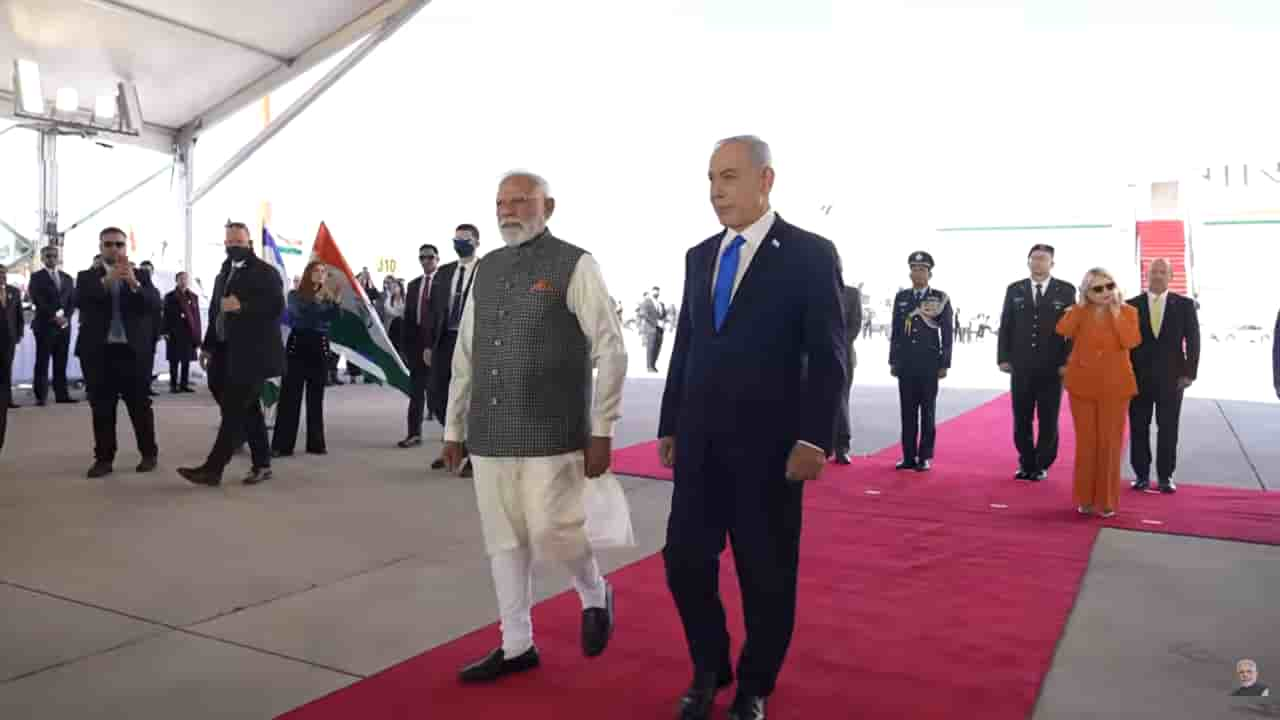
Prime Minister Narendra Modi undertook a two-day official visit to Israel, marking a significant moment in India–Israel relations at a time of heightened geopolitical volatility in West Asia. The visit, described by official sources as historic, was aimed at consolidating India’s long-standing strategic partnership with Israel while navigating the complex regional and global environment shaping Middle Eastern politics.
The visit underscored India’s commitment to sustained engagement with Israel across defence, technology, agriculture, innovation and economic cooperation, even as regional conflicts and shifting alliances pose diplomatic headwinds.
Context and Timing of the Visit
Prime Minister Modi’s Israel visit comes at a sensitive juncture for the region. West Asia continues to witness prolonged instability, with security concerns, evolving power equations and humanitarian challenges dominating the geopolitical landscape. Against this backdrop, India’s outreach to Israel reflects a calibrated diplomatic approach that balances strategic interests with regional stability and global responsibilities.
India and Israel share a relationship that has evolved steadily since the establishment of full diplomatic ties in 1992. Over the years, cooperation has expanded from defence procurement to joint research, innovation-driven partnerships and people-centric development projects. The current visit builds on this foundation while acknowledging the realities of a strained regional environment.
High-Level Engagements and Bilateral Talks
During the visit, Prime Minister Modi held extensive talks with Benjamin Netanyahu, focusing on deepening the India–Israel strategic partnership. The discussions reviewed the full spectrum of bilateral cooperation, including defence and security, economic engagement, technological collaboration, water management and agricultural innovation.
Both leaders reaffirmed their commitment to strengthening institutional mechanisms that support cooperation in critical and emerging sectors. Emphasis was placed on sustaining momentum in joint initiatives that align with India’s development priorities and Israel’s technological expertise.
Defence and Strategic Cooperation
Defence cooperation remains a central pillar of India–Israel relations. Israel is among India’s key defence partners, particularly in areas such as surveillance systems, missile defence technologies, unmanned aerial vehicles and advanced electronics.
During the talks, the two sides reviewed ongoing defence collaboration and explored avenues for deeper cooperation under India’s ‘Make in India’ and ‘Atmanirbhar Bharat’ initiatives. Officials highlighted the importance of co-development, technology transfer and long-term industrial partnerships rather than transactional procurement.
The visit reaffirmed mutual interest in enhancing defence industrial ties while ensuring that cooperation remains aligned with international norms and India’s strategic autonomy.
Technology, Innovation and Economic Cooperation
A major focus of the visit was expanding collaboration in technology and innovation, areas where India and Israel share strong complementarities. Israel’s globally recognised startup ecosystem and India’s scale in digital adoption and manufacturing offer significant opportunities for joint growth.
Discussions covered cooperation in fields such as artificial intelligence, cybersecurity, digital public infrastructure, healthcare technologies and sustainable innovation. Both sides acknowledged the growing role of startups, research institutions and private enterprises in driving the next phase of bilateral engagement.
Economic ties were also reviewed, with leaders noting the steady expansion of bilateral trade and investment. Efforts are underway to diversify trade baskets and encourage partnerships in manufacturing, services and high-technology sectors.
Agriculture and Water Management
Agriculture and water management — long-standing areas of India–Israel cooperation — featured prominently during the visit. Israel’s expertise in drip irrigation, water recycling and arid-zone farming has contributed significantly to India’s agricultural productivity initiatives over the years.
The two sides discussed strengthening cooperation through Centres of Excellence across Indian states, capacity-building programmes and joint research initiatives focused on climate-resilient agriculture.
Geopolitical Considerations and India’s Balanced Approach
Prime Minister Modi’s Israel visit unfolded amid ongoing geopolitical tensions in West Asia, a factor acknowledged in diplomatic discussions. India reiterated its principled position of supporting peace, dialogue and stability in the region while maintaining constructive relations with all key stakeholders.
India’s engagement with Israel is part of a broader West Asia strategy that also encompasses strong ties with Arab nations, Iran and other regional actors. Officials emphasised that India’s foreign policy is guided by national interest, strategic autonomy and respect for sovereignty, rather than bloc-based alignments.
People-to-People Ties and Cultural Engagement
Beyond strategic and economic discussions, the visit also highlighted the importance of people-to-people ties. The Indian diaspora in Israel, academic exchanges and cultural interactions continue to add depth to bilateral relations.
Educational cooperation, student mobility and cultural dialogue were identified as areas with potential for further expansion, particularly among younger generations.
Significance of the Visit
Prime Minister Modi’s Israel visit is significant not merely for the agreements discussed or reviewed, but for its broader diplomatic message. It signals continuity in India–Israel relations, resilience in engagement despite regional uncertainties, and a forward-looking approach to cooperation in technology-driven and innovation-led sectors.
At a time when global geopolitics is marked by uncertainty and realignment, the visit reinforces India’s intent to remain an active, reliable and independent partner on the world stage.
The Road Ahead
The outcomes of the visit are expected to translate into strengthened institutional cooperation, faster implementation of joint projects and expanded engagement between businesses, research institutions and innovation ecosystems in both countries.
As India and Israel look ahead, their partnership is likely to continue evolving — shaped by shared strategic interests, technological collaboration and a mutual commitment to long-term cooperation in an increasingly complex global environment.