SCIENCE
Alaknanda: Indian Astronomers Discover a Milky Way–Like Galaxy from the Universe’s Youth
- Newsyaar
- January 27, 2026
- 6:07 pm

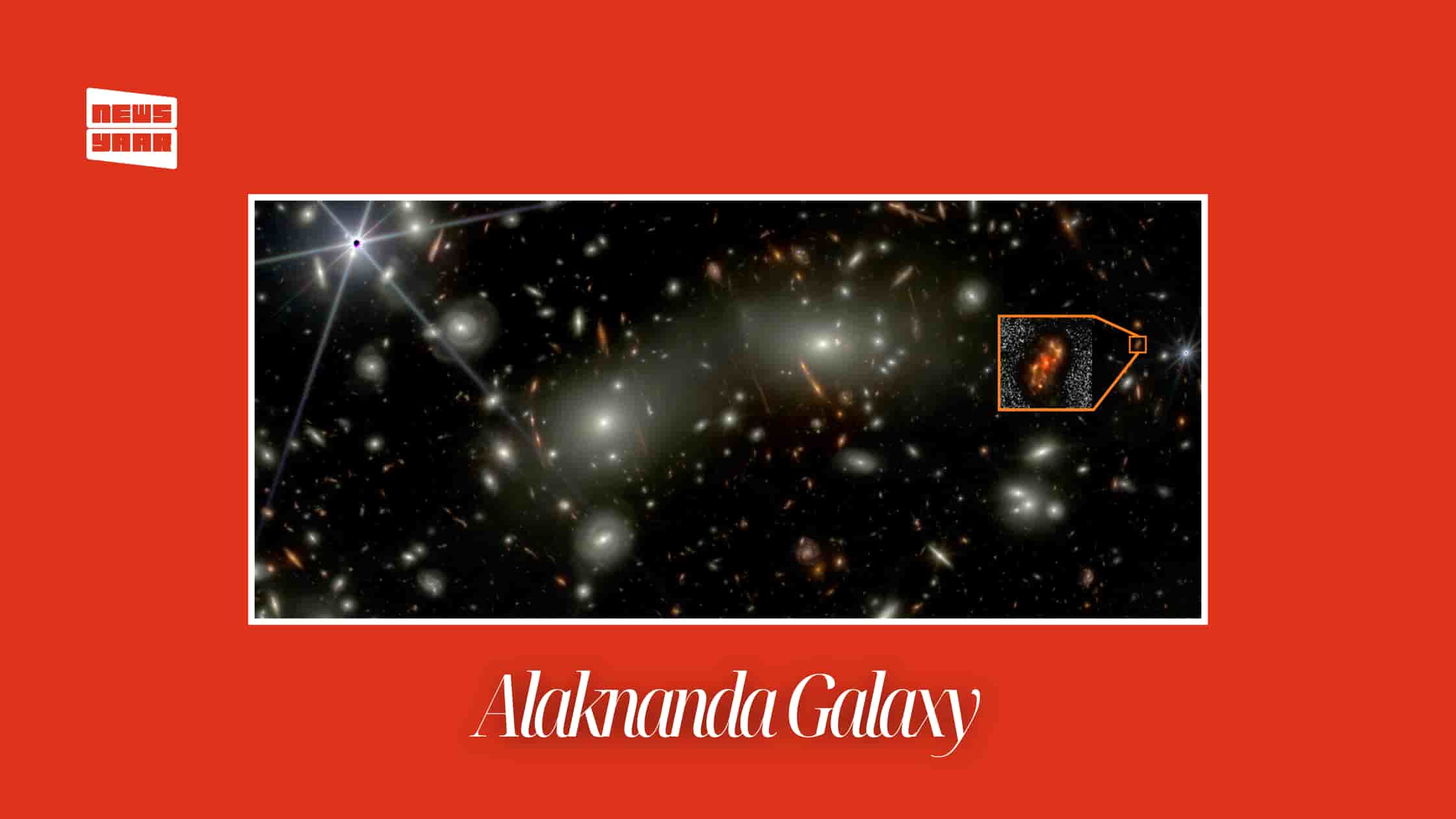
Indian astronomers have made a discovery that could rewrite prevailing theories of galaxy formation, after identifying a massive, well-structured spiral galaxy dating back nearly 12 billion years. Named Alaknanda, after the Himalayan river, the galaxy was observed when the Universe was only about 1.5 billion years old, just 10% of its current age of 13.8 billion years.
The discovery was made using data from the James Webb Space Telescope (JWST) by Rashi Jain, a PhD researcher at the National Centre for Radio Astrophysics (NCRA), part of the Tata Institute of Fundamental Research in Pune, under the supervision of Professor Yogesh Wadadekar. Their findings were published in the prestigious European journal Astronomy and Astrophysics in November.
What makes Alaknanda extraordinary is its structure. According to current models, galaxies that formed so soon after the Big Bang were expected to be small, irregular, and chaotic, still assembling their mass through violent mergers. Instead, Alaknanda appears as a fully formed spiral galaxy, complete with a central bulge and two symmetric spiral arms, remarkably similar to the Milky Way.
Ms Jain discovered the galaxy while analysing nearly 70,000 objects captured by JWST. “There was only one grand-design spiral galaxy in the entire dataset,” she said. Spanning around 30,000 light-years, Alaknanda shows classic spiral features, including a distinctive “beads-on-a-string” pattern, clusters of stars aligned along its spiral arms, commonly seen in nearby mature galaxies.
Professor Wadadekar admitted his initial reaction was disbelief. “It’s astonishing how such a large galaxy with spiral arms could have existed just 1.5 billion years after the Big Bang,” he said. Scientists estimate that Alaknanda had already formed nearly 10 billion times the mass of the Sun in stars, while also developing a stable rotating disc, an achievement that should have taken much longer according to existing cosmic timelines.
The implications of this discovery are significant. It suggests that some galaxies in the early Universe evolved far more rapidly and efficiently than previously thought. The presence of such an organised structure so early challenges assumptions about the pace of star formation, the role of dark matter, and the mechanisms that lead to spiral arm formation.
For Indian astronomy, the finding marks a major milestone, showcasing the country’s growing role in cutting-edge space research enabled by global observatories like JWST. For cosmology as a whole, Alaknanda opens new questions about how order emerged so quickly from the apparent chaos of the early Universe, and whether other such hidden spirals are waiting to be found.
About the Author
Science Reporter