


BRICS Foreign Ministers’ Meeting, New Delhi: A Bloc Divided by the War It Could Not Name
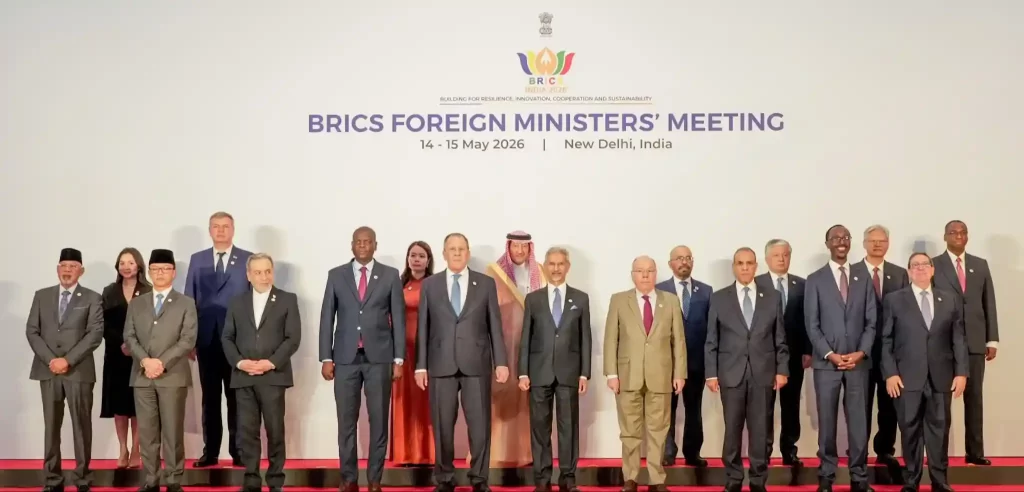
IntroductionWhen India’s External Affairs Minister S. Jaishankar took the chair at Bharat Mandapam in New Delhi, he was presiding over the most consequential BRICS Foreign Ministers’ Meeting since the bloc’s expansion. Eleven member states sat around the table. The agenda was India’s: global institutional reform, South-South cooperation, economic resilience, and the priorities of the developing world. The problem that arrived uninvited was the Iran war.Top diplomats from BRICS nations, including rivals Iran and the United Arab Emirates, failed to issue a joint statement after a two-day meeting in New Delhi, exposing divisions within the bloc over the war in Iran. Host nation India instead released a Chair’s Statement and Outcome Document, saying there were “differing views among some members” as regards the situation in the West Asia and Middle East region.The inability to produce a joint declaration — the standard diplomatic deliverable of any ministerial meeting — was not a procedural failure. It was a substantive one, and it went to the heart of what BRICS is, what it has become after its 2024-2025 expansion, and whether it can function as a coherent voice for the Global South when its own members are on opposite sides of an active war.The Meeting: Who Was There and What Was PlannedThe meeting was held at Bharat Mandapam under India’s 2026 chairship. It followed a preparatory ministerial held on September 26, 2025, on the sidelines of UNGA 80, where India as the incoming chair had set out its agenda.Those in attendance included Indonesia’s Foreign Minister Sugiono, Iran’s Foreign Minister Abbas Araghchi, South Africa’s Foreign Minister Ronald Lamola, Russia’s Foreign Minister Sergei Lavrov, India’s External Affairs Minister S. Jaishankar, Brazil’s Foreign Minister Mauro Vieira, Egypt’s Foreign Minister Badr Abdelatty, Ethiopia’s Foreign Minister Gedion Timothewos, China’s Ambassador to India Xu Feihong, and UAE’s Minister of State for Foreign Affairs Khalifa bin Shaheen Al Marar. Uganda’s Foreign Minister Odondo Jeje Abubakha was also present as a representative of the bloc’s outreach partners.India’s intended agenda was carefully constructed to avoid precisely the kind of confrontation that ultimately occurred. India’s chairship theme — Building for Resilience, Innovation, Cooperation and Sustainability — framed the meeting. Ministers reaffirmed BRICS’s three pillars: political and security cooperation, economic and financial cooperation, and people-to-people exchanges. They repeated the bloc’s commitment to openness, equality, and consensus.What the Chair’s Statement CoveredDespite the headline failure to produce a joint declaration, the Chair’s Statement and Outcome Document ran to 63 paragraphs covering a wide range of issues where agreement was possible.The Chair’s Statement gave most space to reform of global institutions: the United Nations and its Security Council, the IMF, the World Bank, and the WTO. Members argued that present structures do not reflect contemporary realities and favour developed Western powers. The statement reiterated support for a multipolar order and for greater representation of Africa, Asia, and Latin America in global decision-making.On economic matters, the ministers called for resilient supply chains, fair trade, reform of the global financial architecture, expansion of local-currency trade, and stronger South-South cooperation. The bloc opposed unilateral sanctions, protectionism, and trade barriers, and backed a rules-based multilateral trading system centred on the WTO.The document also covered cooperation on artificial intelligence, digital infrastructure, cybersecurity, climate change, energy transition, health security, food security, and innovation-led growth. Initiatives endorsed included the BRICS Grain Exchange, cross-border payment systems, and a stronger role for the New Development Bank and the Contingent Reserve Arrangement.On geopolitics, the ministers discussed West Asia, Gaza, Lebanon, Sudan, Syria, and Yemen, but could not agree on language for the Iran war. The text instead set out general principles: diplomacy, humanitarian access, ceasefires, protection of civilians, and respect for international law. The ministers strongly condemned terrorism, including the Pahalgam attack of April 22, 2025, and called for closer counter-terrorism cooperation.On Palestine specifically, the Chair’s Statement had four paragraphs on Palestine, including one recognising a two-state solution with East Jerusalem as the capital of an independent Palestine. The ministers recalled that the Gaza Strip is an inseparable part of the Occupied Palestinian Territory and reaffirmed the right of the Palestinian people to self-determination, including the right to an independent State of Palestine.The Fault Line: Iran vs. the UAE Inside the Same BlocThe meeting’s collapse into a Chair’s Statement rather than a joint declaration had a specific cause, a specific pair of actors, and a specific set of paragraphs that could not be reconciled.The central dispute was over how BRICS should describe the war involving Iran, the US, and Israel. Iran wanted the grouping to condemn US-Israeli attacks on it, while accusing the UAE — a fellow BRICS member and US ally — of direct involvement in military operations against Iran.On the first day of talks, Iranian Foreign Minister Abbas Araghchi called upon BRICS member states and the international community to explicitly condemn violations of international law by the United States and Israel, including their illegal aggression against Iran, to prevent the politicisation of international institutions, and to take concrete action to halt warmongering and bring an end to the impunity of those who violated the UN Charter.Araghchi explicitly accused the UAE of being “directly involved in the aggression against my country.” Tehran views the UAE and Saudi Arabia not as neutral neighbours but as “hostile bases” because they host critical US military infrastructure and failed to condemn the initial US-Israeli strikes on Iran.The UAE’s response was unequivocal. UAE’s Minister of State for Foreign Affairs Khalifa bin Shaheen Al Marar categorically rejected the allegations levelled by Iran and condemned what he termed “unjustified attacks” on civilian infrastructure. He defended UAE sovereignty against Iran’s charges in his national statement. “Despite numerous international and regional resolutions and condemnations, Iran has continued its terrorist attacks against the UAE and other countries in the region, in clear disregard of the international consensus,” he said.It is learnt that Iran had an issue specifically with paragraphs 26 and 29 of the proposed joint statement — the paragraphs covering Palestine and the Red Sea respectively. However, Araghchi, without naming the UAE, blamed a country