
A Moment Sixty Years in the Making
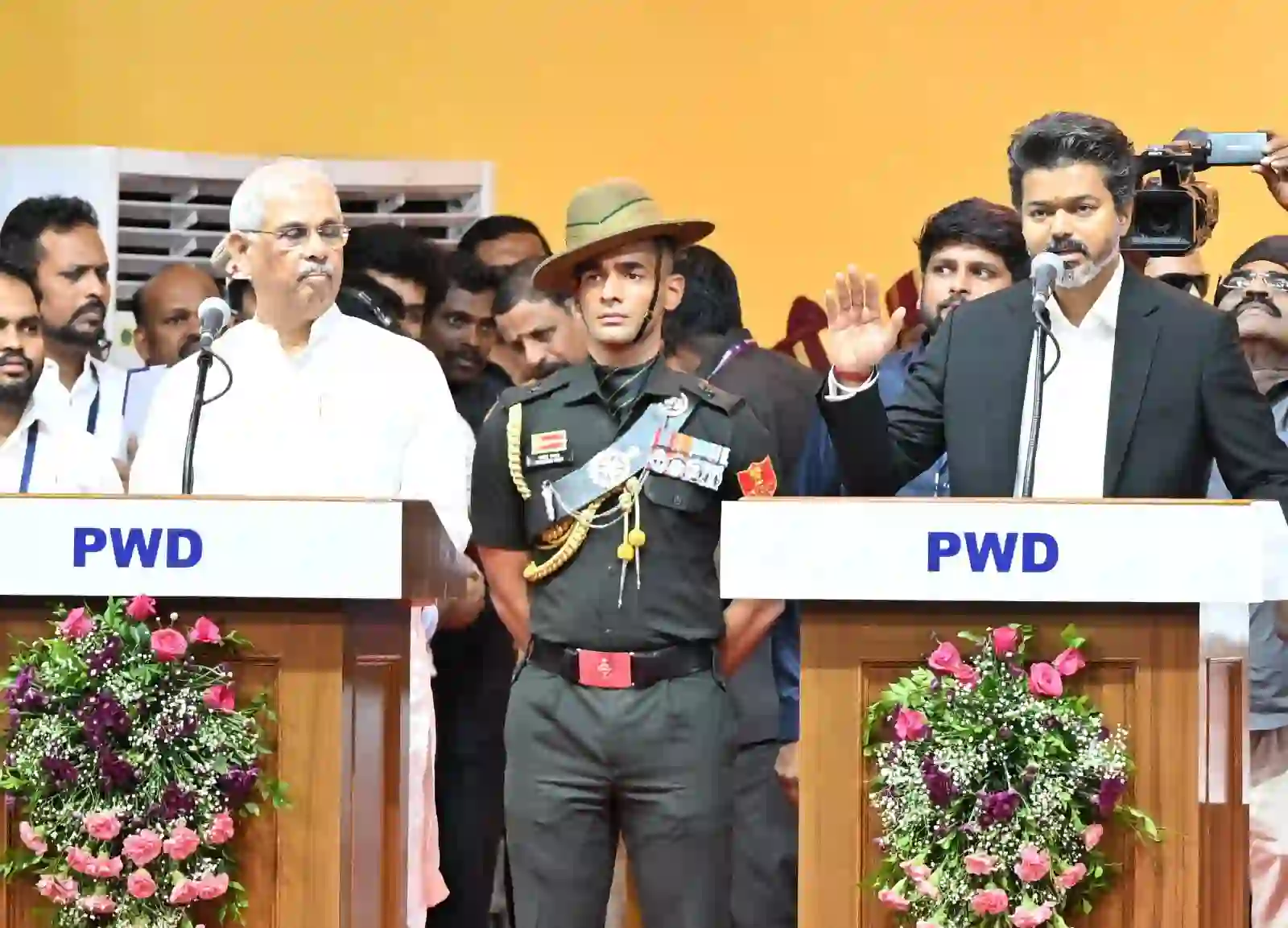
At the sprawling Jawaharlal Nehru Stadium in Chennai, on the morning of May 10, 2026, Joseph Vijay Chandrasekhar raised his right hand and took the oath of office as the ninth Chief Minister of Tamil Nadu. In the stands, tens of thousands of supporters who call themselves Thalapathy fans — a word that means commander, leader, one who stands at the front — watched the man they had followed from cinema hall to cinema hall for three decades step into the most consequential role of his life.
He is 51 years old. He has made 69 films. He has never previously held elected office, never managed a government department, never sat in a cabinet meeting. He has, on the other hand, commanded the loyalty of one of the most organised fan networks in India for the better part of thirty years. He drew on every inch of that loyalty — and then built something entirely beyond it — to produce one of the most startling political debuts in the history of any Indian state.
Vijay is the first leader outside the DMK and AIADMK camps to head the Tamil Nadu government since 1967. For 59 years, power in this state alternated between two Dravidian parties with near-mechanical regularity, each with roots in a political and social movement that had shaped Tamil identity for generations. Both of them are now in the opposition. Neither of them saw it coming.
The Beginning: A Child of Cinema, Shaped by Loss
Chandrasekaran Joseph Vijay was born on June 22, 1974, in Madras, Tamil Nadu. His father, S. A. Chandrasekhar, is a film director and his mother, Shoba Chandrasekhar, is a playback singer and vocalist.
Cinema, then, was not something Vijay chose. It was the air he breathed from birth. He began as a child star with a role in Vetri in 1984, directed by his father. He continued to act in S. A. Chandrasekhar's films through the 1980s, and was launched as a lead actor in the commercially unsuccessful Naalaiya Theerpu in 1992, also directed by his father.
Before any of that, however, came a loss that those close to him say shaped his character more than anything else. Vijay had a sister, Vidhya, who died when she was two years old. In a family so defined by warmth and creative expression, that absence was not something that closed over easily. People who know him well say it gave him an empathy he has carried into every phase of his life — a quality his films would later translate into a screen persona that felt less like performance and more like genuine feeling.
Vijay did his schooling initially at Fathima School, Kodambakkam, and later at Balalok School, Virugambakkam. He pursued a bachelor's degree in visual communication from Loyola College, Chennai, but dropped out early to focus on his acting career.
The Actor: From Romantic Hero to People's Champion
The Vijay who arrived in Tamil cinema in the early-to-mid 1990s was not immediately what people imagined he would become. He rose to fame with romance films such as Poove Unakkaga in 1996, Love Today in 1997, Kadhalukku Mariyadhai in 1997, and Thullatha Manamum Thullum in 1999, before transitioning into an action star with Thirumalai in 2003, Ghilli in 2004, and Pokkiri in 2007.
The transformation that Thirumalai triggered was decisive. Thirumalai was pivotal to Vijay's transformation from the romantic hero into an action star embodying a grittier screen persona. Ghilli followed, and Ghilli was not merely a hit — it was a cultural event. Its mass scenes generated the kind of theatrical response, the whistles, the standing ovations mid-scene, that Tamil cinema reserves only for its greatest stars.
From that point, the question was never whether Vijay would become a superstar. It was what kind of superstar he would become. He answered that across the next two decades by making a very deliberate choice: to use his screen presence for something beyond entertainment.
In the 2010s Vijay refined his "angry young man" image with socially conscious roles in Thalaivaa in 2013, Thuppakki in 2012, Kaththi in 2014, Mersal in 2017, Bairavaa in 2017, and Bigil in 2019. Kaththi took on corporate exploitation of farmers and drew an official complaint from a pesticide company. Mersal directly attacked government health policy and demonetisation, prompting the BJP to demand scenes be deleted, making it a national news story. Sarkar in 2018 depicted a businessman running for office after confronting electoral fraud — a storyline that, in retrospect, reads less like fiction and more like a blueprint.
From the 2010s onward, he starred in major commercial successes including Thuppakki in 2012, Kaththi in 2014, Mersal in 2017, Sarkar in 2018, Master in 2021, Leo in 2023, and The Greatest of All Time in 2024, several of which rank among the highest-grossing Tamil films.
By the time his final film, Jana Nayagan, meaning People's Leader, was released, the title was not a creative choice. It was a cinematic preamble to a political life. The screen dimmed; the work began.
The Political Stirring: Years Before the Party Was Formed
The conventional narrative of Vijay's entry into politics begins in February 2024, when he formally announced Tamilaga Vettri Kazhagam. That narrative misses the fifteen years that preceded it.
In 2009, his fan club Vijay Makkal Iyakkam was launched, and his forum actively supported Jayalalithaa-led AIADMK in the 2011 assembly elections in Tamil Nadu. In March 2011, his father S. A. Chandrasekhar met Jayalalithaa and extended support to her. It can be said that in a way Makkal Iyakkam proved to be a stepping stone for the further political journey Vijay.
The Iyakkam ran blood donation camps, disaster relief operations, and educational support drives. During the 2015 Chennai floods, the network was among the first organised volunteer groups distributing aid. During Covid-19, Vijay personally funded meals and essential supplies for migrant workers and vulnerable communities. This was not a film star looking for good press. It was the systematic construction of a ground-level social infrastructure — the kind political parties spend decades and hundreds of crores building.
In 2022, members of the Vijay Makkal Iyakkam contested the Tamil Nadu local body elections and won 115 seats across various municipal and panchayat bodies. It was a quiet test run — a signal that the network was ready.
With the formation of TVK in February 2024, he formally joined politics. Making his official announcement via social media, he wrote that it was his long-term intention and desire to help the people of Tamil Nadu and the Tamil community, who gave him name, fame, and everything after his parents, as much as he can.
He announced the same day that TVK would not contest the 2024 Lok Sabha elections. The 2026 Tamil Nadu assembly election was the sole target. Every bullet would go into one chamber.
Building TVK: Two Years, 234 Constituencies
What happened between February 2024 and April 2026 was, as The Week's post-election analysis described it, not politics as Tamil Nadu had known it. The 2026 TVK victory was not a product of chance, but a result of meticulous institutional engineering. This specific leadership cohort succeeded because they replaced the ageing district satrap model with a modern, professionalised structure.
TVK established booth-level party structures across all 234 assembly constituencies. Not district offices, not town offices — booth-level. The granularity was the point.
At TVK's inauguration, historic resolutions were passed: Social Justice, Secularism, and Egalitarianism were declared as TVK's ideological pillars. Periyar, Ambedkar, Kamaraj, Velu Nachiyar, and Anjalai Ammal were named as intellectual mentors. This was a deliberately inclusive list that signalled positioning beyond caste, beyond community, and in conscious conversation with Tamil Nadu's deepest reform traditions.
TVK contested alone in 233 constituencies, positioning itself as a rival to the oscillating duopoly of the DMK and AIADMK, and an ideological adversary of the Bharatiya Janata Party. No alliances. No safety net. Either the ground work they had built was strong enough, or it wasn't.
On May 4, 2026, it turned out to be more than strong enough.
The Campaign: A New Grammar of Tamil Politics
TVK's election campaign looked like nothing Tamil Nadu had seen before. In less than two years after launching TVK, Vijay emerged victorious through a campaign that depended heavily on digital circulation rather than constant roadshows, marathon speeches, or primetime television visibility. The outreach was structured less like a conventional political campaign and more like a tech-first media operation built around fandoms, algorithms, and Gen Z internet behaviour.
TVK relied significantly on supporter-led circulation instead of a purely centralised communication structure. Much of that traction came from first-time voters, Gen Z audiences, and women voters, with supporters constantly repackaging and redistributing campaign material across platforms.
AI-generated visuals featuring Vijay regularly circulated online during the election period, while hologram projections were deployed at campaign events across Tamil Nadu, extending his virtual presence without depending entirely on physical rallies. In one widely circulated example from Kumbakonam, an AI-assisted hologram projection of Vijay addressing supporters spread rapidly across platforms.
The inner circle behind this operation was formidable. Political strategist John Arokiasamy, working through his firm JPAC Persona, designed the statewide election architecture and drafted Vijay's core speeches. He engineered a hybrid ideology that fused Dravidian principles with Tamil nationalism — a strategic pincer movement that allowed TVK to challenge both the DMK and the BJP simultaneously without being boxed into a singular ideological corner.
Propaganda secretary Rajmohan Arumugam, emerging from the digital creator space, brought an instinct for satire and online commentary. He eschewed the formal cadences of traditional Dravidianism for a hybrid grammar of irony, relatable humour, and conversational outrage, translating complex policy ideas into viral reels and YouTube clips.
The TVK miracle demonstrates that modern political power in Tamil Nadu has shifted toward those who can command narrative velocity and institutional credibility simultaneously. By assembling a team that understands algorithms as well as they understand Ambedkar, social justice and booth management, Vijay seems to have created a third force that speaks the language of the 21st century.
The Election: How Vijay Beat the Unbeatable
When polls opened on April 23, 2026, Tamil Nadu's political establishment broadly believed one of two things would happen: the DMK would win a third term, or the AIADMK would stage a recovery. Almost nobody predicted what actually occurred.
TVK amassed 108 seats but fell short of a majority at 118. The SPA was reduced to 73 seats, with the DMK securing 59 and the INC five. The NDA won 53 seats, with the AIADMK securing 47 seats and the BJP a lone seat. This created a hung assembly for the first time in the state, with no party or alliance achieving a clear majority.
This election marked the first time a non-Dravidian party emerged as the largest party in the assembly since the 1960s, breaking a tradition of power alternating between the DMK and the AIADMK. The outgoing Chief Minister of Tamil Nadu, M. K. Stalin of the DMK, lost his election from the Kolathur constituency where he had previously won thrice consecutively.
The TVK's chief-ministerial candidate Vijay emerged victorious in both the Perambur and Tiruchirappalli East constituencies he contested in. Fifteen of Stalin's cabinet ministers were also defeated — a rout that went far beyond a change of government and looked more like a complete repudiation.
The election recorded the highest voter turnout in the state's history at 85.1 percent. Analysts reported that TVK hauled the votebooks of both the DMK and AIADMK, pulling their youth, women, urban, and first-time voters irrespective of caste or religious affiliations, and attributed Vijay's appeal more to a promise of change than a meticulous ideology.
Media outlets compared Vijay's rise to that of the former actor-turned-Chief Ministers M. G. Ramachandran and J. Jayalalithaa. The comparison carries weight because both those men also broke established political orders in their debut elections. But neither of them did it in a party that was exactly two years old.
Government Formation: The Tense Week After Victory
Winning 108 seats in a 234-member house left TVK exactly 10 seats short of governing alone. What followed was a week of intense political manoeuvring.
TVK facilitated an alliance with the INC MLAs to form the new government, effectively integrating TVK into the INDIA bloc and withdrawing INC from the DMK-led SPA. On May 6, 2026, Vijay met the Governor of Tamil Nadu, Rajendra Vishwanath Arlekar, and laid claim to the formation of the new government.
The suspense over government formation ended when the Thol Thirumavalavan-led VCK, which has two seats, finally extended support after keeping TVK on tenterhooks. Shortly after VCK's decision, another DMK ally, the IUML, also extended support to TVK. IUML has two MLAs. With the two small parties' support, the numbers in favour of TVK rose to 120, just two more than the simple majority mark of 118 in the 234-member Tamil Nadu Assembly.
Vijay recommended a list of nine individuals for appointment as ministers in the state cabinet: N. Anand, Aadhav Arjuna, Dr KG Arunraj, KA Sengottaiyan, P. Venkataramanan, R. Nirmalkumar, Rajmohan, Dr TK Prabhu, and Selvi S. Keerthana. Once sworn in, 51-year-old C. Joseph Vijay became the first leader outside the DMK and AIADMK camps to head the Tamil Nadu government since 1967.
At his swearing-in, Vijay declared he would be the "sole power centre" of the government — a signal that there would be no parallel authority structures, and that governance would be direct and accountable.
The Vision: What Vijay Has Said He Wants to Do
TVK's governance agenda rests on several clearly stated pillars.
Employment is the centrepiece. TVK has promised job guarantees and a structured approach to reducing Tamil Nadu's unemployment rate, with particular focus on the 18-25 age cohort — the very voters who powered the party's victory.
Vijay Vidyashiram and student welfare schemes emerged as the movement's most visible social infrastructure, and education welfare including student stipends is a core commitment.
Social justice, the ideological thread running through TVK's founding documents, translates in policy terms to equal representation for women in legislative bodies, fair pricing for farmers and fishermen, and administrative reform that removes caste-based barriers in government access.
On governance, Vijay has emphasised clean administration, digitalisation of government services, and direct accountability — an explicit contrast to the cronyism and dynastic succession his campaign identified as the defining failures of the Dravidian establishment.
The ideological pillars of Social Justice, Secularism, and Egalitarianism — drawn from the teachings of Periyar, Ambedkar, Kamaraj, Velu Nachiyar, and Anjalai Ammal — are now the mandate of 80 million people.
On federalism, TVK is firmly opposed to both the BJP's centralising agenda and the NDA's national political project. The coalition with Congress keeps TVK within the INDIA bloc's orbit without binding it to the bloc's leadership hierarchy — giving Vijay maximum independence while maintaining national opposition credibility.
The Challenges: What He Walks Into
The mandate is exhilarating. The responsibilities are daunting.
Coalition management will be his first test. His government depends on the continued support of Congress, VCK, and IUML — each with its own community base and political red lines. Keeping all three aligned while governing effectively will require political skill of a kind Vijay has never previously been called upon to demonstrate.
Administrative experience is the honest gap. TVK is a two-year-old party. Most of its MLAs have never sat in an assembly before. Navigating a civil service deeply networked with the previous government will require patience and a willingness to listen to expertise while asserting political direction.
The relationship with New Delhi will require careful calibration. TVK is ideologically opposed to the BJP, yet the central government controls significant fiscal transfers and approvals that Tamil Nadu needs. Balancing political opposition with practical necessity is a challenge every Tamil Nadu CM faces. Vijay will face it in the most politically charged national environment in a generation.
A stampede at a TVK rally in Karur last year caused multiple deaths and injuries which sparked questions about crowd management and accountability. The incident led to investigations and severe backlash from opposition. His critics have not forgotten, and how his government handles public safety going forward will be watched carefully.
His personal life also came under public scrutiny after his wife filed for divorce alleging extra-marital affairs, and speculation surrounding his alleged relationship with actress Trisha Krishnan surfaced. These are realities a Chief Minister must manage in a higher-scrutiny environment than any film set.
The Opportunities: What Tamil Nadu Has to Gain
Tamil Nadu's industrial base, port infrastructure, educated workforce, and position in India's technology and manufacturing ecosystem make it genuinely well-placed to accelerate under a government with a clean-image mandate and an anti-cronyism platform. If Vijay can demonstrate that governance under TVK is transparent and accountable, Tamil Nadu could see a significant increase in investor interest from domestic and international sources.
The youth dividend is perhaps the largest single opportunity. The 18-30 age group that voted overwhelmingly for TVK will spend the next five years watching whether a government they chose actually delivers for them. If it does, TVK's position in Tamil Nadu will be structural rather than circumstantial.
Women's political representation, a stated TVK priority, could produce meaningful and lasting change in a state where it has lagged relative to its broader social development indicators. How early cabinet compositions and government appointments reflect this commitment will be the first signal.
The Road Ahead
In the immediate term, Vijay must build a functioning government from a coalition with no governing experience, manage the expectations of an electorate that believed profoundly in the promise of change, and establish a working relationship with New Delhi that delivers for the state without compromising political independence.
In the medium term, his government's economic record and administrative competence will determine whether TVK can build the kind of durable political organisation that survives beyond its founder's personal appeal — the challenge that defeated Kamal Haasan's Makkal Needhi Maiam and that will be the defining test of whether TVK is a movement or a moment.
In the long term, Vijay's political trajectory will intersect with the 2029 Lok Sabha elections in ways both national coalitions are already computing. Tamil Nadu's 39 Lok Sabha seats are now genuinely in play in a way they have not been in years. His alignment choices — or deliberate non-alignment — will shape national coalition arithmetic well beyond his own state.
Thalapathy is now Thalaivar. He spent 30 years telling stories about the common person's dignity. He has now stepped up to make that dignity a matter of policy rather than screenplay. The screen has gone dark. The work has begun.