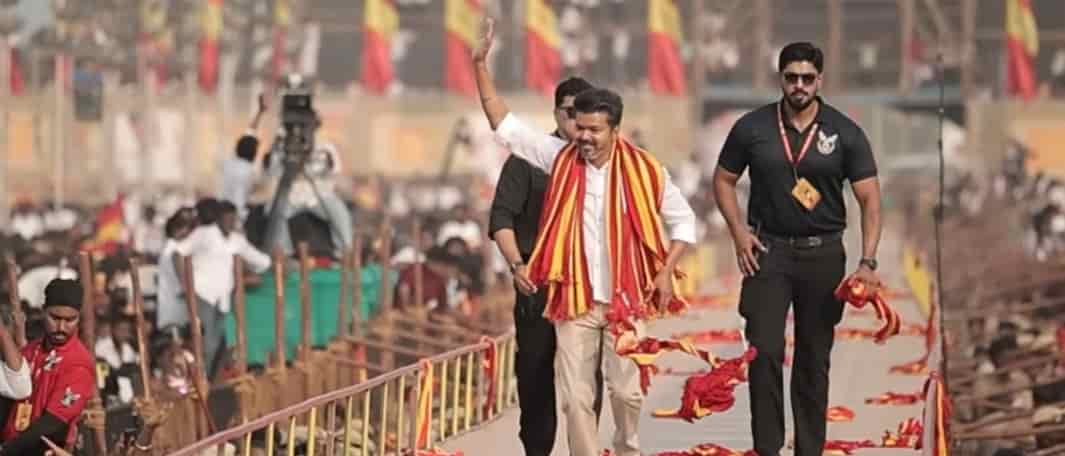
The political landscape of Tamil Nadu saw a noticeable shift after actor Vijay formally entered active politics with the launch of his party, Tamilaga Vettri Kazhagam (TVK). His entry came at a time when the state’s politics had largely been dominated by established players like the ruling Dravida Munnetra Kazhagam (DMK) led by Chief Minister M. K. Stalin.
While the DMK continued to hold a strong organisational and electoral position, Vijay’s political move introduced a fresh layer of competition, particularly among younger voters and first-time participants in the electoral process.
From Cinema Influence to Political Mobilisation
Vijay’s transition into politics did not come abruptly. Over the years, his fan clubs had actively participated in social work, gradually building a grassroots presence across Tamil Nadu. This network later became the foundation for TVK’s early organisational structure.
When Tamilaga Vettri Kazhagam was formally announced, it marked a shift from indirect public influence to structured political participation. Vijay positioned the party around governance issues, accountability, and people-centric policies, attempting to create a distinct space separate from traditional Dravidian party narratives.
How TVK Positioned Itself Against the DMK
Instead of direct confrontation in its initial phase, TVK adopted a measured approach in shaping its political messaging. Vijay raised concerns around governance efficiency, employment opportunities, and the need for greater transparency, which indirectly placed the party in contrast with the ruling DMK government.
The focus remained on:
- Youth employment and skill development
- Education and equitable access
- Administrative accountability
- Anti-corruption positioning
This approach allowed TVK to build a narrative without immediately engaging in aggressive political attacks.
Youth Connect and Grassroots Energy
One of the most defining aspects of Vijay’s political entry was the scale of youth engagement it generated. His popularity translated into strong mobilisation, particularly in urban and semi-urban regions.
Fan clubs, which had earlier functioned as cultural and social groups, were reorganised into local-level political units. This gave TVK an initial advantage in terms of visibility and outreach, especially on digital platforms where Vijay already had a strong following.
The party’s messaging resonated with a section of voters looking for alternatives outside the traditional political framework.
The DMK’s Continued Dominance
Despite the emergence of TVK, the DMK retained its stronghold, backed by a well-established cadre system, governance record, and welfare-driven policies. Under M. K. Stalin’s leadership, the party continued to emphasise its development initiatives and administrative stability.
Rather than reacting aggressively to Vijay’s entry, the DMK maintained its focus on governance and voter outreach, relying on its long-standing political base.
Challenges Faced by TVK
While Vijay’s entry generated significant attention, translating popularity into electoral success remained a complex task.
TVK faced key challenges such as:
- Converting fan following into consistent voter support
- Building a structured party organisation across constituencies
- Establishing policy depth beyond campaign messaging
- Competing with deeply rooted political networks
These factors highlighted the difference between public popularity and electoral viability in a state with a strong political legacy.
A Shift in Political Conversation
Even without immediate electoral outcomes, Vijay’s political entry influenced the broader political discourse in Tamil Nadu. It brought renewed focus on youth participation, governance expectations, and the role of new-age leadership in state politics.
The presence of TVK added a third dimension to what had traditionally been a bipolar contest, making the political environment more competitive and dynamic.
Vijay’s move from cinema to politics, through Tamilaga Vettri Kazhagam, did not just introduce a new party—it reshaped conversations around leadership, representation, and voter expectations in Tamil Nadu. While the DMK continued to hold its ground, the emergence of TVK ensured that the political landscape was no longer as predictable as before, setting the stage for a more contested and evolving electoral environment.