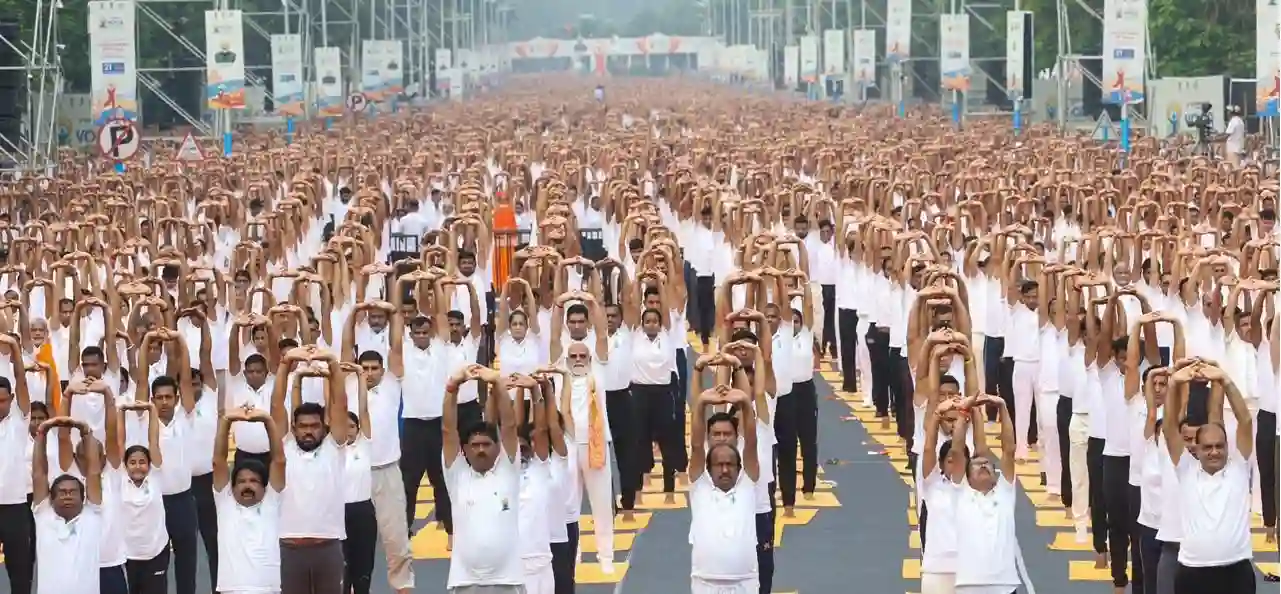
The 12th International Day of Yoga will be celebrated globally on Sunday, June 21, 2026, with Prime Minister Narendra Modi leading the nation's celebrations from Kolkata's historic Red Road while this year's theme, "Yoga for Healthy Ageing," emphasizes yoga's crucial role in promoting physical health, mental well-being, emotional resilience, and active ageing for improved quality of life across all age groups. President Droupadi Murmu led State-level celebrations in Madhya Pradesh, performing asanas at the event in Jabalpur, while yoga enthusiasts across several Western countries practiced yoga in large groups ahead of International Day of Yoga, demonstrating yoga's unprecedented global reach as a movement for collective well-being.
Addressing the nation from Kolkata, PM Modi remarked that "June 21 marks the longest day on Earth, it has now become the largest community celebration day because of yoga," emphasizing that "yoga brings people together; I congratulate people of the world on this occasion. Yoga is not just physical exercise, not restricted to any age group; it is an expression of the human spirit." This year's celebration marks a significant milestone as IDY has completed 11 years, and in 2026, we are celebrating the 12th IDY in a truly global and inclusive manner with the main national event, "Yoga Sangam," orchestrating a synchronized mass yoga demonstration based on the Common Yoga Protocol (CYP) simultaneously at multiple locations across India.
Yoga for Healthy Ageing: Transforming Demographic Challenges into Wellness Opportunities
The theme for International Day of Yoga 2026, "Yoga for Healthy Ageing," affirms that yoga is not a practice confined to any single stage of life but a lifelong resource that can be adapted to our changing needs and capacities, supporting vitality, independence, and dignity at every age. In the rapidly ageing WHO South-East Asia Region, the demographic shift deepens the urgency of investing in healthy ageing interventions that are scalable, low-cost, and responsive to the Region's diverse cultural contexts, and yoga fulfills each of these criteria by addressing the core pillars of healthy ageing through improving mobility, protecting cognitive health, and reducing isolation through community.
Yoga reminds us that longevity is not just about adding years to life but also adding life to years, offering an accessible way for many older adults to maintain their physical and emotional health because it can be adapted to different fitness levels and health conditions. These benefits support several goals of the WHO Decade of Healthy Ageing (2021–2030), including promoting independence, reducing fall risk, enhancing quality of life, and encouraging person-centred approaches to health and well-being, making yoga one of the most powerful tools for addressing global ageing challenges.
The supporting global and regional policy architecture is substantial, with the WHO Global Action Plan on Physical Activity 2018–2030 providing a framework for embedding structured physical activity, including yoga, within health systems, while the WHO Global Traditional Medicine Strategy 2025–2034 encourages the safe and regulated integration of evidence-based traditional medicine, such as yoga, into health systems. On this International Day of Yoga, we are reminded that healthy ageing is shaped not only by the health systems we build but also by the daily choices we make throughout our lives, and yoga, when practiced regularly, safely, and in ways appropriate to individual needs and abilities, is one such powerful choice.
Global Celebrations: From Kolkata's Red Road to Lincoln Memorial in Washington, DC
The main national celebration of International Yoga Day 2026 will be held at Kolkata's historic Red Road under Prime Minister Narendra Modi's leadership, with the Ministry of Culture organizing special International Day of Yoga events at 100 iconic locations across the country, bringing together India's rich cultural heritage and yoga traditions. Through the coordinated efforts of the Indian Council for Cultural Relations and Indian Missions abroad, Yoga Day celebrations this year are being organized across nearly 2,500 locations worldwide, with participation from more than 210 Indian Missions, reflecting yoga's role as a global movement for collective well-being.
In Canada's Toronto, an enthusiastic gathering of government representatives, diplomatic corps, yoga practitioners, wellness organizations, and community leaders participated in a Yoga session against the historic backdrop of the Legislative Assembly of Ontario, where the Consul General of India emphasized Yoga's unique power to transcend cultural, linguistic, and national boundaries, bringing people together in a shared pursuit of well-being and reaffirming its timeless relevance as a universal path to health, harmony, and inner balance. In Brazil, a curated yoga session was led by the Ambassador of India to Brazil, Dinesh Bhatia, at the majestic Foz do Iguacu waterfalls as a prelude to IDY 2026, while the Denmark Yoga Team in Aarhus organized celebrations in Dokk1 with Ambassador Manish Prabhat reading Prime Minister Narendra Modi's letter addressed to Denmark Prime Minister Mette Frederiksen.
According to the Embassy of India in Washington, DC, hundreds came together at the iconic Lincoln Memorial to celebrate the 12th International Day of Yoga, demonstrating how yoga has become the world's largest community celebration spanning continents from North America to South America to Europe. The All India Institute of Ayurveda in New Delhi organized a Run for Yoga and a special Zumba session ahead of tomorrow's celebrations, emphasizing the importance of incorporating yoga into daily life, with Director Professor Pradeep Kumar Prajapati stating that yoga should not be limited to one day of observance but practiced regularly throughout the year.
The Science Behind Yoga: Holistic Discipline Integrating Physical Activity
Yoga is among the world's oldest and most enduring practices for human health and wellbeing, a holistic discipline that integrates physical activity, breath regulation, mindfulness, and meditation, supporting physical function, mental well-being, and social connectedness. The Common Yoga Protocol (CYP) used in the synchronized mass yoga demonstration at Yoga Sangam ensures that practitioners across 2,500 locations worldwide perform the same asanas in the same sequence, creating unprecedented unity through synchronized movement that demonstrates yoga's power to bring millions together in shared practice.
Because yoga can be adapted to different fitness levels and health conditions, it offers accessible benefits for everyone from young children to elderly adults, from athletes to those with chronic health conditions, making it uniquely positioned to address diverse population health needs. The practice's integration of physical postures (asanas), breath control (pranayama), and meditation (dhyana) creates a comprehensive approach to wellness that addresses body, mind, and spirit simultaneously, unlike exercise programs that focus solely on physical fitness.
The Ministry of Social Justice & Empowerment organized a special Yoga Day celebration at Bharat Mandapam, while yoga has become crucial in classical dance, with fitness through yoga enabling dancers to maintain the physical demands of their art. President Murmu stated that "Yoga is a celebration of India's great tradition," emphasizing how yoga represents India's cultural heritage while serving global health needs, creating a bridge between ancient wisdom and modern wellness imperatives.
Historical Context: India's Proposal and the UN's 175-Member State Support Created a Global Movement
Proposed by India, the United Nations General Assembly in 2014, with the support of a record 175 Member States, declared June 21 as the International Yoga Day, making it one of the most widely supported UN declarations ever. The date, the summer solstice, was chosen for its symbolic association with light, balance, and longevity, connecting ancient yogic traditions with astronomical significance that resonates across cultures and traditions worldwide.
The 12th International Day of Yoga in 2026 represents 11 years of successful global implementation, with each year building on the previous one to create increasingly massive participation, deeper understanding of yoga's benefits, and broader integration into health systems worldwide. The Common Yoga Protocol (CYP) has become standardized globally, ensuring that whether practitioners are in Kolkata's Red Road, Toronto's Legislative Assembly, Brazil's Foz do Iguacu waterfalls, or Washington's Lincoln Memorial, they perform the same Yogyakarta sequence, creating unprecedented global unity.
India's successful proposal demonstrates how the country has positioned itself as a leader in global wellness and traditional medicine, with yoga becoming one of India's most significant cultural exports alongside cuisine, film, and spirituality. The record 175-member state support for the UN declaration shows unprecedented international recognition of yoga's value, creating a foundation for continued growth and integration into global health systems that will define the next decade of yoga's development.
Conclusion: Yoga as a Daily Choice for Healthy Ageing and Global Collective Well-being
International Yoga Day 2026's "Yoga for Healthy Ageing" theme transforms the celebration from a one-day observance into a lifetime commitment, inviting every person at every stage of life to invest in their own health and vitality and carry that commitment into families, communities, and societies. PM Modi's leadership from Kolkata's Red Road, President Murmu's participation in Jabalpur, and participation across 2,500 locations worldwide with 210+ Indian Missions demonstrate yoga's unprecedented scale as the world's largest community celebration that transcends cultural, linguistic, and national boundaries.
The science supporting yoga's benefits for healthy ageing, improving mobility, protecting cognitive health, reducing isolation, promoting independence, reducing fall risk, and enhancing quality of life, combined with WHO's policy frameworks embedding yoga in health systems, creates a powerful foundation for yoga's continued integration into global wellness practices. As yoga practitioners from Toronto to Washington, DC, to Brazil to Denmark participate in synchronized celebrations, they demonstrate that yoga's unique power brings people together in shared pursuit of well-being, reaffirming its timeless relevance as a universal path to health, harmony, and inner balance.
The 12th International Day of Yoga represents not just celebration but invitation, to practice yoga regularly throughout the year rather than limiting it to one day, to adapt yoga to individual needs and abilities, and to recognize that healthy ageing is shaped by daily choices throughout life. Yoga, when practiced regularly, safely, and appropriately, becomes one of the most powerful choices for adding life to years, making International Yoga Day 2026 a milestone that transforms global awareness into personal commitment to yoga as a lifelong resource for vitality, independence, and dignity at every age.