
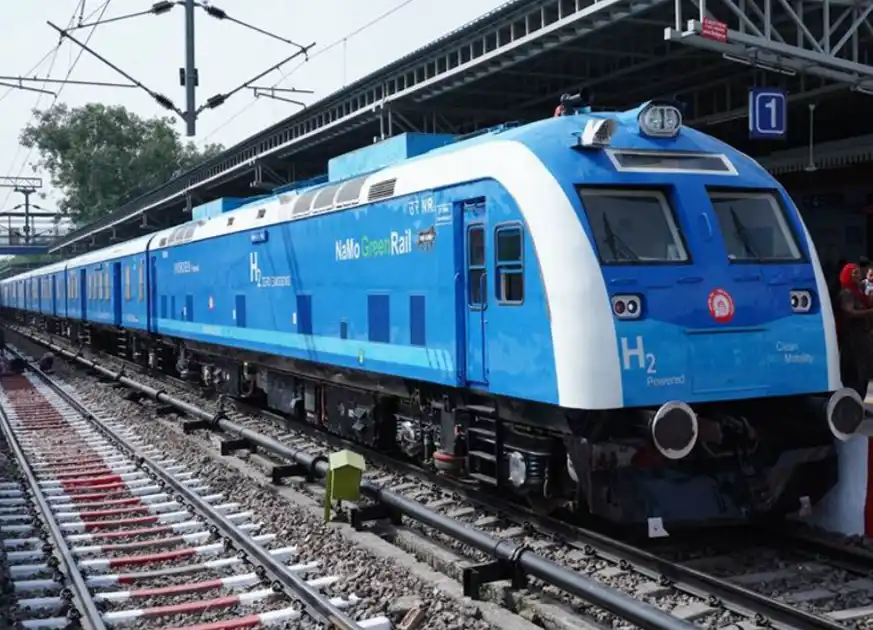
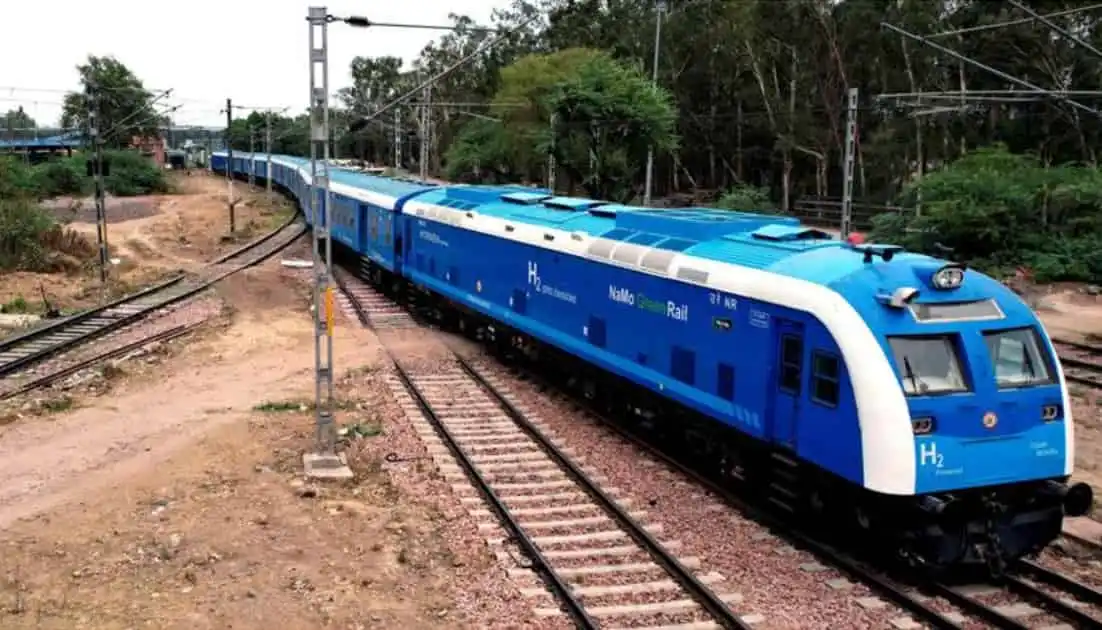
Indian Railways has taken a major step towards introducing alternative-energy propulsion with the launch of NaMo Green Rail, India’s first hydrogen-powered train. The train was flagged off by Prime Minister Narendra Modi from Jind in Haryana on July 17, 2026, and has begun passenger operations on the Jind–Sonipat route. The project is being presented as a significant milestone in the development of indigenous hydrogen-powered railway technology and the country's broader shift towards cleaner transportation.
The launch is significant not only because India now has a hydrogen-powered passenger train in operation, but also because the project covers the wider ecosystem required to run such a train. Along with the train itself, Indian Railways has developed hydrogen storage and refuelling infrastructure at Jind, allowing the technology to be tested under actual operating conditions.
The NaMo Green Rail is designed to demonstrate how hydrogen fuel-cell technology can be used as an alternative to conventional diesel propulsion, particularly on railway routes where electrification may not always be the most practical option.
What Is NaMo Green Rail?
NaMo Green Rail is the official name of India's first hydrogen-powered train. It has been designed and developed in India as part of Indian Railways' efforts to explore next-generation fuel technologies.
Unlike a conventional diesel train, which burns diesel in an internal-combustion engine to generate mechanical power, a hydrogen fuel-cell train uses an electrochemical process to generate electricity.
Hydrogen stored onboard the train is supplied to fuel cells, where it reacts with oxygen from the air. This produces electricity, which is then used to power the train's traction system. At the point of operation, the principal by-product of the process is water vapour rather than the carbon dioxide and particulate emissions associated with diesel combustion.
The environmental benefit, however, depends on how the hydrogen is produced. Hydrogen produced using renewable electricity can have a substantially lower carbon footprint than hydrogen produced using fossil fuels.
The Jind–Sonipat Route
NaMo Green Rail is being operated on the Jind–Sonipat section of Northern Railway in Haryana.
The route provides Indian Railways with an opportunity to assess hydrogen propulsion in actual railway conditions rather than limiting the technology to laboratory or controlled trials.
The passenger service began after the train was flagged off on July 17. The route covers approximately 89 kilometres, connecting Jind with Sonipat in Haryana.
The deployment is particularly important because it allows Indian Railways to collect operational data on hydrogen consumption, fuel-cell performance, reliability, maintenance, safety and refuelling requirements.
The experience gained from this route could help determine where hydrogen-powered trains can be practically deployed in the future.
A 10-Coach Hydrogen Train
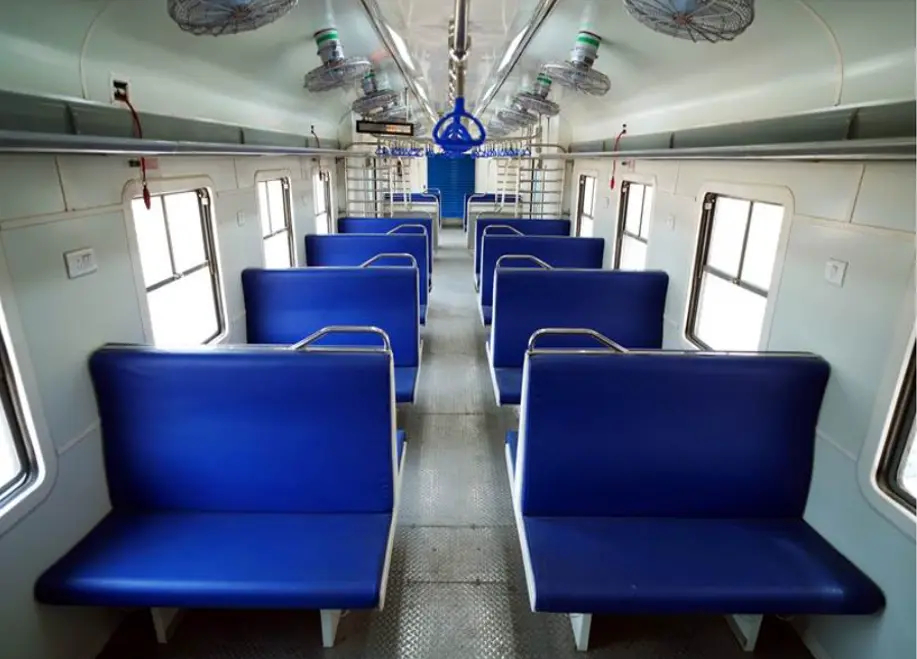
The NaMo Green Rail trainset consists of 10 coaches, including two driving power cars and eight passenger coaches.
Each driving power car has a power output of 1,200 kW, giving the trainset a combined installed power of 2,400 kW. Indian Railways has described it as the world's longest and most powerful hydrogen trainset on a broad-gauge platform.
The train has been designed to operate at speeds of up to 75 kmph in regular service.
Its passenger capacity is approximately 2,600 people, according to officials.
The combination of hydrogen fuel-cell propulsion and battery-based energy management allows the train to generate and use electricity without relying on a conventional diesel engine.
How Does a Hydrogen Train Work?
The basic principle behind a hydrogen fuel-cell train is different from both diesel and conventional electric trains.
A conventional electric train receives electricity through an external system, generally an overhead catenary or third rail. A diesel locomotive carries its fuel onboard and uses combustion to produce power.
A hydrogen train carries its own energy source in the form of hydrogen.
Inside the fuel-cell system, hydrogen is combined with oxygen through an electrochemical reaction. The process generates electricity, which powers the train's electric traction motors.
The direct by-product is water vapour.
This means that the train does not produce carbon dioxide from hydrogen fuel-cell operation at the point of use. Indian Railways has therefore positioned NaMo Green Rail as a cleaner alternative for routes where diesel trains are still required.
Why Is Hydrogen Being Considered for Railways?
India has made substantial progress in railway electrification, and electric traction remains the primary direction for the majority of the network.
Hydrogen is therefore not intended to replace electric trains across the country.
Its potential lies in specific applications, particularly on routes that are difficult or expensive to electrify.
Installing overhead electrical infrastructure requires significant investment in catenary systems, substations and other supporting infrastructure. On some low-density, heritage or difficult-to-electrify routes, a hydrogen train could provide an alternative without requiring the entire route to be equipped with overhead electrical systems.
Hydrogen trains can also operate independently of an overhead power supply because their electricity is generated onboard.
The Role of Green Hydrogen
The environmental case for hydrogen trains depends heavily on the source of the hydrogen.
Hydrogen itself is not automatically a zero-carbon fuel.
If hydrogen is produced using renewable electricity, the resulting fuel can have a much lower lifecycle carbon footprint. This is generally referred to as green hydrogen.
Green hydrogen is produced by splitting water into hydrogen and oxygen through electrolysis, using electricity. When renewable sources such as solar or wind power provide that electricity, the production process can be significantly cleaner than conventional fossil-fuel-based hydrogen production.
This makes hydrogen relevant to India's broader clean-energy strategy and its efforts to build a domestic green hydrogen economy.
Indigenous Technology and Atmanirbhar Bharat
One of the most important aspects of NaMo Green Rail is its indigenous development.
Indian Railways says the project involved designing the train from the initial stages, prototype manufacturing and the development of hydrogen traction technology specifically for Indian Railways. The project is being presented as an example of Atmanirbhar Bharat, or self-reliance in technology and manufacturing.
Developing hydrogen railway technology domestically has strategic significance.
Hydrogen propulsion requires expertise in fuel cells, power electronics, energy storage, hydrogen handling, control systems and safety technologies. Building these capabilities within India can help create a domestic industrial ecosystem around hydrogen-powered transportation.
It also gives Indian engineers and manufacturers experience with a technology that is still developing globally.
Hydrogen Refuelling Infrastructure at Jind
A hydrogen train requires infrastructure that is fundamentally different from conventional railway fuelling systems.
To support NaMo Green Rail, Indian Railways has established an integrated hydrogen production, storage and refuelling facility at Jind.
The facility is an important part of the project because the experiment is not limited to the train. Indian Railways is also testing the processes required to produce, store, handle and dispense hydrogen safely for railway operations.
According to railway officials, the facility has approximately 3,000 kg of hydrogen storage capacity. Hydrogen is stored at pressures of up to 500 bar and dispensed to the train at 350 bar.
The development of this infrastructure provides Indian Railways with practical experience that could become important if hydrogen trains are introduced on additional routes.
Safety of Hydrogen Operations
Safety is a central consideration in hydrogen-powered transportation because hydrogen is highly flammable and requires specialised storage and handling systems.
The NaMo Green Rail project therefore incorporates multiple safety mechanisms.
These include systems for detecting hydrogen leaks, heat, flames and smoke, along with automatic shut-off mechanisms and ventilation systems. The objective is to detect abnormal conditions quickly and isolate the hydrogen supply when required.
The refuelling infrastructure is similarly designed around controlled handling and monitoring of hydrogen.
Safety will remain one of the most important areas of evaluation as Indian Railways gains operational experience with the technology.
The Environmental Advantage
The most visible advantage of a hydrogen fuel-cell train is the absence of carbon emissions from the fuel-cell operation itself.
A diesel engine releases carbon dioxide and other pollutants as a result of combustion.
A fuel cell instead produces electricity through an electrochemical reaction. At the point of use, water vapour is the principal direct emission.
This can make hydrogen particularly attractive for reducing emissions from railway operations on routes that continue to depend on diesel traction.
However, the overall environmental benefit must be assessed across the entire hydrogen supply chain. If hydrogen is produced using carbon-intensive energy, some of the environmental advantage is reduced.
For that reason, the expansion of hydrogen-powered railways will be closely linked to the availability of affordable low-carbon hydrogen.
Early Operational Performance
The launch of NaMo Green Rail has moved India's hydrogen railway programme from development and testing into actual passenger operations.
According to Indian Railways, the train had travelled more than 1,200 kilometres during its initial period of operations and had avoided the consumption of more than 3,200 litres of diesel.
These early figures are significant because they provide operational experience that cannot be obtained through laboratory testing alone.
As the train continues to operate, Indian Railways will be able to assess its fuel consumption, maintenance requirements, reliability and performance over a longer period.
Why Hydrogen May Be Useful on Non-Electrified Routes
India's railway electrification programme has progressed rapidly, but some routes can still present challenges.
There are routes where passenger volumes may not justify immediate investment in complete electrification, while other sections may involve difficult terrain or special infrastructure considerations.
Hydrogen-powered trainsets could potentially operate on such routes without requiring a conventional overhead electrical system.
This is one reason Indian Railways has previously explored hydrogen trains under its Hydrogen for Heritage programme.
The programme was aimed at exploring hydrogen-powered trains for selected heritage and hill railway routes, where the characteristics of the railway lines make them different from the country's mainline network.
Hydrogen for Heritage
Indian Railways has identified hydrogen as a possible technology for some of its heritage railway routes.
India's hill and heritage railways operate through difficult terrain and include several historically important lines. Electrification on such routes can present engineering and environmental challenges.
Hydrogen propulsion could potentially provide a cleaner alternative to diesel while preserving the operating characteristics of these routes.
The experience gained through NaMo Green Rail could therefore have implications beyond the Jind–Sonipat corridor.
However, each route would need to be assessed separately based on passenger demand, terrain, hydrogen availability, infrastructure requirements and economics.
Hydrogen Train vs Electric Train
Hydrogen trains and conventional electric trains should not necessarily be viewed as competing technologies.
For routes where electrification is already available, electric trains are generally the established solution.
An electric train can draw power directly from the railway's electrical infrastructure, avoiding the need to carry an energy-generation system onboard.
Hydrogen becomes more relevant where installing or maintaining such infrastructure may be difficult or uneconomical.
The future Indian railway network could therefore use different technologies for different types of routes.
Electric traction can remain the dominant system, while hydrogen could serve selected non-electrified corridors.
Hydrogen Train vs Diesel Train
The comparison with diesel is more direct.
Diesel trains carry their fuel onboard and rely on combustion. They have historically been important for non-electrified routes but produce carbon emissions and other pollutants.
Hydrogen fuel-cell trains also carry their energy source onboard but convert hydrogen into electricity through fuel cells.
This allows them to operate without the direct carbon emissions associated with diesel combustion.
The challenge is that hydrogen requires a new infrastructure network and can currently be more complex and expensive to produce, store and distribute.
The commercial viability of the technology will therefore be an important factor in deciding how widely it can be deployed.
The Economic Question
Hydrogen trains are technologically promising, but technology alone does not guarantee commercial success.
The overall economics depend on several factors:
- Cost of producing hydrogen
- Availability of green hydrogen
- Hydrogen storage infrastructure
- Refuelling facilities
- Fuel-cell costs
- Maintenance requirements
- Train utilisation
- Passenger demand
- Cost of alternative electrification
- Availability of supporting infrastructure
If hydrogen production becomes cheaper and renewable energy capacity continues to expand, the economics of hydrogen transportation could improve.
For railways, the key question will be whether hydrogen-powered trains can provide a practical and cost-effective solution on routes where conventional electrification is difficult.
India's Wider Hydrogen Strategy
The railway project forms part of India's broader effort to establish hydrogen as an important component of its future energy system.
The National Green Hydrogen Mission seeks to develop India's production capabilities, domestic demand and supporting ecosystem for green hydrogen.
Transport is one of the areas where hydrogen can potentially be used alongside other sectors such as fertilisers, refining, steel and heavy industry.
For a country with one of the world's largest railway systems, the development of hydrogen rail technology also creates an opportunity to establish domestic expertise that can potentially be applied to other forms of heavy transportation.
India's Position in Global Hydrogen Rail
India is not the first country to develop hydrogen-powered trains.
Countries including Germany, France, China and others have experimented with or introduced hydrogen rail technology.
Germany was among the first countries to put hydrogen fuel-cell trains into passenger service.
India's project is significant because of the scale of its railway network and the indigenous development of the train for the country's broad-gauge system.
The NaMo Green Rail therefore represents India's attempt to build domestic expertise rather than simply import existing foreign train technology.
What Comes Next for NaMo Green Rail?
The immediate priority is to evaluate the train under actual operating conditions.
The Jind–Sonipat service will provide data on the technology's reliability, fuel consumption, maintenance, safety and overall operating costs.
The government has also discussed the potential development of additional hydrogen-powered trains, particularly for selected heritage and hill routes.
However, the expansion of the technology will ultimately depend on technical performance, infrastructure availability and economics.
The objective is not to convert the entire Indian railway network to hydrogen. Instead, the technology could become another option within a diversified railway energy system.
The Significance for Indian Railways
The importance of NaMo Green Rail goes beyond its status as India's first hydrogen-powered passenger train.
The project brings together several emerging technologies: hydrogen production, high-pressure storage, fuel cells, battery systems, electric traction and digital monitoring.
It also demonstrates how Indian Railways is experimenting with alternative propulsion technologies while continuing its large-scale electrification programme.
The project provides an opportunity to build domestic expertise in hydrogen technology and understand the practical challenges of operating hydrogen-powered trains in Indian conditions.
Challenges That Remain
Despite the potential advantages, several challenges will need to be addressed before hydrogen trains can be deployed widely.
The first is the cost of hydrogen. Producing and distributing hydrogen remains more expensive than using conventional fuels in many applications.
The second is infrastructure. Hydrogen trains require dedicated production, storage and refuelling facilities.
The third is energy efficiency. Hydrogen involves several stages between electricity generation and the final movement of the train, and these stages result in energy losses.
The fourth is availability of green hydrogen. The environmental case becomes stronger when the hydrogen is produced using renewable energy.
Finally, the railway must determine where hydrogen provides a genuine advantage over direct electrification.
These factors will determine whether hydrogen remains a limited pilot technology or becomes a meaningful part of India's future railway network.
A New Chapter in India's Railway Transition
Indian Railways has undergone several major technological transitions over its history.
Steam locomotives were gradually replaced by diesel and electric traction, while electrification has now become the dominant direction for the network.
NaMo Green Rail represents another stage in this evolution.
It does not signal the end of railway electrification. Instead, it introduces hydrogen as an additional technology that could potentially address specific operational requirements.
The importance of the project lies in India's willingness to test the technology at scale and develop the required systems domestically.
Conclusion
The launch of NaMo Green Rail marks a significant milestone in India's railway and clean-energy journey. Flagged off from Jind on July 17, 2026, the train is India's first hydrogen-powered passenger train and has begun commercial operations on the Jind–Sonipat route in Haryana.
With 10 coaches, two 1,200 kW driving power cars and a total installed power of 2,400 kW, the train is among the most significant hydrogen railway projects undertaken by Indian Railways. Its supporting hydrogen production, storage and refuelling infrastructure also makes the project a test of an entire ecosystem rather than simply a new form of train propulsion.
The technology offers the possibility of reducing dependence on diesel on selected railway routes, while its success will depend on the availability and cost of hydrogen, particularly green hydrogen, as well as the economics of building dedicated infrastructure.
For now, NaMo Green Rail should be seen as a large-scale demonstration and an important learning exercise for Indian Railways. If the technology proves reliable, safe and economically viable, hydrogen could eventually find a place alongside electric and other forms of propulsion on selected railway routes.
The larger significance is that India is not merely experimenting with hydrogen as a future fuel; it is beginning to develop the trains, infrastructure and technical capabilities required to use it on the railway network.
Video: YT/@AshwiniVaishnaw