

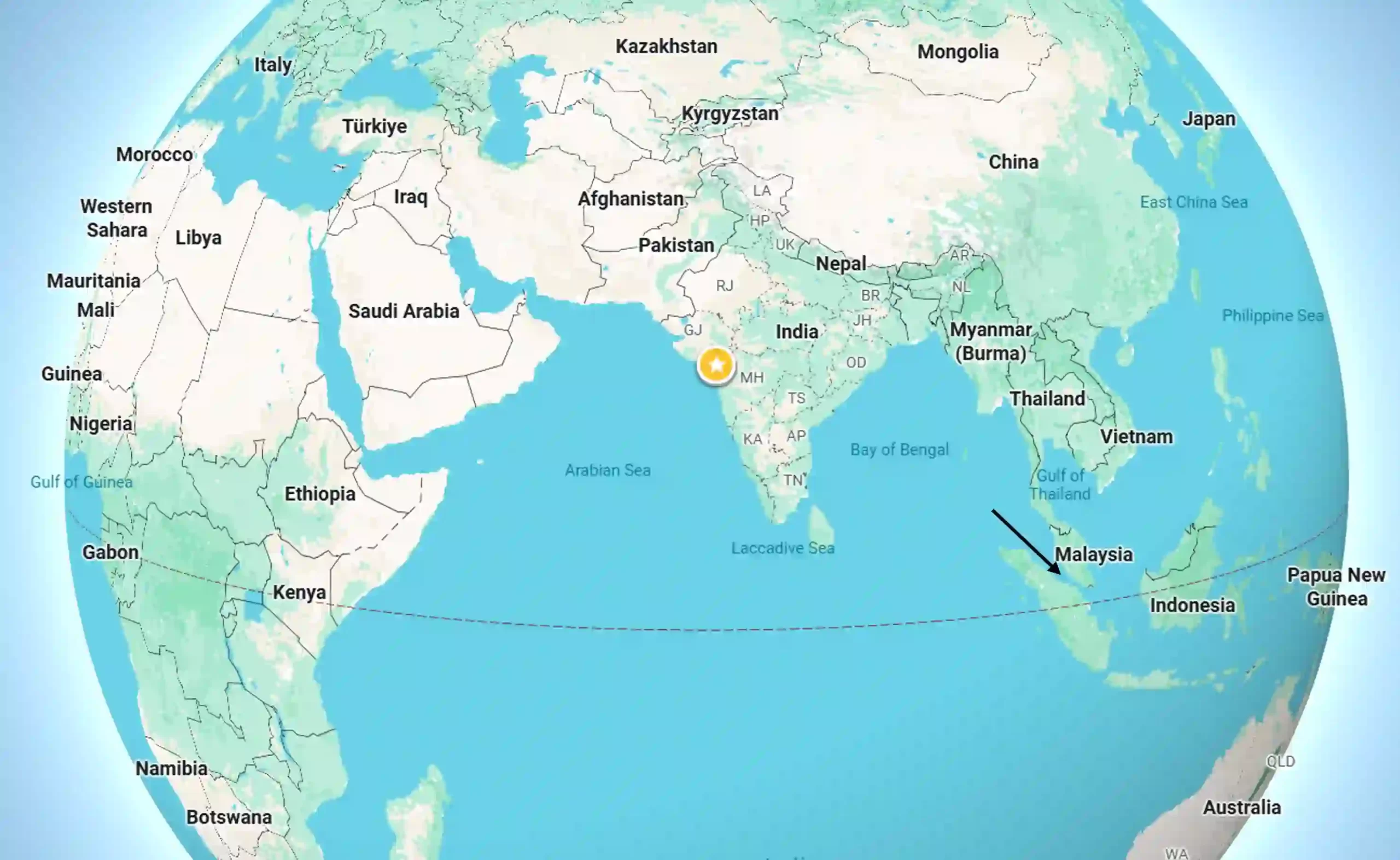
The Strait of Malacca is one of those rare places on the map where geography, economics and security converge so tightly that any change there sends ripples across the world. Stretching around 900 kilometres between Indonesia, Malaysia and Singapore, it links the Indian Ocean with the Pacific and acts as the main artery for global trade, energy flows and naval movement. For India, Malacca is not just a distant waterway, it is a critical bridge between the country’s Act East policy, its Indo-Pacific ambitions, and the broader security architecture of Asia.
What makes Malacca strategically irreplaceable is the sheer volume of commerce that passes through it. Roughly a quarter of the world’s seaborne trade, nearly half of global seaborne oil shipments, and a large share of container cargo move through this narrow funnel. Any disruption, whether from conflict, piracy, blockade or accident, would instantly affect energy prices, shipping costs and supply chains far beyond Southeast Asia.
Why Malacca Matters to India
For India, the stakes are direct and immediate. More than half of India’s external trade, including a major share of its energy imports, passes through the Strait of Malacca and Singapore. Crude oil from the Middle East, LNG, electronics, machinery, fertilisers, and consumer goods all move through this route, which means that India’s economic stability is tightly linked to its security.
That is why New Delhi cannot treat Malacca as a purely regional issue. It is a strategic lifeline that connects India’s eastern seaboard, the Andaman and Nicobar Islands, ASEAN, Japan, Australia and the wider Indo-Pacific. If India aspires to be a serious Indo-Pacific power, it must have a clear, credible and sustainable strategy for this waterway.
Geography as Strategy
India’s biggest natural advantage is the Andaman and Nicobar archipelago, which sits at the western approach to the Malacca Strait. These islands give India a forward position to monitor shipping lanes, develop maritime domain awareness, and project naval and coast guard presence without appearing aggressive.
The Andaman and Nicobar Command (ANC) is the operational expression of this advantage. It serves as a joint-services platform that improves surveillance, logistics, and rapid response capabilities near one of the world’s busiest maritime corridors. For India, this is not about controlling the strait; it is about being a responsible stakeholder with the ability to protect its own interests and contribute to regional security.
Sabang and Great Nicobar: A Strategic Arc
India’s evolving Malacca strategy is increasingly built around two complementary nodes: Sabang in Indonesia and the Great Nicobar development in India. Sabang, located at the northern tip of Aceh, overlooks the western entrance to the Malacca Strait and lies just over 100 miles from Great Nicobar. Together, they form a powerful maritime arc that enhances India’s ability to monitor, secure, and influence one of the world’s most critical chokepoints.
The joint development of Sabang Port and the new Framework on Maritime Safety and Security Cooperation between India and Indonesia institutionalise this partnership. It covers coast guard collaboration, blue economy projects, port development, and maritime trade. For India, this is a way to deepen ties with a key ASEAN power without appearing to dominate the strait.
India’s Approach: Presence, Partnership, Preparedness
India’s Malacca strategy can be summarised in three simple principles: presence, partnership, and preparedness. Presence means maintaining a visible but non-threatening naval and coast guard footprint in the Bay of Bengal and Andaman Sea. Partnership means working closely with Indonesia, Malaysia, Singapore, Thailand and ASEAN on maritime safety, anti-piracy, search and rescue, and domain awareness. Preparedness means building the infrastructure, intelligence, and logistics needed to respond to crises and protect trade routes.
This approach is carefully calibrated. India does not want to be seen as an external policeman in waters that the littoral states fiercely guard. Instead, it seeks to position itself as a reliable partner that contributes to stability without undermining sovereignty.
The China Factor
China’s heavy dependence on Malacca, often called the “Malacca Dilemma”, is the biggest strategic backdrop. Around 80 percent of China’s crude oil imports and a large share of its trade pass through this strait. Any disruption would hit Beijing’s energy security and economic logistics hard. That reality gives India some leverage, but it also means India must be extremely cautious in how it talks about Malacca.
Openly framing Malacca as a tool to pressure China would alarm ASEAN and make India look aggressive. The smarter path is quiet strength: improving surveillance, naval readiness, and infrastructure around the Andaman Sea and Bay of Bengal while maintaining diplomatic balance.