


ODOP – One District One Product: Transforming Local Economies into Global Opportunities
The One District One Product (ODOP) initiative has emerged as a key strategy in India’s effort to promote balanced regional development and strengthen local economies. The programme focuses on identifying and promoting a unique product from each district, with the aim of boosting manufacturing, generating employment, and enhancing exports.By linking traditional skills and local specialisations with modern market access, ODOP seeks to position India’s diverse district-level products on both national and global platforms.Concept and Origin of ODOPThe idea behind ODOP is rooted in the principle that every district has a distinct product, craft, or agricultural strength that can be developed into a competitive economic asset. The initiative was first implemented at the state level in Uttar Pradesh, where it gained considerable success in promoting local industries and artisans.Building on this model, the concept was later adopted at the national level to encourage districts across India to identify and develop their unique products. These include handicrafts, textiles, agricultural goods, processed foods, and industrial products.Objectives of the InitiativeODOP is designed to address multiple economic and developmental challenges through a focused approach. The initiative aims to promote indigenous products, support local artisans and manufacturers, and create sustainable employment opportunities at the district level.Another key objective is to reduce regional imbalances by ensuring that economic growth is not limited to major urban centres but is distributed across smaller districts. By strengthening local industries, ODOP also contributes to increasing exports and enhancing India’s global trade presence.Implementation and Institutional FrameworkThe ODOP initiative is implemented through coordination between central ministries, state governments, and district administrations. Each district identifies its flagship product based on factors such as historical significance, availability of raw materials, and existing skill sets.Once identified, support is provided in areas such as production, processing, packaging, branding, and marketing. Financial assistance, training programmes, and infrastructure development are also part of the implementation framework.The initiative is closely aligned with broader national programmes aimed at promoting self-reliance and entrepreneurship.Focus on Skill Development and Capacity BuildingA significant component of ODOP is the emphasis on skill development. Artisans and producers are trained in modern techniques, quality control, and business practices to improve productivity and competitiveness.Capacity-building programmes also focus on enhancing design, innovation, and value addition, enabling local products to meet global standards. This approach helps traditional industries adapt to changing market demands without losing their authenticity.Market Linkages and Export PromotionOne of the major challenges faced by local producers has been access to markets. ODOP addresses this by facilitating market linkages through exhibitions, e-commerce platforms, and export channels.Products identified under the initiative are promoted through various trade fairs and government-supported platforms, helping them reach a wider audience. The focus on branding and packaging has further improved the visibility and appeal of these products in international markets.Economic and Social ImpactThe ODOP initiative has contributed to strengthening local economies by creating employment opportunities and increasing income levels in districts. By promoting district-specific industries, it has encouraged entrepreneurship and reduced migration to urban areas.Socially, the initiative has helped preserve traditional crafts and cultural heritage, providing recognition and support to artisans who were previously operating in informal sectors.Integration with National Development GoalsODOP aligns with India’s broader vision of self-reliance and inclusive growth, complementing initiatives focused on manufacturing and exports. It also supports the development of micro, small, and medium enterprises (MSMEs), which play a crucial role in the country’s economy.The initiative contributes to the goal of making India a global manufacturing hub by leveraging local strengths and diversifying production bases.Challenges and the Way ForwardDespite its potential, the implementation of ODOP faces certain challenges. These include issues related to infrastructure, supply chain inefficiencies, and limited awareness among producers in some regions.Ensuring consistent quality, scaling production, and maintaining competitiveness in global markets are also areas that require continued attention. Strengthening digital platforms and improving logistics will be crucial for the initiative’s long-term success.The One District One Product initiative represents a strategic approach to decentralised economic development. By focusing on local strengths and connecting them to larger markets, it is creating new opportunities for growth while preserving India’s rich cultural and industrial diversity.
India Registers Karan Fries as a High-Yield Synthetic Cattle Breed
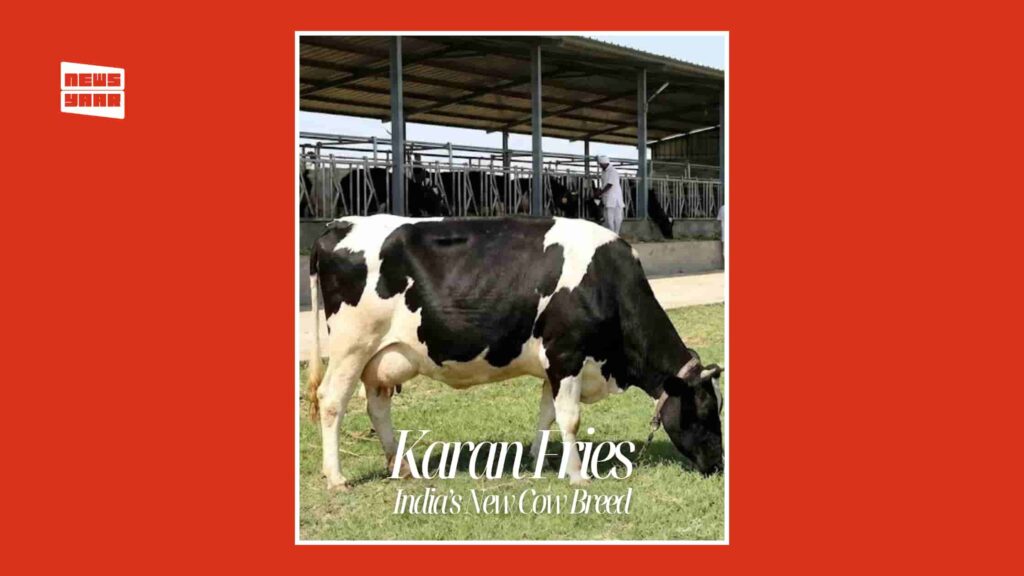
New Delhi:In a significant boost to India’s dairy and livestock sector, the country has officially registered Karan Fries, a high-yielding synthetic cattle breed capable of producing over 3,000 kilograms of milk in a standard 10-month lactation cycle. With this addition, India’s total number of registered livestock and poultry breeds has risen to 246, underlining the government’s continued push towards scientific breeding and productivity-led growth in animal husbandry.Developed through systematic cross-breeding programmes, Karan Fries combines the high milk-producing traits of exotic cattle with the hardiness and adaptability of Indian breeds. Officials say the breed has been designed to perform well under Indian agro-climatic conditions, making it suitable for farmers seeking higher productivity without compromising resilience.The focus on Karan Fries comes at a crucial time. Despite India being the world’s largest milk producer, the dairy sector faces persistent challenges. Many indigenous cattle breeds produce relatively low milk yields, typically between 1,000 and 2,000 kilograms per lactation, while farmers struggle with rising feed costs, limited veterinary access, and deteriorating cattle health. Poor nutrition, inadequate shelter, and climate stress have further affected productivity, particularly among small and marginal farmers.Against this backdrop, Karan Fries is being seen as a ray of hope. Higher milk yields per animal can help farmers increase income without expanding herd size, easing pressure on land, water, and fodder resources. Experts believe that productivity-focused breeds like Karan Fries could play a critical role in making dairying more sustainable and economically viable.Officials emphasised that the registration of Karan Fries reflects a broader strategy to modernise animal husbandry through genetic improvement, scientific breeding, and performance recording, while continuing to conserve indigenous breeds. “Native cattle remain essential for biodiversity, disease resistance, and ecological balance, but synthetic breeds like Karan Fries are necessary to meet growing commercial and nutritional demands,” an official said.However, experts caution that success will depend on responsible implementation. High-yielding breeds require better management, balanced nutrition, disease control, and regular veterinary care. Without adequate support systems, farmers may struggle to realise the full benefits. Policymakers are therefore being urged to strengthen extension services, expand artificial insemination coverage, and ensure affordable access to feed and healthcare.For farmers engaged in animal husbandry, the recognition of Karan Fries opens new possibilities. With proper support, the breed could help stabilise incomes, encourage youth participation in dairying, and enhance rural livelihoods. It also aligns with India’s long-term goals of improving farm productivity while maintaining sustainability.As India looks ahead, the challenge will be to balance productivity, animal welfare, and genetic diversity. The inclusion of Karan Fries marks an important step in that direction—signalling a future where scientific innovation supports farmers, strengthens the dairy economy, and addresses long-standing challenges in livestock management.