


Suvendu Adhikari Sworn In as West Bengal’s First BJP Chief Minister
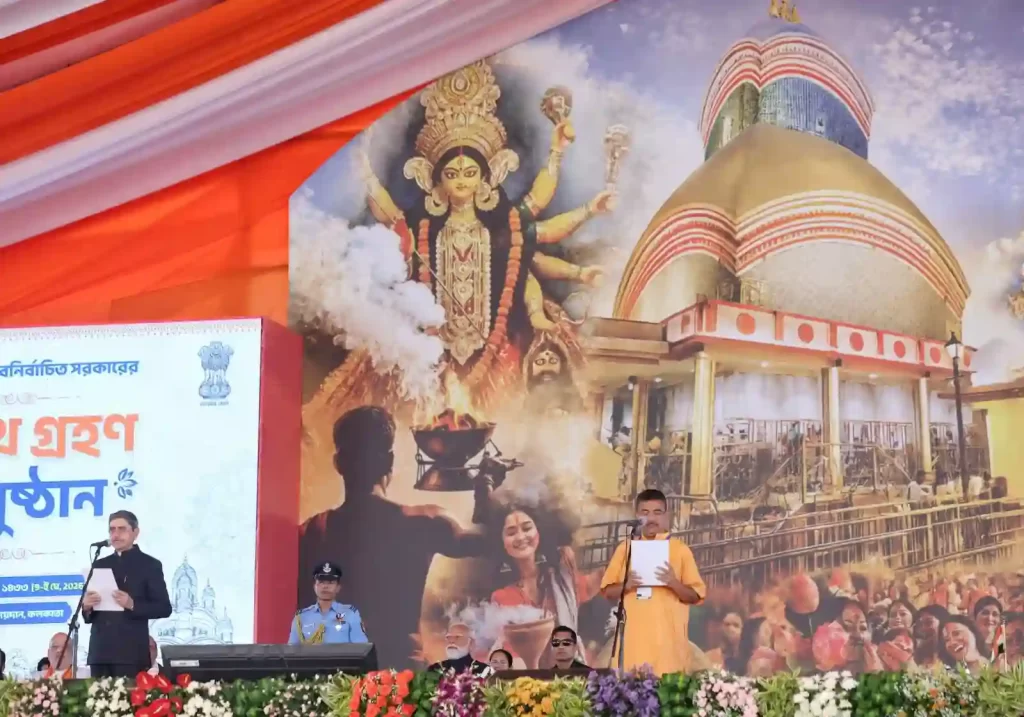
Suvendu Adhikari took the oath as the Chief Minister of West Bengal on May 9, 2026. This marked a historic moment for the state. The Bharatiya Janata Party (BJP) won 207 out of 294 assembly seats in the recent elections. This landslide victory ended the 15-year rule of Mamata Banerjee’s Trinamool Congress (TMC). Prime Minister Narendra Modi and Home Minister Amit Shah attended the swearing-in ceremony at Kolkata’s Brigade Parade Ground. Governor R. N. Ravi administered the oath. Five other BJP MLAs, Dilip Ghosh, Agnimitra Paul, Ashok Kirtania, Kshudiram Tudu, and Nisith Pramanik, also took oath as ministers.Adhikari’s rise ends TMC’s long dominance in West Bengal. Once a close ally of Mamata Banerjee, he switched to the BJP in 2020. His combative style and grassroots work helped the BJP break into the state’s politics. Supporters see him as a local hero who turned the tide. Critics call him divisive due to past remarks. Now, he leads a polarized state with big promises and tough challenges ahead.Early Life and Family Roots in PoliticsSuvendu Adhikari was born in 1970 in Purba Medinipur district. He comes from one of West Bengal’s most powerful political families. His father, Sisir Adhikari, served as a veteran Member of Parliament. The family built strong networks across coastal Bengal. Relatives held many elected posts over the years. This base gave Suvendu an early edge in politics.He started his career with the Congress party. Later, he joined TMC when it fought the Left Front government. Adhikari quickly rose through the ranks. He became known for his organizational skills and sharp political instincts. His family’s influence and personal drive made him a key player in local politics.Rise to Fame: The Nandigram Turning PointAdhikari’s big break came in 2007 in Nandigram. Farmers there protested a proposed chemical hub project by the Left Front government. The land acquisition plan sparked violent clashes. Adhikari organized much of the ground movement. He rallied villagers and led the resistance. The protests weakened the Left’s grip on power.This agitation paved the way for TMC’s 2011 victory. Mamata Banerjee swept to power, ending 34 years of Left rule. Adhikari emerged as a hero from Nandigram. He earned a reputation as Bengal’s top political organizer. Banerjee saw him as her trusted lieutenant. He won elections and held key posts in TMC, including transport minister.Fallout with TMC and Bold Switch to BJPTies with Banerjee soured over time. A 2016 Narada sting operation hurt his image. Videos showed TMC leaders, including Adhikari, allegedly taking cash from a fake investor. He denied the charges and questioned the footage’s authenticity. The scandal strained relations within TMC.By 2020, cracks widened. Adhikari resigned from TMC and joined BJP. It was a dramatic defection just before the 2021 assembly polls. He contested from Nandigram against Banerjee herself. In a nail-biter, Adhikari won by 1,956 votes. Though BJP lost the state, his personal win made him Banerjee’s main rival. It boosted his stature in the party.In 2026, he repeated the feat. BJP swept the polls. Adhikari defeated Banerjee in her Bhabanipur stronghold while retaining Nandigram. This double victory symbolized BJP’s takeover of TMC bastions.Key Role in BJP’s Historic Landslide VictoryAdhikari played a central role in BJP’s Bengal breakthrough. The party was marginal in the state for decades. TMC held a strong grip with welfare schemes and muscle power. Adhikari changed that with aggressive campaigning. He tapped into local issues like jobs, development, and alleged TMC corruption.His street-level networks mobilized voters in rural and coastal areas. Adhikari led charges against TMC’s “syndicate raj” and cut-money culture. He focused on Hindu consolidation in key seats. BJP promised industrial revival and safety from violence. Adhikari’s wins in Nandigram and Bhabanipur broke TMC’s psychological hold.The 207 seats gave BJP a clear majority. Adhikari became leader of the legislature party on May 8. His elevation shows PM Modi’s trust. Adhikari credits the victory to “people’s mandate against TMC misrule.” He vows to end “goonda raj” and bring “double-engine growth” with Delhi’s help.Controversies and Criticism Along the WayAdhikari’s journey faced storms. Critics accuse him of communal rhetoric. In 2021, the Election Commission warned him for calling Banerjee “Begum” and linking her win to a “mini-Pakistan.” In 2025, he said BJP would “throw out Muslim MLAs physically” if it won. TMC called it hate speech. He faced assembly suspension.He also alleged TMC medical camps pushed “birth control” to cut Hindu numbers. Opponents labeled it conspiratorial. Post-poll violence added tension. Days before swearing-in, Adhikari’s aide was shot dead near his home. BJP blamed TMC workers. Police probe unidentified attackers. These issues paint him as a polarizing figure.Vision for West Bengal: Jobs, Growth, and StabilityAdhikari promises big changes. His vision centers on “Viksit Bengal” by 2047. Key goals include attracting investment, creating youth jobs, and boosting industry. West Bengal lags in private investment. He plans “single-window clearance” for businesses. Focus areas: manufacturing, IT, and tourism.His eyes reviving stalled projects like Singur and Nayagram. Agriculture gets priority with better irrigation and markets. Women’s safety and law and order top the list. Adhikari pledges zero tolerance for violence. He wants to end political clashes that plague polls.Cultural revival features too. Promote Bengal’s heritage while integrating with national schemes. “Poribortan” (change) was the BJP’s slogan. Adhikari says it means jobs over doles, development over division.Challenges Ahead as New CMAdhikari faces tough tests. The state economy struggles. Unemployment haunts youth. Factories fled under TMC due to red tape and unions. Investors fear unrest. He must balance the Hindutva base with inclusive governance.Political rivals won’t fade. TMC remains strong in pockets. Mamata Banerjee vows opposition fight. Post-poll violence lingers. Healing divides need care. Adhikari must shift from agitator to administrator. Deliver results fast or risk backlash.Neutral bureaucracy and judiciary cooperation matter. Center-state ties help, but local execution decides.Road Ahead: From Firebrand to State BuilderAdhikari’s journey from TMC boy to BJP CM inspires supporters. At 56, he leads West Bengal’s first non-Left, non-TMC government since 1977. Modi walked him to the stage, signaling strong backing. Ministers like Dilip Ghosh add
Assembly Election Results 2026: Five States, Four Verdicts, One Seismic Political Shift
IntroductionThe verdict is in. The five simultaneous assembly elections held across India in April 2026 — in Assam, Kerala, Tamil Nadu, West Bengal, and the Union Territory of Puducherry — delivered their final results on counting day, May 4, 2026, and the political map of India looks meaningfully different today from what it did a month ago.Three of the five contests produced changes of government. Two of the three changes were historic by any measure. In West Bengal, 15 years of Trinamool Congress rule ended as the BJP swept to a majority of 206 seats in one of the most dramatic transfers of power any Indian state has witnessed since the early 1980s. In Tamil Nadu, a film star’s two-year-old party destroyed the 59-year dominance of the Dravidian duopoly, producing the state’s first-ever hung assembly. In Kerala, the Congress-led United Democratic Front routed a two-term Left government and returned to power with its best result since 1977. Assam and Puducherry returned their incumbents with comfortable margins.Together, the five results carry consequences for Indian politics that will be felt well beyond state boundaries, with the 2029 general election now firmly in view.West Bengal: The Fall of a 15-Year FortressThe ResultThe BJP won 206 seats in the 294-member West Bengal Legislative Assembly, clearing the 148-seat majority mark by a margin of 58 seats. The Trinamool Congress, which had governed the state continuously since 2011, was reduced to 76 seats — a collapse from the 213 seats it had won in 2021. Congress and the Left together won the remaining seats.The Election Commission ordered a repoll in the Falta constituency due to EVM tampering, scheduled for May 21, with results on May 24. One seat, Falta in South 24 Parganas, has results pending.What HappenedMamata Banerjee won her own Bhabanipur constituency, surviving a challenge from Suvendu Adhikari in a closely watched count that saw multiple lead reversals through the day before she eventually held on by a margin of 7,184 votes. Adhir Ranjan Chowdhury, the veteran Congress leader, lost from his traditional Baharampur stronghold, one of the starkest individual reversals of the day.The voter turnout was a record 92.6 percent across both phases. That extraordinary participation figure produced a result that defied most pre-election predictions of a close contest. The BJP crossed the majority mark in early counting and never looked back.The BJP’s Salt Lake headquarters in Kolkata broke into celebrations well before the afternoon counts were completed. The Election Commission, anticipating violence, banned all victory processions and rallies across the state following the result. Despite that ban, incidents of unrest were reported in multiple districts, with a TMC office vandalized and set alight in the Barabani constituency as counting trends turned heavily against the ruling party.A VVPAT slip controversy had emerged the night before counting, when hundreds of printed slips were found discarded near a roadside in the Subhashnagar area of Madhyamgram, from booth number 29 of the Noapara constituency. The incident prompted demands for an inquiry but did not delay counting.Why It HappenedAnti-incumbency after 15 years in power was the structural force underlying the result. Several compounding factors sharpened its impact. A recruitment scandal in government examinations, concerns about law and order, and questions about job creation had eroded public confidence during the incumbent government’s final two years. The Special Intensive Revision of electoral rolls, which resulted in the deletion of 91 lakh voters from West Bengal’s rolls, became the most politically charged controversy of the campaign, with the TMC accusing the BJP of engineering the exercise and the BJP counter-alleging that the TMC’s opposition to SIR was motivated by its dependence on undocumented voters. The controversy turned citizenship and identity into the dominant electoral themes, replacing the governance record debate that the TMC had wanted to fight on.Why It MattersWest Bengal holds 42 Lok Sabha seats. It is one of the largest states in India by parliamentary representation, and the BJP has historically underperformed in its Lok Sabha tally relative to its assembly vote share in the state. A government in Kolkata changes that structural equation ahead of 2029 in a way nothing else could.Tamil Nadu: The End of a 59-Year Dynasty — and a Hung AssemblyThe ResultTamil Nadu produced the most extraordinary result of the five elections. The final seat count in the 234-member assembly was:Tamilaga Vettri Kazhagam (TVK): 108 seatsDMK-led Secular Progressive Alliance (SPA): 73 seats (DMK: 59, INC: 5, others: 9)NDA led by AIADMK: 53 seats (AIADMK: 47, BJP: 1, others: 5)The majority mark is 118. No party or alliance crossed it. Tamil Nadu produced a hung assembly for the first time in its history.TVK, a party formed in February 2024 and contesting its first election, emerged as the single largest party. It beat both the DMK and AIADMK alliances in seat count but fell 10 seats short of forming a government on its own.Government FormationFollowing the declaration of results, Vijay invited the Indian National Congress to join a coalition government. Congress, which had won only 5 seats as part of the DMK-led SPA, accepted the invitation and formally left the DMK-led Secular Progressive Alliance, entering a new TVK-INC alliance. On May 6, 2026, Vijay met the Governor of Tamil Nadu, Rajendra Vishwanath Arlekar, and staked claim to form the government. He is expected to be sworn in as Chief Minister in the coming days.The Individual StoryThe personal stories from the counting day deserve particular mention. Vijay himself won both constituencies he contested, Perambur and Tiruchirappalli East, making him the clear face of government formation. Outgoing Chief Minister M. K. Stalin lost his Kolathur seat, which he had won three times consecutively. Deputy CM Udhayanidhi Stalin also lost his constituency. Fifteen ministers from the outgoing DMK cabinet were defeated. AIADMK general secretary Edappadi K. Palaniswami, however, retained his Edappadi seat with the widest winning margin in the state.Why It HappenedAnalysts identified several factors. TVK successfully targeted the youth vote, women voters, urban voters, and first-time voters across caste and religious lines. Anti-incumbency against the DMK government, widely