


The Strait of Hormuz: The World’s Most Consequential Waterway and the 2026 Crisis That Changed Everything
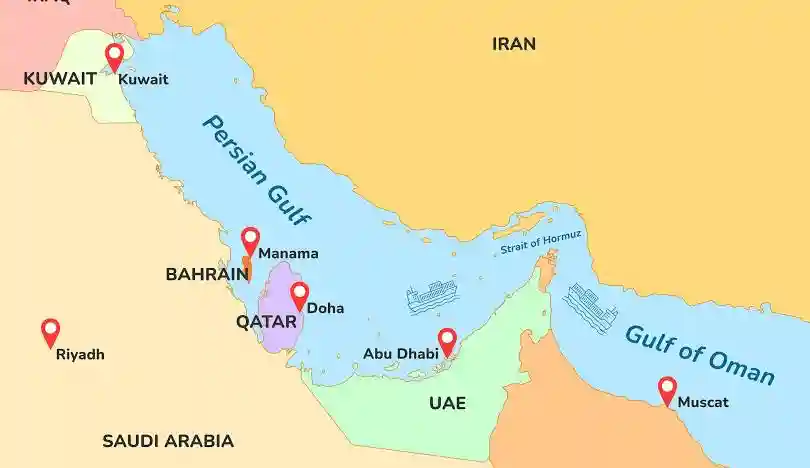
IntroductionThere are a handful of places on the map whose disruption alone can determine the fate of the global economy. The Strait of Hormuz is the most consequential of them all. A narrow strip of water barely 39 kilometres wide at its most constricted point, sitting between the southern coast of Iran and the Musandam Peninsula shared by Oman and the United Arab Emirates, it has for decades carried approximately 20 percent of the world’s seaborne oil supply and 20 percent of its liquefied natural gas.In February 2026, this artery was effectively shut. The consequences have been catastrophic.Following United States and Israeli strikes on Iran on February 28, 2026, the conflict prompted a closure of the Strait of Hormuz, through which most oil produced in the Persian Gulf is exported. Iran’s Islamic Revolutionary Guard Corps closed the strait to commercial shipping in retaliation for strikes that killed Iran’s Supreme Leader Ayatollah Ali Khamenei. What followed was the most severe energy shock the world has ever experienced, surpassing, by multiple measures, the oil crises of the 1970s, the Iran-Iraq War of the 1980s, and Iraq’s invasion of Kuwait in 1990.This article covers the geography, history, and strategic importance of the Strait of Hormuz in full, and then details the 2026 crisis that has brought the world’s energy system to the edge of collapse.Geography: What the Strait Actually IsThe Strait of Hormuz connects the Persian Gulf to the Gulf of Oman. It provides the only sea passage from the Persian Gulf to the open ocean and is one of the world’s most strategically important choke points. On the north coast lies Iran, and on the south coast lies the Musandam Peninsula, shared by the United Arab Emirates and the Musandam Governorate, an exclave of Oman. The strait is about 104 miles long, with a width varying from about 60 miles to 24 miles.Despite that width, the usable shipping lane is far more constrained. To reduce the risk of collision, ships moving through the strait follow a traffic separation scheme: inbound ships use one lane, outbound ships another, each lane being two miles wide. The lanes are separated by a two-mile-wide median. The combined active shipping corridor is therefore, in practice, just six miles wide.The northern coast belongs entirely to Iran. To traverse the strait, ships pass through the territorial waters of Iran and Oman under the transit passage provisions of the United Nations Convention on the Law of the Sea. Both Iran and Oman have expanded their territorial seas to 12 nautical miles, which means, by 1972, the entire strait fell within the combined territorial waters of the two states.Key features of the strait include Hormuz Island and Qeshm Island on the Iranian side. The main Iranian port city on the strait is Bandar Abbas, which serves as the base for Iran’s naval forces and the headquarters of the IRGC Navy. On the Omani side, the port town of Khasab in the Musandam Governorate sits along the strait’s southern edge.Historical Significance: A Trade Route Since AntiquityThe Strait of Hormuz is not merely a modern energy artery. It has been one of the world’s most strategically important trade routes for over two millennia.The 1st century AD mariner’s guide, the Periplus of the Erythraean Sea, described the mouth of the Persian Gulf as a passage connecting to vast interior trading networks, noting that pearl diving was prevalent at its upper end. Memoirs of Babur, who established the Mughal Empire, recount how almonds had to be carried from the distant Ferghana region in Central Asia to Hormuz to reach markets. From the 10th to the 17th centuries AD, the Kingdom of Ormus, which occupied the territory around the strait and appears to have given it its name, was one of the most prosperous trading kingdoms in the medieval world.The origin of the name is debated. Popular etymology derives “Hormuz” from the Middle Persian pronunciation of the name of the Zoroastrian god Ahura Mazda. Scholars and historians also derive the name from the local Persian word “Hur-mogh,” meaning date palm. A third theory links it to “hormos,” the Greek word for cove or bay.The Portuguese were the first European power to recognise the strait’s imperial importance. They occupied Hormuz Island from 1507 to 1622, using it as a base to control trade between the Persian Gulf and Europe. Their expulsion by Shah Abbas I of Persia, with British assistance, ended European direct control, but confirmed the strait as the fulcrum of Indian Ocean power politics.During the modern era, the strait’s importance shifted from spice and luxury goods to oil. When Persian Gulf oil exports began in earnest in the mid-20th century, the Strait of Hormuz became the primary commercial artery for the world’s most critical energy supply.Strategic Importance: The NumbersThe raw statistics explain why the closure of the Strait of Hormuz has no precedent in peacetime energy disruption.During 2023 to 2025, 20 percent of the world’s liquefied natural gas and 25 percent of seaborne oil trade passed through the strait annually. In 2018, 21 million barrels a day passed through the strait, worth USD 1.2 billion at 2019 prices. In 2011, according to the US Energy Information Administration, an average of 14 tankers per day passed outbound through the strait carrying 17 million barrels of crude oil. More than 85 percent of these crude oil exports went to Asian markets, with Japan, India, South Korea, and China the largest destinations.In 2024, an estimated 84 percent of crude oil and condensate shipments through the strait were destined for Asian markets, with China receiving a third of its oil via the strait. Europe gets 12 to 14 percent of its LNG from Qatar, through the strait.Beyond oil and gas, the strait is critical for the global fertiliser trade. Over 30 percent of global urea, which is widely used and produced from natural gas, is exported from Gulf countries through the Strait. Gulf countries account for roughly 45 percent of global sulfur supply, a key input for everything