

Introduction
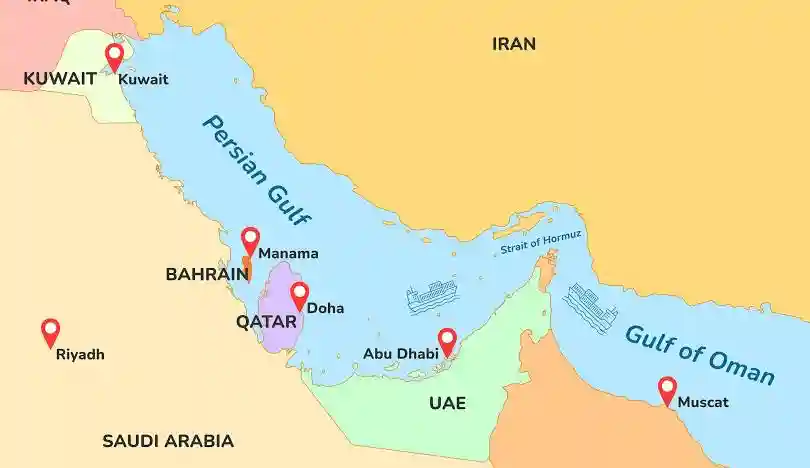
There are a handful of places on the map whose disruption alone can determine the fate of the global economy. The Strait of Hormuz is the most consequential of them all. A narrow strip of water barely 39 kilometres wide at its most constricted point, sitting between the southern coast of Iran and the Musandam Peninsula shared by Oman and the United Arab Emirates, it has for decades carried approximately 20 percent of the world's seaborne oil supply and 20 percent of its liquefied natural gas.
In February 2026, this artery was effectively shut. The consequences have been catastrophic.
Following United States and Israeli strikes on Iran on February 28, 2026, the conflict prompted a closure of the Strait of Hormuz, through which most oil produced in the Persian Gulf is exported. Iran's Islamic Revolutionary Guard Corps closed the strait to commercial shipping in retaliation for strikes that killed Iran's Supreme Leader Ayatollah Ali Khamenei. What followed was the most severe energy shock the world has ever experienced, surpassing, by multiple measures, the oil crises of the 1970s, the Iran-Iraq War of the 1980s, and Iraq's invasion of Kuwait in 1990.
This article covers the geography, history, and strategic importance of the Strait of Hormuz in full, and then details the 2026 crisis that has brought the world's energy system to the edge of collapse.
Geography: What the Strait Actually Is
The Strait of Hormuz connects the Persian Gulf to the Gulf of Oman. It provides the only sea passage from the Persian Gulf to the open ocean and is one of the world's most strategically important choke points. On the north coast lies Iran, and on the south coast lies the Musandam Peninsula, shared by the United Arab Emirates and the Musandam Governorate, an exclave of Oman. The strait is about 104 miles long, with a width varying from about 60 miles to 24 miles.
Despite that width, the usable shipping lane is far more constrained. To reduce the risk of collision, ships moving through the strait follow a traffic separation scheme: inbound ships use one lane, outbound ships another, each lane being two miles wide. The lanes are separated by a two-mile-wide median. The combined active shipping corridor is therefore, in practice, just six miles wide.
The northern coast belongs entirely to Iran. To traverse the strait, ships pass through the territorial waters of Iran and Oman under the transit passage provisions of the United Nations Convention on the Law of the Sea. Both Iran and Oman have expanded their territorial seas to 12 nautical miles, which means, by 1972, the entire strait fell within the combined territorial waters of the two states.
Key features of the strait include Hormuz Island and Qeshm Island on the Iranian side. The main Iranian port city on the strait is Bandar Abbas, which serves as the base for Iran's naval forces and the headquarters of the IRGC Navy. On the Omani side, the port town of Khasab in the Musandam Governorate sits along the strait's southern edge.
Historical Significance: A Trade Route Since Antiquity
The Strait of Hormuz is not merely a modern energy artery. It has been one of the world's most strategically important trade routes for over two millennia.
The 1st century AD mariner's guide, the Periplus of the Erythraean Sea, described the mouth of the Persian Gulf as a passage connecting to vast interior trading networks, noting that pearl diving was prevalent at its upper end. Memoirs of Babur, who established the Mughal Empire, recount how almonds had to be carried from the distant Ferghana region in Central Asia to Hormuz to reach markets. From the 10th to the 17th centuries AD, the Kingdom of Ormus, which occupied the territory around the strait and appears to have given it its name, was one of the most prosperous trading kingdoms in the medieval world.
The origin of the name is debated. Popular etymology derives "Hormuz" from the Middle Persian pronunciation of the name of the Zoroastrian god Ahura Mazda. Scholars and historians also derive the name from the local Persian word "Hur-mogh," meaning date palm. A third theory links it to "hormos," the Greek word for cove or bay.
The Portuguese were the first European power to recognise the strait's imperial importance. They occupied Hormuz Island from 1507 to 1622, using it as a base to control trade between the Persian Gulf and Europe. Their expulsion by Shah Abbas I of Persia, with British assistance, ended European direct control, but confirmed the strait as the fulcrum of Indian Ocean power politics.
During the modern era, the strait's importance shifted from spice and luxury goods to oil. When Persian Gulf oil exports began in earnest in the mid-20th century, the Strait of Hormuz became the primary commercial artery for the world's most critical energy supply.
Strategic Importance: The Numbers
The raw statistics explain why the closure of the Strait of Hormuz has no precedent in peacetime energy disruption.
During 2023 to 2025, 20 percent of the world's liquefied natural gas and 25 percent of seaborne oil trade passed through the strait annually. In 2018, 21 million barrels a day passed through the strait, worth USD 1.2 billion at 2019 prices. In 2011, according to the US Energy Information Administration, an average of 14 tankers per day passed outbound through the strait carrying 17 million barrels of crude oil. More than 85 percent of these crude oil exports went to Asian markets, with Japan, India, South Korea, and China the largest destinations.
In 2024, an estimated 84 percent of crude oil and condensate shipments through the strait were destined for Asian markets, with China receiving a third of its oil via the strait. Europe gets 12 to 14 percent of its LNG from Qatar, through the strait.
Beyond oil and gas, the strait is critical for the global fertiliser trade. Over 30 percent of global urea, which is widely used and produced from natural gas, is exported from Gulf countries through the Strait. Gulf countries account for roughly 45 percent of global sulfur supply, a key input for everything from phosphate fertiliser to industrial chemicals and copper production.
Pre-conflict, around 3,000 vessels used the strait each month.
Legal Status: Who Controls the Strait
The legal status of the Strait of Hormuz has been contested for decades, and those disputes are now at the centre of the 2026 crisis.
In 1959, Iran altered the legal status of the strait by expanding its territorial sea to 12 nautical miles and declaring it would recognise only transit by innocent passage through the newly expanded area. In 1972, Oman also expanded its territorial sea to 12 nautical miles by decree. Thus, by 1972, the Strait of Hormuz was completely closed by the combined territorial waters of Iran and Oman.
Upon signing the convention in 1982, Iran entered a declaration stating that only states parties to the Law of the Sea Convention shall be entitled to benefit from the contractual rights created therein, including the right of transit passage through straits used for international navigation. In 1993, Iran enacted a comprehensive law on maritime areas, provisions of which conflict with UNCLOS provisions, including a requirement that warships, submarines, and nuclear-powered ships obtain permission before exercising innocent passage through Iran's territorial waters. The US does not recognise any of the claims by Oman and Iran and has contested each of them.
International legal experts noted during the 2026 crisis that under international law, neither the US nor Iran has the legal authority to close, suspend, or impede transit passage through Hormuz. Only Iran and Oman are coastal states, and even they are prohibited from suspending transit passage.
A History of Confrontation: Key Incidents Before 2026
The Strait of Hormuz has been the site of recurring military and diplomatic confrontations throughout modern history.
The Tanker War, 1984 to 1988: The Tanker War phase of the Iran-Iraq War started when Iraq attacked the oil terminal and oil tankers at Iran's Kharg Island in early 1984. Saddam Hussein's aim in attacking Iranian shipping was, among other things, to provoke the Iranians to retaliate with extreme measures such as closing the Strait of Hormuz to all maritime traffic, thereby bringing American intervention. Iran limited the retaliatory attacks to Iraqi shipping, leaving the strait open.
Operation Praying Mantis, April 1988: Operation Praying Mantis was an attack on April 18, 1988 by the United States Armed Forces within Iranian territorial waters in retaliation for the Iranian naval mining of international waters in the Persian Gulf during the Iran-Iraq War and the subsequent damage to an American warship. The US Navy attacked with several groups of surface warships, plus aircraft from the aircraft carrier USS Enterprise.
Iran Air Flight 655, July 1988: On July 3, 1988, 290 people were killed when an Iran Air Airbus A300 was shot down over the strait by the United States Navy guided missile cruiser USS Vincennes when it was wrongly identified as a jet fighter. The incident remains a deep source of grievance in Iran.
Speedboat Confrontations, 2007 to 2008: Naval standoffs between Iranian speedboats and US warships in the strait occurred in December 2007 and January 2008. On June 29, 2008, the commander of Iran's Revolutionary Guard, Mohammad Ali Jafari, said that if either Israel or the US attacked Iran, it would seal off the strait to wreak havoc in the oil markets.
2011 to 2012 Threat Cycle: On December 27, 2011, Iranian Vice President Mohammad Reza Rahimi threatened to cut off oil supply from the strait should economic sanctions limit or cut off Iranian oil exports. A US Fifth Fleet spokeswoman said the Fleet was "always ready to counter malevolent actions," whilst Admiral Habibollah Sayyari of the Iran Navy claimed cutting off oil shipments would be "easy." On January 3, 2012, Iran threatened to take action if the US Navy moved an aircraft carrier back into the Persian Gulf. Iranian Army chief Ataollah Salehi said the US had moved a carrier out of the Persian Gulf because of Iran's naval exercises. "Iran will not repeat its warning," he said. "I recommend and emphasise to the American carrier not to return to the Persian Gulf."
Maersk Tigris Incident, April 2015: IRGC patrol boats contacted the Marshall Islands-flagged container ship Maersk Tigris, which was westbound through the strait, and directed the ship to proceed further into Iranian territorial waters. When the ship's master declined, one of the Iranian craft fired shots across the bridge. The captain complied and proceeded into Iranian waters near Larak Island. The US Navy sent aircraft and a destroyer, USS Farragut, to monitor the situation.
MSC Aries Seizure, April 2024: In April 2024, the Iranian Navy seized MSC Aries, a Portuguese-flagged container ship sailing through the Gulf of Oman off the UAE coast, then steered the container ship through the strait, with 25 personnel on board, claiming that it had violated maritime laws. The crew of 25 included 17 Indian nationals, Filipinos, Pakistanis, a Russian, and an Estonian.
Mine Loading, June 2025: In June 2025, it was reported that US intelligence detected, possibly through satellite imagery or human informants, that Iranian military forces loaded naval mines onto vessels in the Persian Gulf, an act which was interpreted as a preliminary step to blockading the strait. The mines were ultimately not deployed, though their presence raised alarms in Washington about Tehran's intent to escalate the conflict.
None of these incidents resulted in a sustained closure. The strait had never been shut for any extended period during a Middle East conflict, making the 2026 event without historical parallel.
The 2026 Crisis: How the Strait Was Closed
The Opening Strikes: February 28, 2026
Shipping traffic through the Strait of Hormuz has been largely blocked by Iran since February 28, 2026, when the United States and Israel launched an air war against Iran and assassinated its Supreme Leader Ali Khamenei. In retaliation, Iran launched missile and drone attacks on Israel, US military bases, and US-allied Gulf states. The Iranian Revolutionary Guard issued warnings forbidding passage through the strait, boarded and attacked merchant ships, and laid sea mines in the strait.
The Iranian military shut the strait, which is shared between the territorial waters of Iran and Oman, following the February 28 strikes on Tehran that killed Supreme Leader Ayatollah Ali Khamenei. His son, Mojtaba Khamenei, has taken over the top job in Tehran since.
Within hours of the strikes, the IRGC transmitted warnings via VHF radio to vessels in the strait, stating that no ships would be permitted to pass. Although the closure is not legally binding as Iran did not formally declare a blockade, military and industry sources say that safety cannot be guaranteed, and several ships stayed in port or turned back. The threats led to a partial closure, with ship-tracking data first showing a 70 percent reduction in traffic.
Major container shipping companies, including Maersk, CMA CGM, and Hapag-Lloyd, suspended transits through the strait and related routes such as the Red Sea. Houthi-controlled Yemen announced on February 28 that it would resume attacks on Israel and commercial ships in the Red Sea, forcing Suez Canal traffic to be rerouted around Africa's Cape of Good Hope. This added weeks to transit times and increased shipping costs.
Early Casualties
On March 1, the oil tanker Skylight was struck by a projectile north of Khasab, Oman, killing two Indian crew members and injuring three others. The rest of its 20 crew evacuated. The MKD VYOM was struck by a drone boat, sparking a fire and an explosion in its engine room. An Indian sailor was killed, and its 21 crew evacuated. Another Indian was critically wounded on the LCT Ayeh.
On April 1, QatarEnergy-owned oil tanker Aqua 1 was attacked by two projectiles north of Doha, causing a fire that was extinguished. The IRGC claimed that the tanker was Israeli. On April 4, the IRGC claimed that it attacked the MSC Ishyka with a drone in the Strait of Hormuz, claiming it was linked to Israel.
Selective Access and Iranian Tolls
In the weeks following the initial closure, Iran moved to control rather than blanket-ban shipping. Iran began to control traffic through the strait and charging tolls of over USD 1 million per ship. While Tehran was previously allowing ships from countries it deemed friendly, or which paid a toll, mostly from India, Pakistan, Turkey, and China, to pass the strait, it has now closed it to all foreign-flagged ships until the US lifts its naval blockade.
Iran has published a map showing parts of the strait that it said had been mined, and an alternative route for approved ships. This route brings ships much closer to the coast of Iran, whereas they previously passed closer to Oman. Iran said this was to help tankers avoid the danger of mines.
Iran's oil exports through the Strait of Hormuz account for about 80 percent of its total oil exports. Iran exported 1.84 million barrels per day of crude oil in March.
The April 8 Ceasefire and Its Collapse
On April 8, a temporary ceasefire was agreed that was to involve the re-opening of the strait. However, Iran began to control traffic through the strait and charging tolls. Following the failure of the Islamabad Talks, the US Navy itself began to blockade Iranian ports from April 13.
On April 17, Iran's foreign minister Abbas Araghchi announced that the Strait of Hormuz was open to all shipping traffic. Iran said that the strait would remain open for the duration of the ceasefire in Lebanon. Following the announcement, oil prices dropped sharply, losing 11 percent in the immediate aftermath of the announcement. By April 20, traffic through the Strait had dropped sharply again.
The Dual Blockade
On April 13, the US launched a counter-blockade of the strait, targeting all ships seeking to reach Iranian ports. Since the US began its naval blockade of Iranian ports in mid-April, Iranian officials have repeatedly promised that their country will defend itself and respond to any US attack.
On April 18, Iran said that it closed the Strait of Hormuz after threatening to do so in response to the US blockade of Iran. Two Indian-flagged ships were targeted by gunfire in the strait and forced to turn back, with the VLCC Sanmar Herald coming under fire from two Iranian gunboats despite receiving prior clearance to pass. Later, a container ship reported damage from a rocket attack off the coast of Oman. The vessel was later identified by French company CMA CGM as the CMA CGM Everglade.
Iran has targeted energy infrastructure in Israel and across the Gulf, threatened to target banking institutions, and targeted US data centres of technology companies such as Amazon in the United Arab Emirates and Bahrain.
On April 19, Iran's First Vice President Mohammad Reza Aref said the "security of the Strait of Hormuz is not free." "One cannot restrict Iran's oil exports while expecting free security for others," he wrote. "The choice is clear: either a free oil market for all, or the risk of significant costs for everyone."
The Pakistan-Mediated Islamabad Talks and Their Failure
Tehran used access to the strait as its most powerful leverage in talks between the US and Iran in Islamabad, Pakistan, on April 11, but these failed to yield results. Two days later, US President Donald Trump announced a naval blockade of Iranian ports and the Strait of Hormuz to put economic pressure on Tehran.
The Current Situation
The United States is considering a new proposal from Iran to end the ongoing war amid a fragile ceasefire between the longtime adversaries. The offer focuses on reopening the strategic Strait of Hormuz while postponing a deal on Iran's nuclear programme, arguably the most contentious issue between Tehran and Washington. The proposal was conveyed to Washington through Pakistan, which has been acting as a mediator.
Secretary of State Marco Rubio told Fox News that the proposal was "better than what we thought they were going to submit," but questioned Tehran's intentions, saying "We have to ensure that any deal that is made, any agreement that is made, is one that definitively prevents them from sprinting towards a nuclear weapon at any point."
The reopening of the strait is a major issue in the Pakistan-mediated talks, and Iran has threatened military action if the US blockade does not end.
On April 7, China and Russia vetoed a draft resolution on the strait. The Bahraini-drafted resolution called for an end to Iranian attacks and for states to coordinate efforts defensively for shipping access.
About 2,000 ships remain stranded in the Gulf, waiting to be allowed through. The International Maritime Organization reported on April 21 that about 20,000 mariners and 2,000 ships remain stranded in the Persian Gulf.
The Economic Impact: The Worst Energy Shock in History
Fatih Birol, head of the International Energy Agency, called the disruption the worst energy shock the world has ever seen, more severe than the oil crises of the 1970s and the Ukraine war combined. Daniel Yergin, vice chairman of S&P Global, said: "There has never been anything of this scale. Even the oil crises of the 1970s, the Iran-Iraq war of the 1980s, Iraq's invasion of Kuwait in 1990, none of those come close to the magnitude of this disruption."
Oil Prices
On March 19, Dubai crude oil prices reached USD 166, their highest on record. Following the closure of the Strait of Hormuz on March 4, 2026, oil and LNG exports were stranded, causing Brent Crude to surge past USD 120 per barrel. On March 23, in response to President Trump's comments on US-Iranian negotiations, Brent crude prices fell from USD 114 to USD 102 per barrel. On March 27, Brent crude increased back to USD 114 per barrel, after negotiations did not produce a ceasefire and the IRGC declared the strait to be closed.
A closure of the Strait of Hormuz that removes close to 20 percent of global oil supplies from the market is expected to raise the average West Texas Intermediate price of oil to USD 98 per barrel and lower global real GDP growth by an annualised 2.9 percentage points in the second quarter of 2026, according to Dallas Federal Reserve modelling.
QatarEnergy Force Majeure and LNG Supply
QatarEnergy announced on March 3 that it was declaring Force Majeure on its contracts with buyers, and internal sources said that it would soon be shutting down gas liquefication, as LNG tankers could not leave the Gulf, and that restarting it would take weeks. Europe, which sources 12 to 14 percent of its LNG from Qatar, faced the most immediate consequences for heating and power generation.
Shipping and Insurance
Before the crisis, war-risk insurance premiums for Strait of Hormuz transit were priced at just below 0.25 percent of hull value. In the days before the February 28 strikes, war-risk ship insurance premiums for the strait increased from 0.125 percent to between 0.2 and 0.4 percent of the ship insurance value per transit. For very large oil tankers, this was an increase of a quarter of a million dollars.
The United States has said it will take six months to clear mines it believes have been laid by Iran. Jakob Larsen, head of maritime security for BIMCO, the largest international association representing shipowners, warned that even after peace is brokered, the mine threat is of particular concern. "Given the Iranian indications that mines have been laid in parts of the Strait of Hormuz, a mine clearance effort will most likely be needed to fully reopen the Strait. Shipping will be restricted to using routes close to Iran and Oman. Due to their confined nature, these routes cannot safely accommodate the normal volumes of shipping through the Strait of Hormuz."
Impact on Asian Economies
Asian countries are the primary destination for crude oil from the Gulf, with most of it travelling via the Strait of Hormuz. In 2024, around 84 percent of the crude oil and 83 percent of LNG passing through the Strait went to Asia; nearly 70 percent of the oil went to China, India, Japan, and South Korea.
India imports nearly 85 percent of its crude oil, and a large portion comes through the Strait of Hormuz. Higher oil prices mean India needs more dollars to pay for imports, and a weaker rupee makes imports even more expensive, creating a feedback loop. Bangladesh is among the worst-hit economies and is projected to have a severe impact on GDP growth inducing recession-like conditions. Universities were closed in advance for the upcoming Eid al-Fitr holidays in order to conserve electricity and fuel. All shopping centres and commercial establishments were directed to shut down by 8 pm.
The Philippines declared an energy emergency. Pakistan imposed a two-week school holiday to conserve fuel used by commuters.
Impact on Europe
The European Central Bank warned that a prolonged conflict will likely trigger a period of stagflation and push major energy-dependent economies, including Germany and Italy, into technical recession by the end of 2026. British company Shell issued a warning that Europe could face a shortage of fuel as early as April. Chemical and steel manufacturers have imposed surcharges of up to 30 percent to offset surging electricity and feedstock costs, potentially leading to permanent deindustrialisation in some sectors.
Thousands of flights were cancelled in Europe over a spike in jet fuel prices. The OECD identified the UK as the worst-hit major economy globally.
Impact on the United States
In the second week of March, California's gasoline prices exceeded USD 5 per gallon due to the United States' conflict with Iran. Gas prices have risen USD 1.16 per gallon in the United States since the start of the war. Jet fuel in North America has spiked 95 percent since the war began, causing multiple airlines to raise prices for checked baggage. The US defense industry faces near-total disruption of critical minerals supply, in particular sulfur, through the strait.
Global Supply Chain Disruptions Beyond Oil
In addition to the ongoing disruption to supplies of crude oil and liquefied natural gas, the strait's closure affects other important commodities as well. The collapse of shipping through the Strait of Hormuz is two problems at once. The first problem is the immediate supply shock for several important global commodities, from ammonia to aluminium. The second problem is that even if the strait were to reopen soon, the underlying supply and logistical stresses of the waterway's closure will likely persist for months.
The near-total halt of tanker traffic in the Strait of Hormuz has caused a significant disruption in the global supply of sulfur, with Gulf countries accounting for roughly 45 percent of the global commodity. The crisis has also constrained the supply of helium, crucial for semiconductor manufacturing. China has banned exports of sulfuric acid, impacting copper production in Chile.
UNCTAD stated that disruptions in the Strait of Hormuz underscore the vulnerability of critical maritime chokepoints to geopolitical tensions and their potential to transmit shocks across supply chains and commodity markets. Higher energy, fertiliser and transport costs may increase food costs and intensify cost-of-living pressures, particularly for the most vulnerable.
What It Would Take to Reopen the Strait
Even if a diplomatic resolution is reached today, the return to normal shipping operations will not be immediate. Maritime war and insurance experts said a lasting commitment by all parties to maintain peace along the sea route is the least they will require to consider the Strait of Hormuz safe again. "They need evidence that the threat environment has fundamentally stabilised. That means a durable ceasefire or political resolution, clear naval security guarantees, consistent freedom of navigation, no recent vessel seizures or attacks, credible mine clearing and surveillance, and predictable rules of engagement among the key military actors in the region."
To restore confidence in the market, insurers require normal vessel movement to resume over a sustained period, not just isolated transits. "The moment underwriters believe a single incident could trigger a broader regional escalation, close the waterway again, or expose multiple vessels at once, the risk becomes much harder to support at scale."
Alternative Routes: Limited, Costly, and Inadequate
One question raised by the 2026 crisis is whether alternative routes exist that could bypass the Strait of Hormuz. The answer, for most of the Gulf region's energy exporters, is that alternatives are severely limited. Arab states of the Persian Gulf as well as Iran itself rely on the Strait of Hormuz for their energy exports and grocery imports, with only Saudi Arabia and UAE having alternative, albeit limited, routes.
Saudi Arabia has the East-West Pipeline carrying crude oil from the Eastern Province to the Red Sea port of Yanbu, with a capacity of approximately 5 million barrels per day. The UAE has the Abu Dhabi Crude Oil Pipeline, which carries crude to the port of Fujairah on the Gulf of Oman. However, these alternative routes collectively account for only a fraction of the approximately 20 million barrels per day that passed through the strait before the crisis. Iraq, Kuwait, Qatar, Bahrain, and Iran itself have no meaningful alternative export routes.
The crisis has also led to a slight increase in the number of ships traversing the Panama Canal. However, this provides no meaningful relief for energy supplies from the Persian Gulf.
Diplomatic Dimensions: Where the Crisis Stands
Analyst Negar Mortazavi, a Center for International Policy senior fellow, said the Iranian proposal looks reasonable as the situation in the Strait of Hormuz has created a global crisis and countries around the world want it resolved. "Both Tehran and Washington need to immediately focus on reforming the Strait. Tehran will not move if the US doesn't lift its blockade, and Washington will not do so if Iran does not open the strait. So this can be a good first step towards a more permanent ceasefire."
The UK and France have hosted two conferences on reopening Hormuz, with a focus on exploring potential sanctions, diplomatic initiatives, and insurance provision for ships.
In Tehran, large billboards have appeared at Enghelab Square reading, in Persian, "The Strait of Hormuz remains closed," reflecting the Iranian government's position that the closure is a sovereign act of self-defence, not a violation of international law.
India and the Strait: A Vital National Interest
For India, the Strait of Hormuz is not an abstract strategic concept. It is a direct determinant of domestic fuel prices, food costs, economic growth, and national security. India imports nearly 85 percent of its crude oil and depends heavily on the Hormuz passage for the majority of those supplies.
Indian crew members were among the earliest casualties of the 2026 crisis. Two Indian nationals were killed in the Skylight attack on March 1. One Indian sailor was killed when the MKD VYOM was struck by a drone boat. Another was critically wounded on the LCT Ayeh. In April 2024, 17 Indian nationals were among those detained when the IRGC seized the MSC Aries. On April 18, 2026, two Indian-flagged ships were targeted by gunfire in the strait and forced to turn back, with the VLCC Sanmar Herald coming under fire from two Iranian gunboats despite receiving prior clearance to pass.
India's diplomatic posture throughout the crisis has been to maintain communication channels with all parties while pressing for a negotiated resolution. India was among the countries permitted to transit the strait under Iran's earlier selective access regime, a consequence of its historical trade and diplomatic relationships with Tehran. That arrangement grew more precarious as the situation deteriorated into a complete closure.
Conclusion: A Chokepoint Revealed
The 2026 Strait of Hormuz crisis has taught the world a lesson it had long understood intellectually but never truly absorbed in practice. The global energy system, the supply chains for food, fertiliser, and industrial inputs, and the stability of the financial system are all, at their foundation, dependent on safe passage through a strip of water 39 kilometres wide off the coast of Iran.
For decades, the Strait of Hormuz was called the world's most important chokepoint. For decades, that claim was theoretical, supported by threat assessments and war gaming but never tested at the scale now unfolding. In 2026, it is no longer theoretical. The world is now living the reality of what happens when that chokepoint closes, and the answer, measured in record oil prices, 2,000 stranded ships, spiralling inflation, school closures in Pakistan, and recession warnings across Europe, is that it is worse than almost anyone had modelled.
Whether the current crisis resolves through diplomacy, military escalation, or some combination of both, the Strait of Hormuz will emerge from 2026 having permanently changed the calculus of global energy security, international law, and the limits of both American and Iranian power in the world's most contested waterway.