

The Numbers Tell the Story First
In 2020, India sold roughly 156,000 electric vehicles of all categories. In 2025, it sold 2.36 million. That is a fifteen-fold increase in five years, and it happened without the kind of aggressive government subsidies that drove adoption in China, without the dense network of home chargers that made EVs viable in Europe, and in a market where a significant portion of buyers are choosing their first vehicle and price is the dominant consideration.
India's total EV sales surpassed 2.36 million units in 2025, representing 8.36 percent of overall automobile sales. The sector recorded year-on-year growth of 16.62 percent, moving beyond early adoption into a phase of diverse, segment-led expansion.
According to data from the government's Vahan Portal, a report by the India Energy Storage Alliance said electric two-wheelers remained the biggest driver of growth, with sales of 1.28 million units, making up 57 percent of total EV sales. Electric three-wheelers, including L3 and L5 categories, followed with 0.8 million units, or 35 percent of the market. Electric four-wheeler sales stood at around 1.75 lakh units during the year.
Those proportions matter. India's EV story is not, at its core, a car story. It is a two-wheeler and three-wheeler story. And that makes it a story about the 1.4 billion people who actually travel on Indian roads every day, not just the fraction who buy passenger cars.
Who Is Actually Buying and Where
The adoption map is as uneven as India's geography suggests it would be.
EV adoption is not uniform across India. Uttar Pradesh remains the top contributor to total Indian EV sales, accounting for 17.15 percent of total sales, largely due to its massive e-rickshaw base. For the highest EV penetration relative to total sales, Tripura leads at 18.27 percent, followed by Assam at 14.3 percent and Delhi at 13.91 percent. West Bengal exhibited the highest year-on-year EV sales growth of 121.3 percent among the top ten states. Bengaluru solidified its status as the electric two-wheeler capital with 90,215 sales.
These numbers reveal something important. The states with the highest EV penetration by percentage — Tripura, Assam, Delhi — are very different places with very different reasons for being early adopters. Delhi's adoption is policy-driven: the capital has one of India's most aggressive EV incentive programmes and a severe air quality crisis that makes the case for cleaner transport viscerally obvious to every resident. Tripura and Assam's adoption, by contrast, reflects a practical reality: in states with high fuel costs due to distance from refining centres, an electric two-wheeler that runs on grid power simply costs less per kilometre to operate, regardless of ideology or policy.
In January 2026, electric car sales surged to 30,314 units — a 51 percent jump from 20,088 units a year earlier and a 27 percent month-on-month growth. The four-wheeler segment is accelerating, but from a smaller base.
The electric goods carrier segment recorded a 77.52 percent year-on-year sales increase, with Maharashtra leading among all states. The commercial logistics sector's turn toward electrification is arguably the most structurally significant development in the 2025 data. Fleet operators — particularly those running last-mile delivery vehicles in dense urban areas — have a clearer return-on-investment calculation for EVs than individual consumers. Fuel savings are predictable, usage patterns are consistent, and charging can be centrally managed overnight. When logistics companies electrify their fleets, they do not do it for reasons of environmentalism. They do it because the numbers work.
The Vehicles Driving Growth: Tata, Mahindra, Ola, TVS, Bajaj
India's EV market is being built by Indian companies, which is itself one of the more consequential industrial stories of this decade.
Domestic manufacturers Tata and Mahindra account for around 60 percent of India's electric car sales. Tata Motors was effectively the pioneer of the mass-market electric car in India with the Nexon EV, followed by the Tiago EV which brought the entry price for an electric car closer to the price of a conventional hatchback. In February 2026, Tata Motors expanded its electric passenger vehicle portfolio with new long-range models aimed at improving affordability and adoption, incorporating enhanced battery management systems and localised lithium-ion battery packs.
In September 2025, Mahindra Electric introduced new electric commercial vehicles targeting last-mile delivery and logistics operations, integrating telematics systems and fleet management platforms to improve operational efficiency. Mahindra's BE and XEV series of electric SUVs have added a premium dimension to India's electric car market that creates aspirational pull at the higher end while Tata holds the volume end.
In the two-wheeler segment, the competitive picture changed significantly through 2025. Top players for April 2026 are TVS Motors, Bajaj Auto, and Ather Energy. The emergence of Bajaj Auto — one of India's most traditional and largest two-wheeler manufacturers — as a top EV player is symbolically important. Bajaj built its brand on petrol two-wheelers for six decades. Its aggressive entry into electric scooters confirms that the mainstream motorcycle industry now treats electrification as an operational necessity, not a niche experiment.
In November 2025, Ola Electric commissioned a large-scale battery manufacturing facility to strengthen domestic supply chains, focusing on cell manufacturing capabilities and advanced battery chemistry development for cost reduction and performance improvement. In June 2025, Ather Energy launched next-generation electric two-wheelers with improved battery range and fast-charging capability, utilising upgraded lithium-ion battery architecture and smart connectivity features for urban mobility.
The Policy Architecture: Three Layers Working Simultaneously
India's EV momentum did not emerge purely from market forces. It was shaped, deliberately and over time, by a layered policy architecture that has become the most comprehensive framework India has built for any industrial transition.
Three layers of policy support are simultaneously active in 2026 — the strongest combined push since FAME-I launched in 2015. The PM E-DRIVE scheme, the ACC PLI Scheme, and the Auto and Components PLI collectively represent over Rs 54,000 crore in government support committed to the EV transition.
The PM E-DRIVE scheme replaced FAME-II when the latter was discontinued in September 2024. Active from October 2024, the scheme allocates Rs 3,679 crore for vehicle subsidies, Rs 2,000 crore for 72,300 charging points, and Rs 500 crore for electric ambulances. PM E-DRIVE differs from its predecessor by explicitly excluding private four-wheelers and focusing instead on mass mobility — electric buses, trucks, ambulances — and public charging infrastructure. For context, FAME II supported approximately 9,300 chargers in five years, while PM E-DRIVE targets over 70,000 in just two years.
The ACC PLI Scheme allocates Rs 18,100 crore toward a 50 GWh battery cell manufacturing target. Reliance, Ola, and Rajesh Exports are beneficiaries. Only 1.4 GWh of the 50 GWh target had been commissioned by October 2025, entirely by Ola Electric. Reliance is expected to commission 10 GWh on schedule. The gap between target and reality in battery cell manufacturing is the honest weak point in India's EV supply chain ambition.
The GST differential is arguably the single most effective policy lever of all. EVs attract 5 percent GST versus 28 percent on internal combustion engine vehicles — a structural 23-point advantage that survives every policy revision and provides a permanent, predictable cost advantage at the point of sale.
The 2026-27 Union Budget extended that commitment further. The budget removes basic customs duty on lithium-ion battery cell machinery and critical minerals processing equipment — a direct intervention in the cost of building the manufacturing capacity India needs to become less dependent on Chinese cell imports.
The Charging Infrastructure Challenge: 29,000 Stations and Counting
The most frequently cited barrier to EV adoption in India — and the barrier that is genuinely not yet resolved — is range anxiety. The fear of running out of charge before reaching a charger is a rational concern, not a psychological one, and it requires a physical solution: many more chargers, in many more places.
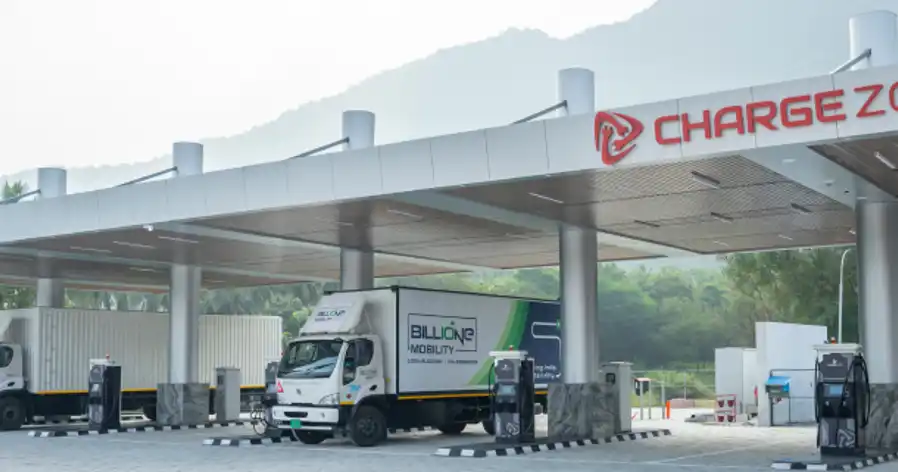
India has 29,277 public charging stations as of November 2025, a substantial increase from just 6,586 in 2023. This fourfold growth is attributed to government efforts through PM E-DRIVE and private investments exceeding Rs 10,000 crore.
The number is real progress. It is also, relative to the task, still modest. The PM E-DRIVE scheme's most transformative component is its push for 72,000 new chargers by FY 2025-26. The plan includes around 22,100 fast chargers for cars, 1,800 charging stations for electric buses, and 48,400 chargers for electric two and three-wheelers, focused on high-demand cities and key highway corridors. Chargers will be strategically placed on 50 national highway corridors and high-footfall public locations such as metro stations, airports, bus depots, and fuel stations.
Under FAME II, charging corridors were established along Delhi-Chandigarh, Delhi-Jaipur-Agra, and the Mumbai-Pune Expressway. More than 2,800 charging stations were sanctioned across urban centres and over 1,500 stations were approved along national highways. Those corridors function as confidence builders — routes where an EV driver can reasonably plan a journey without anxiety. The challenge is scaling that confidence from three corridors to the full national road network.
Tata Motors announced plans to expand its EV charging network to 40,000 chargers by 2027, which would, if delivered, dramatically change the charging landscape beyond what government schemes alone can achieve.
The Supply Chain Reckoning: Batteries, Minerals, and China
India's EV market is growing on top of a supply chain that remains structurally vulnerable. The honest accounting of where India stands on battery manufacturing and critical minerals is both encouraging and sobering.
Pack assembly is well-localised — all major Indian EV manufacturers do their battery pack assembly domestically. But cells are almost entirely imported, primarily from China. India has identified 5.9 million tonnes of lithium reserves in Reasi, Jammu and Kashmir, but the extraction timeline is eight to ten years. Almost 100 percent of refined battery-grade material is currently imported, primarily from China.
This dependency is not unique to India. Most of the world's EV supply chain runs through China, which controls the majority of global lithium processing, cobalt refining, and battery cell manufacturing. But for India, the dependency has a particular strategic edge: the same country that is India's primary competitor in the Asian security environment is also the source of the materials on which India's clean energy transition depends.
Battery recycling capacity stands at approximately 2 GWh against a projected demand of 128 GWh by 2030. Companies including Attero, Lohum, BatX, Tata Chemicals, Gravita, and ACE Green are ramping up capacity, but the gap between current recycling capacity and 2030 demand is large enough to require very significant investment very quickly.
The Honest Gap: Where India Lags
The 8.36 percent EV penetration achieved in 2025 is real progress. It is also well below where India's own policy ambitions say it should be heading, and well below comparable markets at similar income levels.
India's weak showing in passenger EVs is more striking because several emerging markets have moved faster. Southeast Asia's electric car sales share reached nearly 20 percent in 2025, led by Vietnam, Indonesia, and Thailand. Latin America grew by 75 percent, with Brazil and Mexico driving the expansion. Nepal, helped by imports of cheaper Chinese electric cars, has become one of the most successful smaller EV markets. This weakens the argument that India's slow adoption is simply a matter of income. Affordability matters, but poorer or comparable markets have done better where policy support, lower duties, charging access, and consumer incentives worked together.
India's passenger EV market rests on a narrow base — Tata and Mahindra together holding 60 percent of a segment that represents just 7-8 percent of total EV sales. The dominance of two-wheelers and three-wheelers in India's EV numbers is both a genuine strength and a structural constraint. Two-wheelers and three-wheelers are the right segment for a market at India's income level. But the emissions reduction from electrifying a 100cc scooter is smaller than electrifying a car, and the economic transformation from electrifying last-mile delivery is more immediate than the geopolitical transition of reducing oil import dependency.
Where It Is Going: The 2030 Target and What It Requires
India has set an ambitious target to elevate EV sales to 30 percent of private cars, 70 percent of commercial vehicles, 40 percent of buses, and 80 percent of two and three-wheelers by 2030, translating to approximately 80 million EVs on Indian roads.
The India electric vehicle market size was valued at approximately USD 5.22 billion in 2024 and is projected to reach USD 23.52 billion by 2030, growing at a compound annual growth rate of around 28.52 percent.
Hitting those numbers requires solving four problems simultaneously. Battery cell manufacturing needs to scale domestically so India is not perpetually dependent on imports. Charging infrastructure needs to reach not just metros and highways but the tier-2 and tier-3 cities where the majority of India's population — and the majority of India's future EV buyers — live. Vehicle financing needs to evolve so that the upfront cost premium of an EV can be absorbed over its operational life, not paid entirely at point of purchase. And the grid itself needs to decarbonise, because an EV charged on coal-heavy electricity is cleaner than a petrol vehicle but not by as much as the climate math requires.
None of these problems are unsolvable. Each of them is harder than the enthusiasm around India's EV story sometimes acknowledges.
The Larger Stakes: Why This Matters Beyond the Showroom
India imports approximately 85 percent of its crude oil. In 2025-26, with Brent crude averaging well above $100 per barrel for months because of the Hormuz blockade, that dependency cost the Indian economy not just in rupees but in rupee-dollar exchange rate pressure, inflation, current account deficit widening, and constrained monetary policy.
Every electric two-wheeler sold in India is a small but real reduction in that vulnerability. At 1.28 million electric two-wheelers sold in 2025, the aggregate impact on oil import demand is now measurable, not theoretical. At 80 million EVs on Indian roads by 2030 — if that target is met — the strategic energy security implications become transformational.
India's EV story is, at one level, about a market growing from 156,000 units to 2.36 million in five years. At another level, it is about whether a country of 1.4 billion people can build the industrial, infrastructure, and supply chain foundations needed to transition its transportation system in time to matter for its own economy, its own air quality, and its own strategic autonomy.
The direction is unmistakable. The pace is still the question.