
The launch of the all-new Nissan Tekton marks one of the most important product moments in Nissan’s India strategy in years, because it is not just another midsize SUV entering a crowded market, but a carefully positioned global model designed to strengthen Nissan’s presence in India while also serving export markets across the Middle East and Africa. Built in India, developed in partnership with Renault, and shaped around customer insight, the Tekton reflects Nissan’s effort to reassert itself in one of the world’s most competitive SUV segments with a product that feels modern, ambitious, and commercially strategic.
What makes Tekton especially significant is the way it connects design, technology, manufacturing, and business strategy. Nissan is not presenting it as a standalone car; it is presenting it as a symbol of its “One Car, One World” philosophy and a key proof point in its broader resurgence in India.
A World Premiere with Wider Meaning
Nissan unveiled the Tekton at its world premiere in India on 9 July 2026, with introductory pricing starting at ₹10.49 lakh for the T160 range and ₹14.99 lakh for the T280 range. The company positioned the launch as a major milestone in its transformation journey, emphasizing that India is now central not only to Nissan’s domestic ambitions but also to its global product and manufacturing strategy.
That framing matters because it signals a shift in how global automakers view India. Rather than treating the market only as a sales destination, Nissan is increasingly treating India as a development base, a manufacturing hub, and an export platform capable of supplying multiple international markets.
Why Tekton Matters for Nissan
Tekton arrives at a time when Nissan is trying to sharpen its market focus and rebuild momentum through an SUV-led portfolio. The company has described the model as a clear expression of transformation with purpose, combining a more competitive lineup with strategic partnerships and stronger local relevance.
This is important in India because the midsize C-SUV segment is one of the toughest battlegrounds in the market, with customers expecting strong design, premium interiors, advanced infotainment, safety, fuel efficiency, and real-world practicality. In that environment, a brand must offer something more than badge value; it must deliver a convincing product story, and Tekton is Nissan’s answer to that challenge.
Design Inspired by Patrol
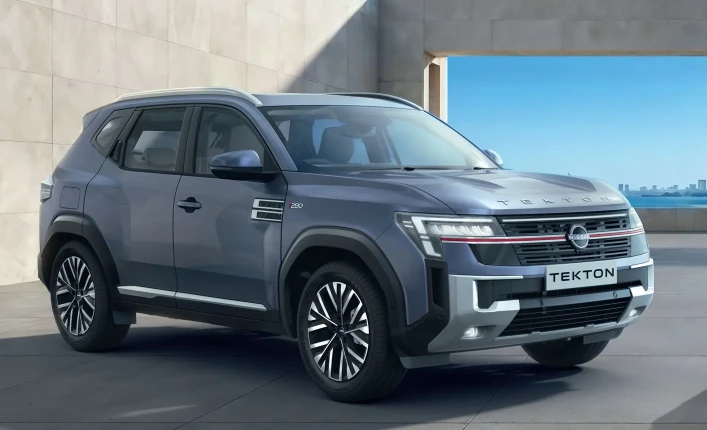
One of Tekton’s biggest talking points is its design language, which draws inspiration from the legendary Nissan Patrol. That influence gives the SUV a more upright, muscular, and premium stance, with bold proportions, a sculpted bonnet, C-shaped lighting signatures, a large grille, and prominent SUV detailing that aims to make the car feel more distinctive on the road.
The design is not just about looking aggressive. It is about creating what Nissan calls an unmistakable presence, one that combines refinement with toughness. Features such as the flush roof rails, chrome grille treatment, signature LED lighting, and strong rear-end styling are intended to give Tekton a premium identity without losing the practicality expected from a family SUV.
Built for Everyday Use
Tekton’s appeal is not limited to styling. Nissan has designed the cabin to feel more premium and more usable, with a tri-tone interior, soft-touch materials, leatherette finishes, and ergonomic controls that place the driver at the center of the experience. The model also offers a panoramic sunroof, ventilated front seats, dual-zone climate control, extensive storage, and a large boot capacity of up to 700 litres, which gives it a strong everyday usability advantage.
That combination is important because Indian SUV buyers often want two things at once: a vehicle that feels aspirational and one that works well for real family life. Tekton is clearly trying to satisfy both, offering enough sophistication to feel premium while remaining practical enough for daily use, highway trips, and urban commuting.
Performance and Powertrain
One of the most notable aspects of the Tekton launch is that Nissan is offering a 100 percent turbocharged engine lineup. The SUV comes with a 1.0-litre turbo petrol and a more powerful 1.3-litre turbo petrol that delivers up to 163 PS and 280 Nm of torque, paired with either a manual gearbox or a six-speed wet clutch DCT depending on the variant.
That powertrain strategy gives Tekton a stronger performance identity than many of its rivals. The 1.3-litre engine in particular is meant to add a more confident, refined, and responsive driving character, while the smaller turbo option helps keep the entry point accessible for buyers who want the SUV’s design and technology without moving into the top end of the range.
Connectivity and Tech
Tekton’s technology package is one of its strongest selling points. The SUV features Google built-in, including Google Maps, Google Assistant, and Google Play, along with a dual-screen digital setup that combines infotainment and driver information in a more intuitive format. Nissan says the system supports more than 200 apps and is designed to make navigation, entertainment, and vehicle interaction smoother and more natural.
This matters because modern SUV buyers increasingly judge a car by how smart it feels in everyday use. Voice commands, live navigation, connected services, and integrated app ecosystems are no longer luxury extras; they are part of the core ownership experience, and Nissan is clearly trying to position Tekton as a tech-forward product rather than just a mechanical one.
Safety as a Core Message
Safety has been emphasized as a central pillar of the Tekton proposition. The SUV features six airbags as standard, a reinforced monocoque body shell with a high proportion of high-strength steel, and a broad suite of advanced driver assistance systems, including Adaptive Cruise Control, Autonomous Emergency Braking, Lane Keep Assist, Blind Spot Warning, Forward Collision Warning, and Driver Attention Alert.
That gives Tekton a more complete safety story than many rivals in its class. In a market where buyers increasingly compare not just convenience but crash protection and driver assistance, Nissan is making it clear that the car is intended to compete on safety as well as styling and performance.
Made in India, Sold to the World
Tekton is manufactured at Nissan’s Chennai plant and developed in partnership with Renault, which reinforces India’s role as a strategic base for both domestic and export markets. Nissan has said that the SUV will be exported to 50 markets across the Middle East and Africa, underlining the company’s confidence that a vehicle developed in India can compete globally. This export role is important for a deeper reason. It shows that India is not just assembling products for local sale, but increasingly shaping vehicles that can travel internationally, strengthening the country’s place in the global automotive value chain.
Pricing and Market Position
The Tekton is priced to sit in the heart of the midsize SUV market, with the base variant starting at ₹10.49 lakh and the top variant going up to ₹18.59 lakh. Nissan has structured the range across multiple trims and engine-transmission combinations, giving it a wide pricing ladder that should help it appeal to different categories of buyers.
That pricing puts Tekton directly into a high-pressure segment, where customers compare features, brand reputation, ride quality, engine performance, and resale expectations very closely. Nissan appears to be betting that Tekton’s combination of turbocharged power, premium design, advanced connectivity, and strong global identity can give it an edge.
What Tekton Says About Nissan’s Future
The broader significance of the Tekton launch is that it signals a more focused and more confident Nissan in India. Instead of spreading itself thin, the company is building around a clearer SUV-first identity, using India both as a customer market and as a manufacturing and export anchor. That is a sensible strategy in a market where product relevance matters more than ever. If Tekton succeeds, it could help Nissan regain visibility, rebuild consideration among Indian buyers, and establish a more durable foundation for future models.
Conclusion
The Nissan Tekton launch is more than the arrival of a new midsize SUV. It is a statement about where Nissan wants to go in India: toward stronger SUV credentials, better product planning, deeper local manufacturing, and a more globally connected role for Indian production.
With Patrol-inspired styling, turbocharged engines, Google built-in technology, strong safety credentials, and export ambitions built into its DNA, Tekton is positioned as a flagship product for Nissan’s next chapter. Whether it succeeds in a fiercely competitive segment will depend on execution, but as a strategic move, it marks one of Nissan’s most meaningful steps forward in years.
Video: Nissan India