


Bhogapuram International Airport: Andhra Pradesh’s New Aviation Gateway
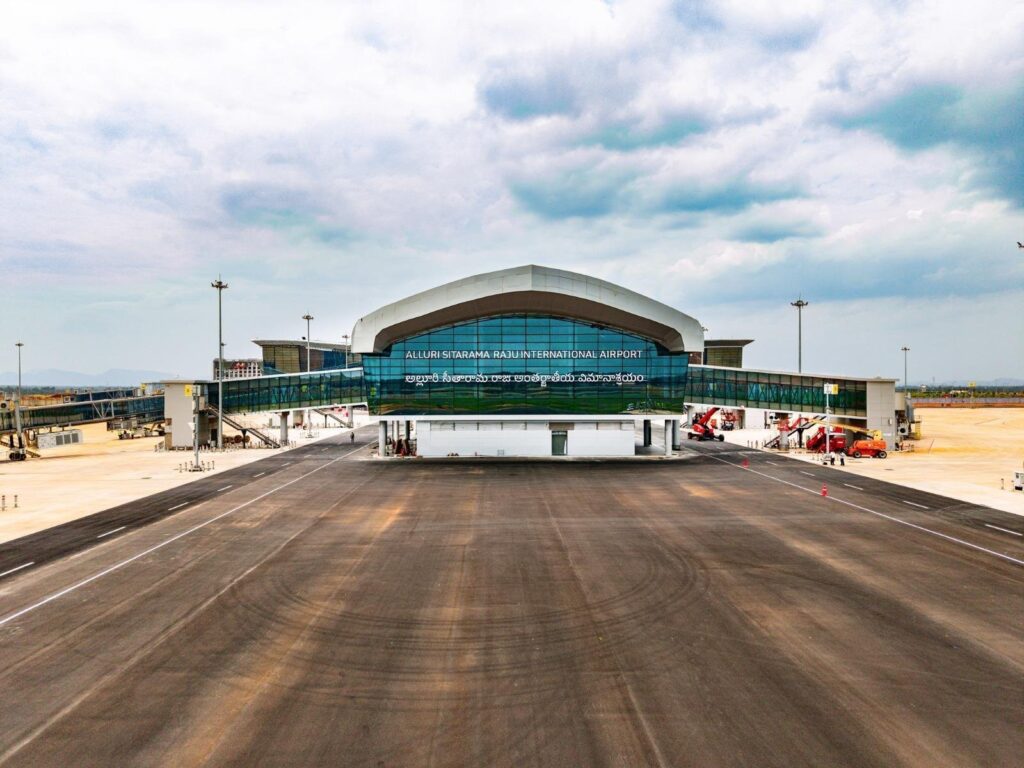
India’s aviation sector has witnessed unprecedented expansion over the past decade, driven by rising passenger traffic, increasing regional connectivity and sustained investment in airport infrastructure. As air travel becomes more accessible and India’s economy continues to grow, several states have undertaken large-scale airport projects to support tourism, trade and industrial development.One of the most significant additions to this network is the Alluri Sitarama Raju International Airport at Bhogapuram, commonly known as Bhogapuram International Airport, in Andhra Pradesh’s Vizianagaram district. Developed as a greenfield international airport, the project is expected to transform air connectivity for North Andhra while serving as a modern alternative to the existing Visakhapatnam Airport, which currently operates as a civil enclave within the Indian Navy’s INS Dega airbase.Designed with modern aviation infrastructure, sustainability features and significant room for future expansion, Bhogapuram Airport is among India’s most ambitious airport development projects. Beyond improving passenger travel, it is expected to become a major catalyst for economic growth, logistics, tourism and industrial investment across the region.Why Bhogapuram Airport Was NeededFor several decades, Visakhapatnam Airport served as the primary aviation hub for North Andhra Pradesh. However, the airport functions as a civil enclave inside INS Dega, limiting its ability to expand operations due to military restrictions.With passenger numbers steadily increasing, the existing airport faced constraints in runway expansion, terminal capacity and future international operations. As Visakhapatnam evolved into one of eastern India’s fastest-growing cities and emerged as an important industrial, maritime and tourism centre, the need for a dedicated greenfield international airport became increasingly evident.Bhogapuram was selected because it offers sufficient land for long-term expansion while providing convenient access to Visakhapatnam, Vizianagaram and Srikakulam districts. The project is intended not only to accommodate future passenger demand but also to support cargo operations, exports and regional economic development.Project OverviewBhogapuram International Airport has been developed under a Public-Private Partnership (PPP) model by GMR Visakhapatnam International Airport Limited (GVIAL), a subsidiary of GMR Airports Limited.The first phase of the project has been developed at an estimated investment of approximately ₹4,700 crore across nearly 2,700 acres. The airport has been designed to handle around six million passengers annually during Phase I, with master plans allowing expansion to accommodate significantly higher passenger traffic in future phases.The airport has also received its Aerodrome Licence from the Directorate General of Civil Aviation (DGCA), confirming its operational readiness ahead of commercial services.Modern Infrastructure and FacilitiesBhogapuram Airport has been planned as a next-generation aviation hub equipped with modern passenger amenities and operational infrastructure.The airport features a 3,800-metre Code-E runway, capable of handling wide-body aircraft such as the Boeing 777, Boeing 787 Dreamliner and Airbus A350. This capability enables the airport to support both domestic and future long-haul international services.The passenger terminal incorporates contemporary architectural design while integrating digital technologies intended to improve passenger movement through self-service check-in systems, baggage handling and security processes.A dedicated cargo terminal has also been developed to strengthen the movement of agricultural products, seafood, pharmaceuticals and industrial goods from Andhra Pradesh to domestic and international markets. Initial cargo handling capacity is estimated at around 20,000 metric tonnes annually, with provisions for future expansion.Sustainability and Passenger ExperienceEnvironmental sustainability has been incorporated into the airport’s planning and construction.The terminal design incorporates energy-efficient systems, natural lighting, rainwater harvesting and environmentally conscious construction practices aimed at reducing operational impact. The airport has also been planned with landscaped public areas and infrastructure capable of supporting future green mobility initiatives.The terminal architecture reflects regional cultural identity while incorporating modern airport design standards expected at international gateways. These features are intended to improve both operational efficiency and passenger comfort.Strengthening ConnectivityOne of Bhogapuram Airport’s primary objectives is to improve connectivity across North Andhra Pradesh.Located approximately 50 kilometres from Visakhapatnam city, the airport is expected to serve not only Visakhapatnam but also neighbouring districts including Vizianagaram and Srikakulam. State authorities have invested substantially in supporting road infrastructure, while dedicated public transport services, including electric buses, have been introduced to improve airport accessibility.Improved connectivity is expected to reduce travel times for residents, facilitate business travel and encourage greater movement of tourists to the region’s beaches, Buddhist heritage sites, hill stations and coastal attractions.Economic Impact on North Andhra PradeshPerhaps the most significant aspect of Bhogapuram Airport is its expected contribution to regional economic development.Large-scale airport projects often become catalysts for wider infrastructure investment, industrial growth and urban expansion. Bhogapuram is expected to attract investments across sectors such as logistics, warehousing, hospitality, information technology, aviation services and manufacturing.The airport is also expected to generate substantial direct and indirect employment during both operational and expansion phases. Businesses dependent on efficient air connectivity—including exporters, logistics providers and multinational companies—are likely to benefit from improved transportation infrastructure.In addition, plans for an aviation ecosystem, including aviation-related educational and industrial facilities near the airport, could further strengthen the region’s long-term economic prospects.Boost to TourismAndhra Pradesh possesses diverse tourism assets, including beaches, temples, Buddhist heritage sites and eco-tourism destinations.Improved international and domestic air connectivity is expected to make these destinations more accessible to visitors from across India and overseas. Visakhapatnam already serves as an important gateway to attractions such as Araku Valley, Borra Caves, Rushikonda Beach, Yarada Beach and the state’s growing cruise tourism sector.The airport is expected to support higher tourist arrivals while encouraging greater investment in hotels, convention centres, restaurants and tourism infrastructure throughout the region.Role in India’s Aviation GrowthBhogapuram Airport reflects India’s broader strategy of expanding aviation infrastructure beyond metropolitan cities.Under national initiatives to strengthen regional connectivity and improve airport capacity, several greenfield airports are being developed across the country. These projects aim to accommodate growing passenger demand while supporting economic development in emerging regions.Bhogapuram is particularly important because it provides Andhra Pradesh with a modern international airport capable of handling future traffic growth without the operational limitations associated with military-controlled facilities. Its development also strengthens aviation infrastructure along India’s eastern coastline, complementing the country’s broader logistics and infrastructure ambitions.Challenges and Future DevelopmentWhile Bhogapuram Airport offers significant long-term potential, its success will depend on continued investment in supporting infrastructure.Efficient road
Skyroot Vikram-1 Launch: India’s Private Space Breakthrough and a New Chapter in Orbital Access
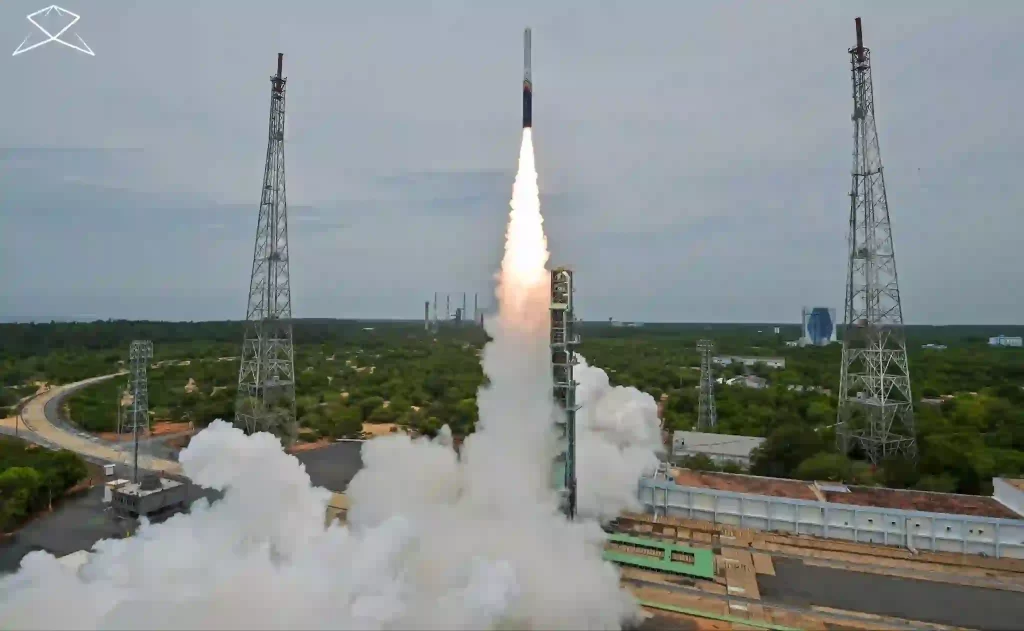
Skyroot Aerospace’s Vikram-1 mission, called Aagaman, is a landmark moment for India’s space story because it demonstrates that a privately built Indian rocket can reach orbit and place payloads successfully into low Earth orbit. For a country that has long been admired for the strength of ISRO, this is an equally important signal of something new: India’s commercial space sector is no longer just preparing for lift-off, it is already there.What makes the launch so significant is not only the technical success, but the symbolism attached to it. Vikram-1 is India’s first private orbital-class rocket, and with its successful flight from Sriharikota, India has entered a small and elite group of nations where private enterprise has independently achieved orbital launch capability.Why Vikram-1 MattersThe space industry often measures progress in very specific terms: payload mass, orbital accuracy, propulsion reliability, turnaround time, and the ability to scale launch services commercially. Vikram-1 matters because it checks several of those boxes at once, proving that an Indian private company can design, build, integrate, and launch a working orbital vehicle from Indian soil.That is a major shift from the older model in which space capability was seen primarily as the domain of the state. Today, Vikram-1 suggests that India’s space future will be shaped not just by ISRO, but by a wider ecosystem of private companies, engineering talent, investors, and customers who want Indian launch capability to be part of the global market.The Launch and Mission ProfileThe rocket lifted off from the Satish Dhawan Space Centre at Sriharikota after a planned pause shifted the launch time from 11:30 am to 12:05 pm. Built by Hyderabad-based Skyroot Aerospace, the mission achieved its intended orbital objective and placed multiple technology demonstration payloads, including postcards from Prime Minister Narendra Modi, into low Earth orbit.Vikram-1 is a three-stage rocket and stands about 22 metres tall, roughly the scale of a seven-storey building. It reportedly delivered customer payloads into an orbit around 450 km above Earth, which is a strong demonstration of practical launch capability rather than a symbolic suborbital test.A Private Rocket With National MeaningIndia has made remarkable progress in space through ISRO’s long record of dependable missions, but the Vikram-1 launch adds a new layer to that success story. It shows that India’s space economy is maturing from a government-led program into a more diversified industrial ecosystem where private players can compete, innovate, and ultimately carry national prestige into commercial markets. That matters because orbital launch is one of the hardest parts of the space business. It requires deep systems engineering, high-reliability propulsion, precision guidance, rigorous testing, and the ability to survive failure during development without losing technical momentum. A successful private orbital launch is therefore not a single achievement; it is proof that a company has built institutional competence at the highest level.The Technology Behind the RocketOne of the most interesting aspects of Skyroot’s approach is its use of modern manufacturing methods, including additive manufacturing, better known as 3D printing. In traditional rocket production, engines are built from many separate parts that must be machined, welded, sealed, and assembled with extreme precision, while 3D printing allows complex components to be built layer by layer, reducing weight, simplifying the structure, and cutting lead time. Skyroot has emphasized this approach before, noting that fully printed components can reduce mass and simplify production. For a startup, that is especially important because launch vehicles are not just engineering artifacts; they are also manufacturing systems, and every improvement in production speed, cost, and consistency improves competitiveness in a market where reliability and economics matter equally.The Commercial Space AngleVikram-1 is also important because it strengthens India’s place in the global commercial launch market. Satellite launches are increasingly driven by demand for small satellites, technology demonstrations, earth observation constellations, and rapid deployment missions, and countries that can offer dependable launch services will have a strategic and economic advantage.India already has strong space credibility through ISRO, but a successful private launcher expands the country’s offering. It suggests that future customers may one day choose India not only for low-cost space hardware or satellite services, but for launch options provided by a competitive domestic private sector. PM Modi’s Response and National SymbolismPrime Minister Narendra Modi praised the mission as a historic new frontier in India’s space journey, framing it as a reflection of the talent, entrepreneurial spirit, and ambition of India’s youth. That kind of response matters because space achievements often become national symbols, and private-sector success at orbit is particularly resonant in a country that sees technology as a key pathway to economic and strategic power. The presence of a postcard from the Prime Minister among the payloads added a distinctive symbolic touch. It turned the mission into something more than a test flight, linking the technical achievement with a broader sense of national participation in the event. What Comes NextThe real test for Vikram-1 begins after the headlines. A successful launch is a milestone, but a repeatable launch service is what turns a demonstration into a business. Skyroot’s challenge now will be to convert this success into a reliable cadence of missions, customer confidence, and operational maturity that can sustain the company over time. If it succeeds, Vikram-1 could become one of the defining vehicles in India’s commercial space era. More importantly, it could help normalize the idea that Indian private companies are not peripheral players in space, but central participants in a new national ecosystem built around launch, innovation, and scale. ConclusionThe Vikram-1 launch is historic because it marks the moment India’s private space sector moved from promise to proof. By placing payloads into orbit with a homegrown private rocket, Skyroot Aerospace has demonstrated that India’s space ambitions are no longer limited to state-led achievement alone.That makes Aagaman feel like more than the name of a mission. It reads like a declaration that a new era has arrived, one in which India’s space story will be written not only by institutions, but by entrepreneurs, engineers, and private companies ready to reach orbit on their own terms.Video: Skyroot Aerospace
PM Modi’s Mann Ki Baat – 135th Episode
PM Modi’s Mann Ki Baat – 135th EpisodeVideo: YT/@PM Modi
The Longest-Serving Indian PM: Narendra Modi Surpasses Nehru’s Record with 4,399 Days
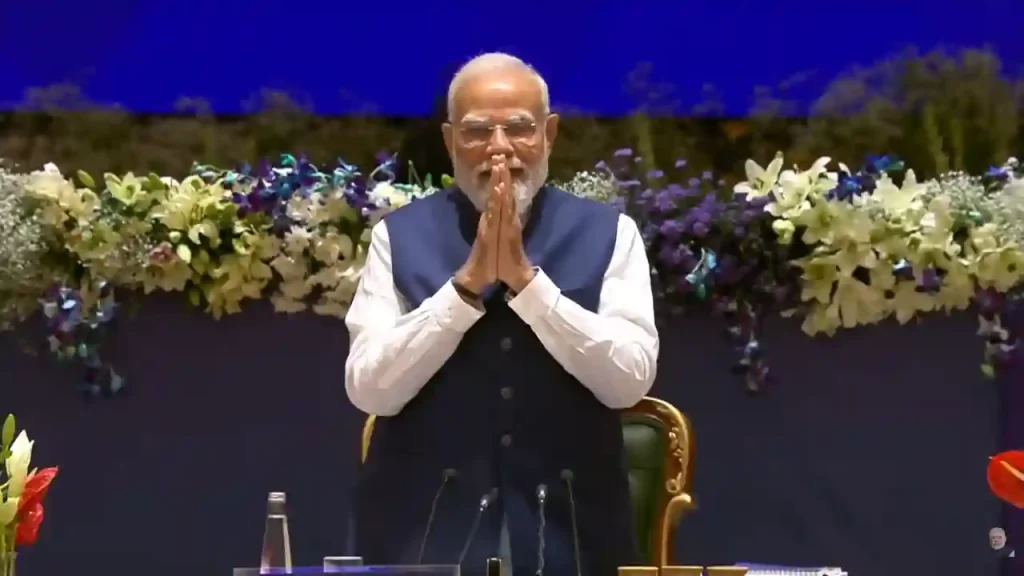
Prime Minister Narendra Modi has officially become India’s longest continuously serving elected Prime Minister, completing 4,399 consecutive days in office on June 10, 2026, surpassing the previous record of 4,398 days held by Jawaharlal Nehru after the country’s first general elections, with the Union Cabinet passing a historic resolution marking this milestone as a symbol of India’s democratic consciousness and public trust. Mr Modi took the oath of office on 26th May 2014 and has surpassed Pandit Jawaharlal Nehru, who first took the oath as an elected Prime Minister on 13th May 1952 and served until 27th May 1964, with Nehru’s tenure amounting to 4,398 days while Modi’s continuous tenure from 26th May 2014 to 10th June 2026 now stands at 4,399 days, making him the longest-serving elected Prime Minister in India’s history.The Historic Milestone: 4,399 Days of Continuous Service Surpassing Nehru’s 1952-1964 RecordThe achievement of Prime Minister Narendra Modi is particularly noteworthy given the scale and complexity of governance in India, a nation of over 1.4 billion people characterized by extraordinary diversity in language, culture, religion, and geography, making sustained leadership across three consecutive national mandates in the world’s largest democracy unprecedented in Indian political history. At a time when many countries have witnessed political churn, frequent changes in government, and policy uncertainty, India has experienced continuity in leadership and governance, reflecting sustained public trust across three consecutive national mandates that demonstrates the unprecedented support bestowed by the people upon a leader guided by the ‘Nation First’ resolve.The Union Cabinet today passed a resolution marking June 10, 2026, as an historic milestone in the journey of Indian democracy, applauding Shri Narendra Modi for becoming the longest-serving elected Prime Minister of the country by establishing a record of 4,399 days of continuous service as an elected PM, surpassing the previous record held by Shri Jawaharlal Nehru, who served for 4,398 continuous days from 1952 to 1964. This occasion stands as a symbol of India’s democratic consciousness, public trust, and the power of public participation, with the resolution extending heartfelt congratulations and best wishes to the Prime Minister while highlighting that this achievement coincides with the NDA government completing 12 years under his leadership.From Humble Beginnings to the Nation’s Highest OfficePrime Minister Modi’s rise from a humble socio-economic background to the highest elected office without the support of a political dynasty is widely seen as an illustration of the opportunities and social mobility offered by India’s democratic system, marking a departure from traditional political patterns where family connections often determined leadership trajectories. Shri Narendra Modi served as the Chief Minister of Gujarat for 14 years and was applauded for the economic growth and setting up advanced infrastructure in the state, among other key developments, before ascending to the nation’s highest office, where he is known for campaigns like Swachh Bharat, Make in India, Digital India, and many more.Amongst his several accolades, he is also famous for being the first Indian to win the Seoul Peace Prize award in 2018, while Independent global surveys have consistently ranked Prime Minister Modi among the world’s most popular democratic leaders, with him also being conferred with the highest civilian honours of more than 30 countries. Harivansh Narayan Singh, Deputy Chairman of the Rajya Sabha, praised PM Modi’s leadership, describing him as a “visionary” who has successfully translated ideas into action, remarking to ANI that “since independence, he is perhaps the first politician and a visionary who didn’t just dream but actually implemented those dreams, bringing them to reality on the ground”.Poverty Eradication and Inclusive Development:During Prime Minister Modi’s tenure, nearly 250 million Indians moved out of multidimensional poverty, with the resolution acknowledging that the welfare of the poor has been placed at the center of governance, detailing an unprecedented scale of amenities delivered including pucca houses, electricity, clean water, and direct benefit transfers, alongside free rations for over 80 crore citizens and free medical treatment for over 60 crore poor individuals. These efforts collectively boosted national self-confidence and enabled over 25 crore people to defeat poverty, expressing gratitude for the policies that have enabled more than 25 crore poor people in India to defeat poverty under his leadership.The resolution maps the empowerment of key demographics, recognizing the focus on youth power that propelled India into becoming the world’s third-largest startup ecosystem and a scientific power through Mission Chandrayaan, while a new chapter of ‘Women-Led Development’ is detailed through comprehensive policies ranging from smoke-free kitchens and the Lakhpati Didi campaign to the historic 33 percent reservation for women in legislative bodies. Affirming farmers as a core pillar of a ‘Viksit Bharat’, the text applauds initiatives like PM Kisan Samman Nidhi and the provision of Kisan Credit Cards to pastoralists and fishermen, which have helped propel agricultural exports past the Rs 5 lakh crore mark, appreciating his efforts directed towards inclusive growth and social justice.Digital Infrastructure and Economic TransformationDuring this period, India has strengthened its position as the world’s fastest-growing major economy, concluded major trade agreements with leading economies, and emerged as a more influential voice on global issues, including development, technology, climate action, and the priorities of the Global South, with people seeing rapid expansion of digital public infrastructure, large-scale infrastructure development, improvements in welfare delivery, and broad-based socio-economic progress. The resolution attributes the advancement of India’s manufacturing capabilities in sectors from defense to AI to the momentum gained by the ‘Make in India’ and ‘Aatmanirbhar Bharat’ campaigns, underlining that political stability, dynamic governance, and far-sighted policies of the last 12 years have transformed India into the world’s fastest-growing large economy.Union Minister Sukanta Majumdar also celebrated PM Modi’s historic milestone, emphasizing its significance in Indian political history, saying “There is a special day in the political history of India. Prime Minister Narendra Modi has set the record for the longest tenure as India’s Prime Minister.” Singh highlighted key policy initiatives under Modi’s tenure, including the introduction of a 33 per cent reservation for women in the Lok Sabha and State Legislative Assemblies, the implementation of
Government Approves E85 and E100 Fuels: India Opens the Door to a New Ethanol-Driven Mobility Era
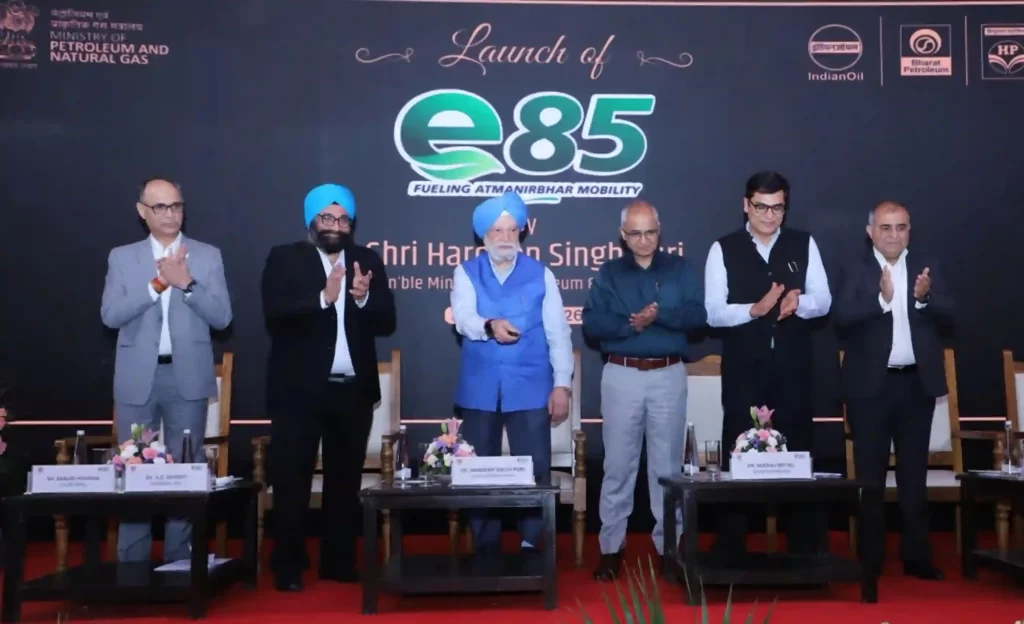
India has taken a significant step toward cleaner and more diversified transport energy by clearing the regulatory framework for E100 fuel, while E85 has already begun appearing in the market in limited form. The move is important not only because it gives legal backing to ethanol-only vehicles, but because it signals that India’s fuel strategy is no longer just about blending ethanol into petrol, it is now about creating a parallel mobility ecosystem around biofuels.The announcement by Union Road Transport and Highways Minister Nitin Gadkari, made at the Sugar, Ethanol & Bio-Energy India Conference in Nagpur, marks a turning point for automakers, fuel retailers, and policy makers alike. Gadkari said he signed the file authorising the use of 100 percent ethanol at 8 pm, giving manufacturers the regulatory certainty they need to invest in flex-fuel platforms and ethanol-compatible powertrains. What E85 and E100 MeanE85 is a high-ethanol fuel blend that contains roughly 85 percent ethanol and a smaller share of petrol or additives, while E100 refers to fuel that is essentially pure ethanol for transport use, though in practice it usually includes a small amount of petrol and additives to support cold starts and handling. These fuels are very different from India’s current E20 programme, which uses 20 percent ethanol blended with petrol.That distinction matters because E20 can be used in vehicles designed or calibrated for it, while E100 requires much more specialised hardware, fuel-system materials, and engine tuning. In other words, this is not a simple switch at the pump; it is a structural shift in how vehicles are designed, tested, and supplied.Why the Approval MattersThe biggest significance of the E100 approval is that it gives the market a legal framework for ethanol-only mobility, something India has been inching toward for years through its broader ethanol-blending push. By creating a formal pathway for E100, the government has effectively opened another route for low-carbon transport alongside electric, CNG, hybrid, and hydrogen technologies. It also sends a strong signal to manufacturers. When policy becomes clearer, investment typically follows, and that is especially true in the auto sector, where new engine families and fuel systems cannot be developed without regulatory certainty. Gadkari said that flex-fuel vehicles are already entering the market, citing Maruti Suzuki’s WagonR flex-fuel model and Hero’s ethanol-compatible motorcycles, with Toyota and Hyundai expected to launch E100-capable vehicles soon. The Technology Behind Flex-Fuel VehiclesFlex-fuel vehicles are built to run on multiple fuel mixes, often ranging from petrol-heavy blends to high-ethanol fuels. To do that safely and efficiently, they need specific changes in engine calibration, corrosion-resistant fuel-system components, and software that can manage combustion differently depending on the blend.This is especially important because ethanol behaves differently from petrol. It absorbs moisture more readily, can be more corrosive to certain materials, and contains less energy per litre than petrol, which means fuel consumption tends to rise when vehicles run on higher ethanol blends. That is one reason E100-compatible vehicles cannot simply be older petrol cars with a software update. Why India Is Pushing EthanolIndia’s ethanol strategy is not just about cleaner tailpipes; it is also about energy security and rural economics. The country imports more than 85 percent of its crude requirement, so every litre of domestic biofuel that replaces imported petrol or diesel helps reduce exposure to volatile global oil prices and improves the trade balance. At the same time, ethanol creates a stronger market for agricultural feedstocks such as sugarcane and maize. Gadkari described the sugar and bio-energy sector as the backbone of rural development, arguing that higher ethanol production can support farm incomes, stimulate bio-refinery investment, and create more value in the countryside rather than only in refineries and fuel-import channels. What Still Needs to HappenFor E100 to move from regulation to widespread use, India will need more than a policy announcement. Oil marketing companies will have to build dedicated E100 dispensing infrastructure, and storage and transportation systems may need upgrades because ethanol’s moisture sensitivity and handling requirements differ from conventional petrol.There is also a vehicle-readiness challenge. Existing E20-compatible vehicles cannot simply be switched to E100, and consumers will need clear guidance on which cars and two-wheelers are certified for which fuel. Emission certification, homologation standards, and warranty frameworks will also need to align before E100 can become a normal part of the retail fuel network. Market Impact for AutomakersFor automakers, the E100 framework creates a new option at a time when the industry is already balancing electrification, hybridisation, CNG, and conventional ICE innovation. That matters because not every market or customer will move to EVs at the same pace, and ethanol-based mobility gives manufacturers an additional decarbonisation path that can be localised more quickly than imported technology chains.It may also accelerate component localisation. If India builds a strong ethanol vehicle ecosystem, suppliers of fuel injectors, seals, sensors, elastomers, and engine control systems could all develop new product lines around alcohol-compatible mobility. In practical terms, that means E100 could become not just a fuel story but a manufacturing story as well.The Consumer QuestionFor consumers, the immediate question is simple: will E100 be cheaper to run? The answer is not straightforward. Ethanol is usually domestically produced and can help reduce dependency on imported fuel, but because it has lower energy density than petrol, a vehicle typically consumes more of it to travel the same distance.So while the policy may improve energy security and support farmers, ownership economics will depend on the final pump price, vehicle efficiency, and how widely the fuel is available. In the short term, the appeal of E100 is likely to be strongest for fleet operators, fuel-conscious early adopters, and buyers who want to support alternative-fuel mobility without moving fully to electric.ConclusionIndia’s approval of the E100 regulatory framework is a major policy shift because it moves ethanol from being only a blending ingredient to being a standalone transport fuel with its own future in the mobility market. Combined with the rollout of E85 in limited markets and the growth of flex-fuel vehicles, the decision shows that the government wants ethanol to play a
India’s First Semi-High-Speed Rail Corridor: The Ahmedabad–Dholera Project Set to Transform Gujarat
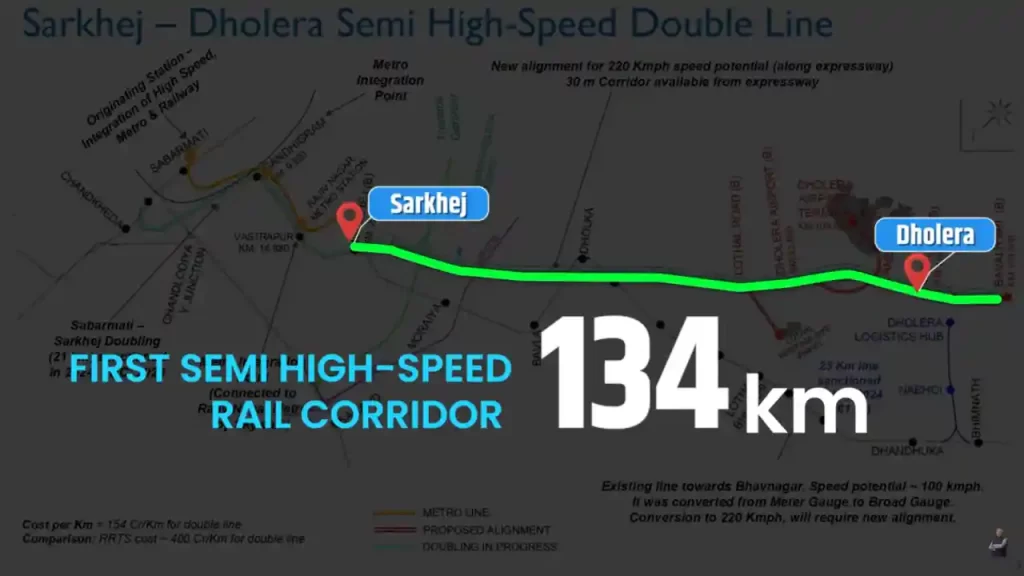
In a landmark decision that marks a new chapter in India’s railway modernization, the Cabinet Committee on Economic Affairs (CCEA), chaired by Prime Minister Narendra Modi, approved the ₹20,667 crore Ahmedabad (Sarkhej)–Dholera Semi High-Speed Double Line Rail Project on May 13, 2026. This 134-kilometer corridor will be Indian Railways’ first semi-high-speed rail project developed entirely with indigenously engineered technology, embodying the nation’s “Aatmanirbhar Bharat” vision while setting a reference model for phased semi-high-speed rail expansion across the country. By slashing travel time between Ahmedabad and Dholera to under an hour, potentially as fast as 34 minutes from Sarkhej to Dholera and 48 minutes from Sabarmati to Dholera, the corridor will enable comfortable daily commuting, same-day business trips, and seamless connectivity to Dholera Special Investment Region (SIR), the upcoming Dholera International Airport, and the Lothal National Maritime Heritage Complex.The project, implemented under the PM Gati Shakti National Master Plan, emphasizes multi-modal connectivity and logistical efficiency through integrated planning and stakeholder consultations. It will expand Indian Railways’ network by approximately 134 km, enhance mobility for around 284 villages with a combined population of 5 lakh people, and support both passenger and freight movement. Officials projecting completion by 2030–31 highlight that trains will operate at speeds up to 200 kmph, with the line designed for 220 kmph, making it a pioneering initiative that will accelerate industrial growth, strengthen Dholera’s position as a smart city and investment hub, and significantly boost employment and regional development under the government’s vision for a New India.Indigenous Technology and the Aatmanirbhar Bharat VisionThis historic corridor is planned with indigenously developed technology, reflecting the government’s strategic push toward “Aatmanirbhar Bharat” and reducing dependence on foreign systems for critical infrastructure. By relying on domestic engineering expertise, the project showcases India’s capability to design and deploy semi-high-speed rail systems without external dependency, setting a benchmark for future railway expansions. The Railways Ministry stated that this initiative will act as a pioneer model for phased semi-high-speed rail expansion across the country, demonstrating how indigenous innovation can drive large-scale infrastructure development while maintaining cost efficiency and technological sovereignty.The emphasis on indigenous technology also aligns with Prime Minister Modi’s vision of making people in the region “Atmanirbhar” through comprehensive development that enhances employment and self-employment opportunities. By integrating local engineering firms, manufacturing units, and research institutions into the project’s execution, the corridor will foster a domestic ecosystem capable of delivering next-generation rail infrastructure, transferring skills, and creating high-value jobs in Gujarat and beyond.Transforming Connectivity: Ahmedabad, Dholera SIR, Airport, and LothalThe corridor will provide seamless connectivity to Ahmedabad, the Dholera Special Investment Region (SIR), the upcoming Dholera International Airport, and the Lothal National Maritime Heritage Complex (NHMC), creating a multi-modal transport network that integrates rail, air, and maritime infrastructure. Dholera SIR, being developed as a major industrial and manufacturing hub, will gain direct access to Ahmedabad’s urban and economic infrastructure, enabling businesses to locate operations in Dholera while maintaining easy access to Ahmedabad’s markets, logistics networks, and skilled workforce. The upcoming Dholera Airport will further enhance connectivity, positioning the region as a hub for aviation, trade, and tourism, while the Lothal National Maritime Heritage Complex will benefit from improved rail access, promoting cultural tourism and heritage preservation.Connecting Ahmedabad with Dholera will drastically cut passenger travel time, enabling comfortable daily commuting and same-day return trips. This semi-high-speed railway will not only bring two cities closer but also connect people living hundreds of kilometres away, fostering greater social and economic integration across the region. Government estimates suggest the project will improve mobility for nearly 284 villages with a combined population of around 5 lakh people, boosting employment opportunities, enabling access to education and healthcare, and strengthening regional development under the PM Gati Shakti National Master Plan.Industrial Growth, Logistics Efficiency, and Economic ImpactThe corridor is expected to support both passenger and freight movement, improving access to Dholera SIR and enhancing logistics efficiency for industries operating in the region. By providing faster and more reliable rail transport, the project will reduce logistics costs, minimize dependency on road transport, and enable manufacturers to move goods more efficiently between Ahmedabad, Dholera, and other industrial hubs. This will accelerate industrial growth, attract investment to Dholera SIR, and strengthen the region’s position as a leading smart city and investment destination, contributing to Gujarat’s and India’s broader economic development goals.The project is aligned with Prime Minister Modi’s vision of a New India, which emphasizes comprehensive development that enhances employment and self-employment opportunities. By improving connectivity to 284 villages and enabling easier access to urban markets, education, and healthcare, the corridor will empower rural communities, create new economic opportunities, and support the government’s goal of inclusive growth. The semi-high-speed rail project will also facilitate the movement of people, goods, and services seamlessly, integrating regional economies and fostering greater economic integration across Gujarat.Environmental Sustainability and Climate GoalsAs an environment-friendly and energy-efficient mode of transportation, the rail corridor will contribute significantly to India’s climate goals by reducing oil consumption and lowering carbon emissions. Official projections estimate the project will reduce oil imports by 0.48 crore litres and lower CO₂ emissions by 2 crore kg, equivalent to planting 10 lakh trees, demonstrating its potential to mitigate environmental impact while supporting sustainable development. By encouraging rail-based travel and logistics instead of road transport, the corridor will reduce greenhouse gas emissions, lower air pollution, and promote cleaner, greener transportation aligned with India’s long-term climate commitments.The environmental benefits extend beyond emission reductions. The project will minimize land degradation and habitat disruption associated with road expansion, reduce noise pollution in urban and rural areas, and promote sustainable urban planning by integrating rail infrastructure with smart city development in Dholera. This aligns with the PM Gati Shakti National Master Plan’s focus on enhancing multi-modal connectivity and logistical efficiency through integrated planning, ensuring that infrastructure development balances economic growth with environmental sustainability.Project Timeline, Speed, and Operational HighlightsThe 134-km broad-gauge semi-high-speed rail corridor is targeted for completion by 2030–31, with trains expected to operate at speeds up to 200 kmph, while the line is
PM Modi’s Mann Ki Baat: Episode – 134th
PM Modi’s Mann Ki Baat: Episode – 134thVideo: YT/NaMo
PM Modi at Art of Living’s 45th Anniversary: Service, Spirituality, and the Path to Viksit Bharat
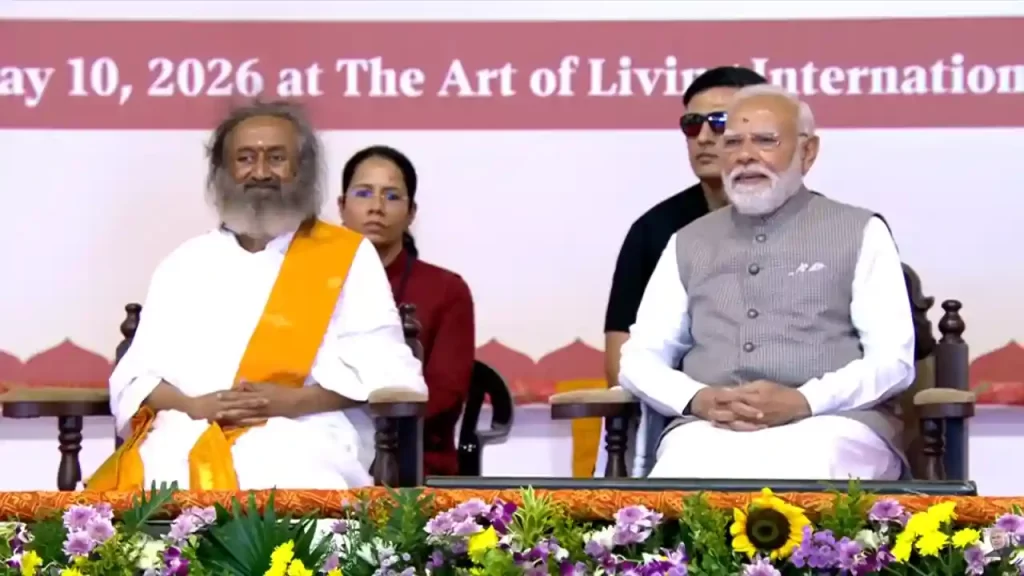
Prime Minister Narendra Modi participated in the 45th Anniversary Celebrations of The Art of Living Foundation in Bengaluru on May 10, 2026, simultaneously marking the 70th birthday of founder Gurudev Sri Sri Ravi Shankar. The Prime Minister inaugurated the newly constructed Dhyan Mandir, a grand Meditation Temple, at the Art of Living International Centre, describing it as a sanctuary of peace and healing for future generations. As Vedic mantras chanted by children filled the atmosphere alongside the darshan of Lord Ganesha, the event showcased Bengaluru’s unique dual identity: a city known worldwide for software and services that has also taken India’s cultural identity, spirituality, and spiritual consciousness to new heights.Reflecting on the auspicious occasion, Modi described these moments as unforgettable: the convergence of Vedic welcome, sacred darshan, Sri Sri Ravi Shankar’s 70th year, and Art of Living’s 45th anniversary. “When resolve is clear and work is done with the spirit of service, then every effort yields pleasant results,” the Prime Minister asserted during the Meditation Temple inauguration. Tracing yoga, meditation, and pranayama as integral parts of India’s values, he noted how people across the world are influenced by India’s spiritual heritage, with many institutions drawing inspiration from these ancient values.Seva Paramo Dharma: Service as India’s Unifying ForcePrime Minister Modi recalled how Sri Sri Ravi Shankar sowed the seed of Art of Living 45 years ago, which has now grown into a huge banyan tree whose thousands of branches touch countless lives globally. Highlighting India’s diversity in languages, traditions, and customs, he posed what binds these together: “The answer is living not for oneself but for others.” Quoting ancient Purana wisdom, Modi emphasized that serving others is a virtue while causing pain is a sin. “Seva Paramo Dharma is the natural character of our society,” he affirmed, recognizing how Art of Living’s volunteer network has consistently channeled society’s strength through tree-planting campaigns, rural smart village centers, women’s and tribal empowerment, and mental health programs for incarcerated individuals. Gurudev Sri Sri Ravi Shankar reflected on the foundation’s journey, stating, “The sign of a healthy society is to see a smile on every face. That is the goal we have been working toward for 45 years.” He recalled the organization’s inclusive foundations, noting former Chief Justices Justice P.N. Bhagwati and Justice V.R. Krishna Iyer among its first trustees.Society’s Power Beyond Politics: The Swachh Bharat ModelStressing that societal engagement is essential for mission success, Modi emphasized that awakening social strength is fundamental to achieving important goals. “No government can succeed unless society itself actively participates in nation-building,” he said, citing Swachh Bharat as exemplary. “Our Swachh Bharat Abhiyan is not just a government programme, but it has become a natural part of people’s lives; now, it is advancing driven by the strength of society,” Modi observed, demonstrating how the sanitation mission transformed from a government programme into a grassroots movement.Viksit Bharat Through Mentally Peaceful, Socially Responsible YouthCommending youth empowerment, Modi emphasized its urgency given rapid global transformations driven by scientific advancement. He observed that India is not merely participating but leading in digital payments, infrastructure, startups, and space technology. “India is not just participating in this change; it is also leading in many areas,” he asserted. Acknowledging technology’s power to connect distant individuals, Modi stressed the parallel necessity of strengthening people’s ability to connect with themselves. “A Viksit Bharat will be built through such youth, mentally peaceful, socially responsible, and sensitive toward society,” he asserted, connecting spiritual practices to national development.The realization of Viksit Bharat will only be possible through youth who are mentally calm, socially responsible, and sensitive towards society, Modi emphasized, linking yoga, meditation, and pranayama to national progress.Natural Farming and Mission LiFE: Art of Living ExtendedModi urged Art of Living to connect farmers with natural farming practices, framing sustainable agriculture as an expression of the philosophy. “Adopting natural farming and saving Mother Earth from chemicals, this too is the Art of Living,” he affirmed. He encouraged expanding the “Ek Ped Maa Ke Naam” campaign, improving water management through “Per Drop, More Crop,” and promoting electricity conservation, elimination of single-use plastics, and locally produced goods under Mission LiFE. “Protecting the environment is also Art of Living,” and “Saving every drop of water is also Art of Living,” he stated, connecting environmental stewardship to spiritual practice.Conclusion: A Collective Journey to Developed IndiaThe 45th anniversary, coinciding with Sri Sri Ravi Shankar’s 70th birthday, reaffirms India’s wisdom that Seva Paramo Dharma, service is supreme duty, and that Viksit Bharat will be built by mentally peaceful, socially responsible youth. As Art of Living’s thousands of branches touch lives globally, its journey from seed to banyan tree exemplifies how spiritual movements create sustainable transformation through service. In Bengaluru, where software meets spirituality, Modi’s participation sent a powerful message about comprehensive development encompassing material progress and inner well-being. As India moves toward Viksit Bharat 2047, Art of Living offers a model for how spiritual institutions contribute through service, environmental stewardship, youth empowerment, and cultivating responsible citizens, building a happier, healthier, peaceful society.
Somnath Amrit Parv 2026: Decades of Faith, Resilience, and Civilizational Renaissance
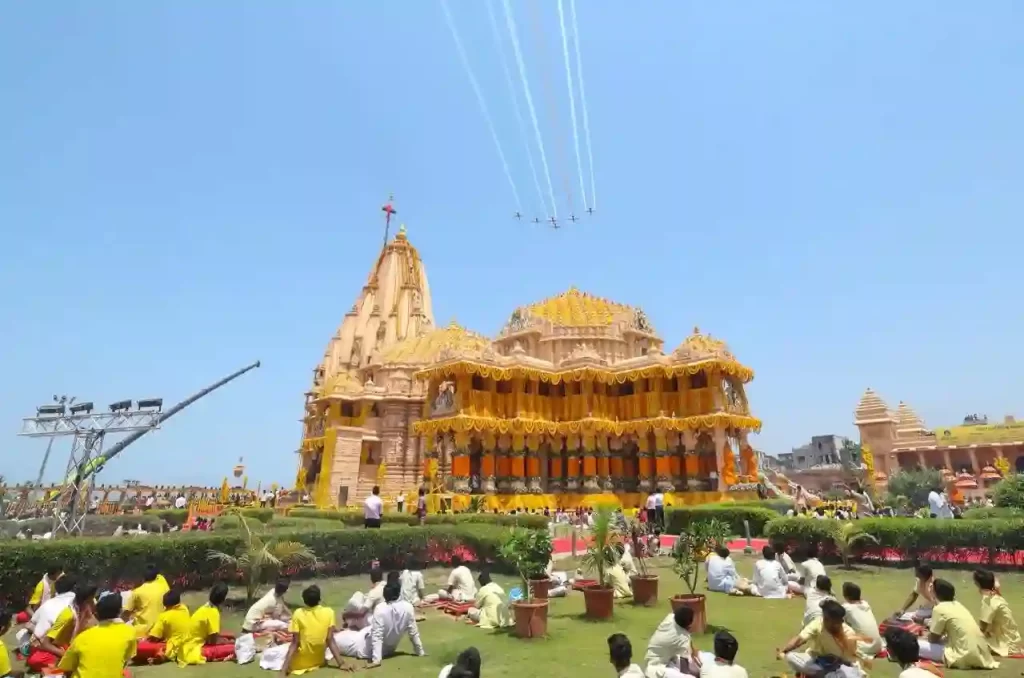
The sacred shores of Prabhas Patan near Veraval in Gujarat are resonating with an unprecedented surge of devotion as the ‘Somnath Amritparv-2026’ officially commenced, marking the 75th anniversary of the reconstruction of the Somnath Mahadev Temple, the foremost among the twelve Jyotirlingas and widely revered as the “Eternal Shrine” of Hinduism. The five-day celebration has transformed the temple precincts into a vibrant hub of Vedic chants, divine energy, and spiritual fervor, attracting devotees from across the nation who have journeyed to witness this historic milestone in India’s civilizational journey. As nearly 1.25 lakh oblations are being offered into the holy fire during the three-day Homatmak Maharudra Yagya, the sacred ritual seeks global peace and the well-being of humanity amidst current international conflicts, embodying the temple’s timeless message of universal harmony and resilience in the face of adversity.The festivities, which kicked off with the Pathatmak Atirudra ritual, will culminate on May 11th with a grand ‘Kumbhabhishek’ at the temple spire, a historic ceremony never before performed on the reconstructed shrine’s spire, using sacred water from 11 revered pilgrimage sites across India, creating a unique spiritual convergence that symbolizes the unity of India’s diverse sacred geography. Currently, the temple is adorned with magnificent decorations, and a steady stream of pilgrims from various states is arriving to seek the blessings of Lord Somnath during this momentous occasion, with Prime Minister Narendra Modi scheduled to attend the Somnath Amrit Parv 2026 celebrations to lead the festivities, highlighting the temple’s enduring legacy of resilience, faith, and national pride.The Eternal Shrine: Six Destructions and Six Rebirths Across MillenniumsThe Somnath Temple’s journey through history is nothing short of extraordinary, earning it the epithet “Eternal Shrine” due to its repeated destruction and reconstruction over centuries, reinforcing its symbolic resilience as a testament to India’s unbreakable spiritual spirit. References in the Shiva Purana and ancient inscriptions suggest worship at this site since antiquity, with multiple pre-medieval reconstructions establishing the temple’s sacred importance long before recorded history began. The temple’s location at Prabhas Patan, near Veraval in Gujarat’s Gir Somnath district, holds immense mythological significance as the place where Lord Shiva is believed to have returned after marrying Sati, and where the moon god Chandra is said to have performed penance to cure his waning affliction.The most cited historical rupture occurred in 1026 CE when Mahmud of Ghazni, the Turkic ruler of the Ghaznavid dynasty, attacked and plundered the Somnath temple during the reign of King Bhima I of the Solanki dynasty, breaking its jyotirlinga and carrying away immense wealth. This invasion marked the beginning of a tragic cycle of destruction and reconstruction that would repeat six times over the centuries. The temple was soon rebuilt around 1050 AD, with an inscription mentioning Siyaka II performing a Swarna Tula ceremony in 1045 AD, demonstrating the immediate devotion of Hindu rulers to restore the sacred shrine. King Kumarapala of the Solanki dynasty (r. 1143–1172) rebuilt the Somnath temple in “excellent stone and studded it with jewels,” according to an inscription in 1169, replacing a decaying wooden temple with a magnificent stone structure that became renowned for its architectural splendor.Post-Independence Revival: Sardar Patel’s Vision and the Temple’s RenaissanceThe modern reconstruction of Somnath Temple represents one of the most significant civilizational projects of independent India, initiated by Vallabhbhai Patel, the Iron Man of India and Deputy Prime Minister, who viewed reconstruction as a sacred civilizational duty to restore the nation’s spiritual dignity after centuries of foreign domination. On November 12, 1947, just months after India’s independence, Sardar Patel came to Junagadh and ordered the reconstruction of the Somnath temple, recognizing that restoring this sacred shrine would symbolize India’s reclaiming of its cultural and religious identity after centuries of Islamic invasions and temple destructions. Accordingly, the Somnath Trust was established to collect funds and oversee the construction of the temple, demonstrating the democratic and participatory nature of the reconstruction effort that drew contributions from ordinary Indians across the country.The new structure was built by the traditional Somapuri builders of temples in Gujarat, the same family of architects who had constructed the temple centuries earlier, ensuring that traditional architectural methods and techniques were employed rather than modern construction approaches. Architect Prabhashankar Sompura led the reconstruction effort, using traditional methods and incorporating the architectural brilliance of medieval Somnath while adapting to contemporary requirements. The temple’s shikhar (spire) was constructed using traditional techniques, with the main structure built in the Chalukya style of temple architecture that characterized medieval Gujarat temple building. On May 11, 1951, Dr. Rajendra Prasad, the first President of India, performed the installation ceremony for the temple, inaugurating the reconstructed shrine despite political differences between Prasad and Patel, demonstrating the temple’s ability to transcend political divisions and unite Indians in shared devotional purpose.Today, the temple is managed by the Somnath Trust, chaired by the Prime Minister of India, institutionalizing the central government’s ongoing commitment to the temple’s maintenance and development while ensuring that the Trust remains accountable to the highest office in the land. This unique arrangement reflects the temple’s national significance as a symbol of India’s civilizational resilience and the government’s role in protecting and promoting Hindu religious heritage. The 75 years since 1951 represent not merely the passage of time but a complete transformation of Somnath from a ruined shrine to one of India’s most visited and revered pilgrimage destinations, with millions of devotees visiting annually and the temple becoming a major economic driver for the Gir Somnath district.Somnath Amritparv-2026: Five Days of Vedic Splendor and Divine RitualsThe ‘Somnath Amritparv-2026’ officially commenced yesterday, transforming the temple precincts into a hub of Vedic chants and divine energy that has attracted devotees from across the nation who have journeyed to witness this historic milestone in the temple’s journey. The sacred shores of Somnath are resonating with devotion as the Somnath Amritparv kicks off with the Pathatmak Atirudra, a profound Vedic ritual that invokes the blessings of Lord Shiva through the chanting of sacred mantras and the performance of elaborate ceremonies that have been preserved for
Noida International Airport Officially Opens: Commercial Flights Begin June 15, Marking New Era for Viksit UP and Viksit Bharat
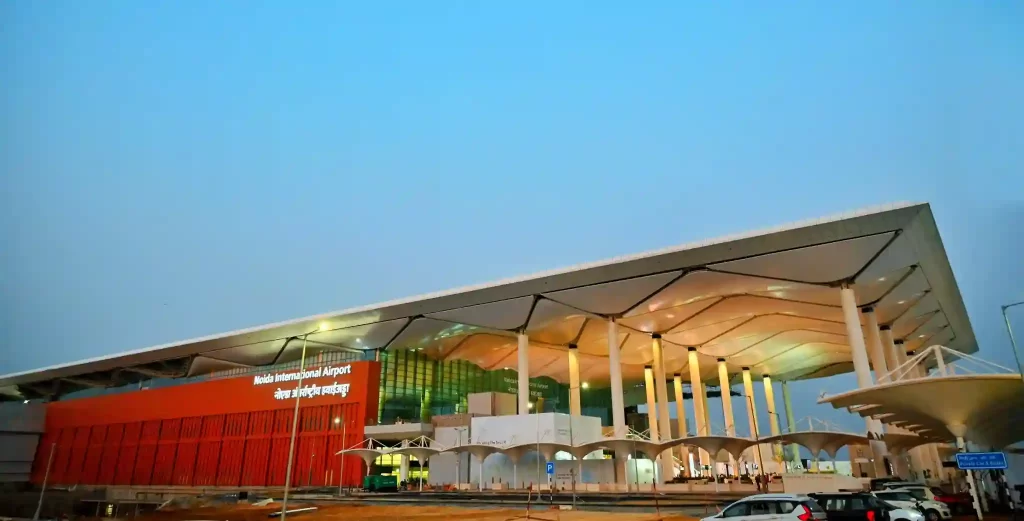
Noida, May 27, 2026 — Prime Minister Narendra Modi officially inaugurated Phase I of the Noida International Airport at Jewar in Gautam Buddha Nagar district of Uttar Pradesh on March 28, 2026, marking a transformative moment for India’s aviation sector and northern India’s connectivity. Noida International Airport at Jewar has officially opened for commercial operations, with flights scheduled to commence from June 15, 2026, marking a transformative moment for India’s aviation sector and northern India’s connectivity. Prime Minister Narendra Modi inaugurated the first phase of the airport earlier this month at Jewar in Gautam Buddha Nagar district of Uttar Pradesh, and the facility has now received final security clearance from the Bureau of Civil Aviation Security. The Prime Minister also laid the foundation stone for 40 acres of Maintenance, Repair, and Overhaul (MRO) facilities at the site during the inauguration ceremony. Speaking on the occasion, Modi declared this a new chapter for the Viksit UP and Viksit Bharat campaign, emphasizing that Uttar Pradesh has now emerged as one of the states with the highest number of international airports in India.Noida International Airport stands among the largest greenfield airport projects in the country, with Phase I developed at a total investment of approximately ₹11,200 crore under a Public-Private Partnership model. The airport will initially handle 12 million passengers per annum, with scalability up to 70 million passengers annually upon full development. Commercial flight operations officially begin June 15, following receipt of approval for its Aerodrome Security Programme from the Bureau of Civil Aviation Security, which certified that the airport’s security framework meets regulatory requirements for commercial operations. IndiGo will operate the first flight from NIA, marking the start of scheduled passenger services, followed shortly by Akasa Air and Air India Express.From Vision to Reality: A 23-Year Journey to CompletionThe airport project was first approved in 2003 during the tenure of former Prime Minister Atal Bihari Vajpayee, making this operational launch the culmination of a 23-year vision. Prime Minister Modi recalled that as soon as the current government was formed, the foundation was laid, construction happened, and now it has started operations. He expressed feeling doubly proud, first for having laid the foundation stone of this airport and now seeing it operational, and second because the name of this grand airport is linked to Uttar Pradesh, the state that chose him as its representative and made him a Member of Parliament.The airport will benefit numerous districts across western UP, including Agra, Mathura, Aligarh, Ghaziabad, Meerut, Etawah, Bulandshahr, and Faridabad, bringing new opportunities for farmers, small and medium enterprises, and the youth of the region. The site is positioned near freight corridors and logistics networks, supporting the movement of goods by air and rail. The area around Dadri, where freight routes converge, has been identified as a key logistics point for northern India. Prime Minister Modi pointed out that this area is becoming the hub of two major freight corridors with special railway tracks laid for goods trains, enhancing North India’s connectivity with the seas of Bengal and Gujarat.Economic Impact Connecting Western UP to Global MarketsPrime Minister Modi emphasized that airports are not just basic facilities in any country but give wings to progress. Due to the expansion of connectivity in the region, agricultural products of western UP will reach the global market in a much better way. The airport will bring numerous new opportunities for farmers, small and medium industries, and the youth of western Uttar Pradesh, with aircraft flying from here to the world, and the airport becoming a symbol of a developed Uttar Pradesh taking flight.The expansion of modern connectivity will further boost food processing prospects in western UP. Prime Minister Modi expressed gratitude to the farmers who gave up their lands to make this project a reality, noting that agriculture and farming hold great importance in the region’s economy. He highlighted that today, Noida is ready to welcome the entire world, and this whole area is strengthening the resolve of Aatmanirbhar Bharat. This multi-modal connectivity is making UP a major attraction for investors worldwide, as whatever farmers grow and industries produce here can now reach every corner of the world swiftly by land and by air.MRO Facility Lays Foundation for Aviation Self-RelianceAddressing a critical gap in India’s aviation ecosystem, Prime Minister Modi drew attention to the Maintenance, Repair, and Overhaul sector, noting that 85 percent of Indian aircraft still have to go abroad for MRO services. The government has resolved to make India self-reliant in the MRO sector, and the foundation stone of an MRO facility was laid at Jewar during the inauguration. When ready, it will serve aircraft from India and abroad, generating revenue for the country, keeping money within India, and creating numerous jobs for the youth.This facility will support aircraft servicing within India, where a significant share of such work is currently carried out overseas, reducing dependency on foreign MRO providers and saving foreign exchange. The government has decided to make India self-reliant in this sector as part of its broader economic policy framework, positioning India as a global hub for aircraft maintenance services.Operational Timeline and First Year ProjectionsThe airport will commence commercial flight operations from June 15 after appointing an Indian CEO, following the security regulator’s approval for its Aerodrome Security Programme. An airport official stated they are looking at 50-60 lakh passengers in the first year of operations. After domestic operations stabilize, they will launch international services, confident of going international before the end of 2026. The airport currently features one runway and one passenger terminal with a capacity to handle 12 million passengers annually, with its master plan including future expansion to accommodate over 70 million passengers each year.The launch follows the DGCA’s clearance granted in March, with PM Modi inaugurating the airport in late March. The airport said the June 15 start date marks the final stage of security clearance after regulatory concerns over a foreign CEO were addressed by appointing Chief Financial Officer Nitu Samra as interim CEO, replacing Swiss national