
Introduction
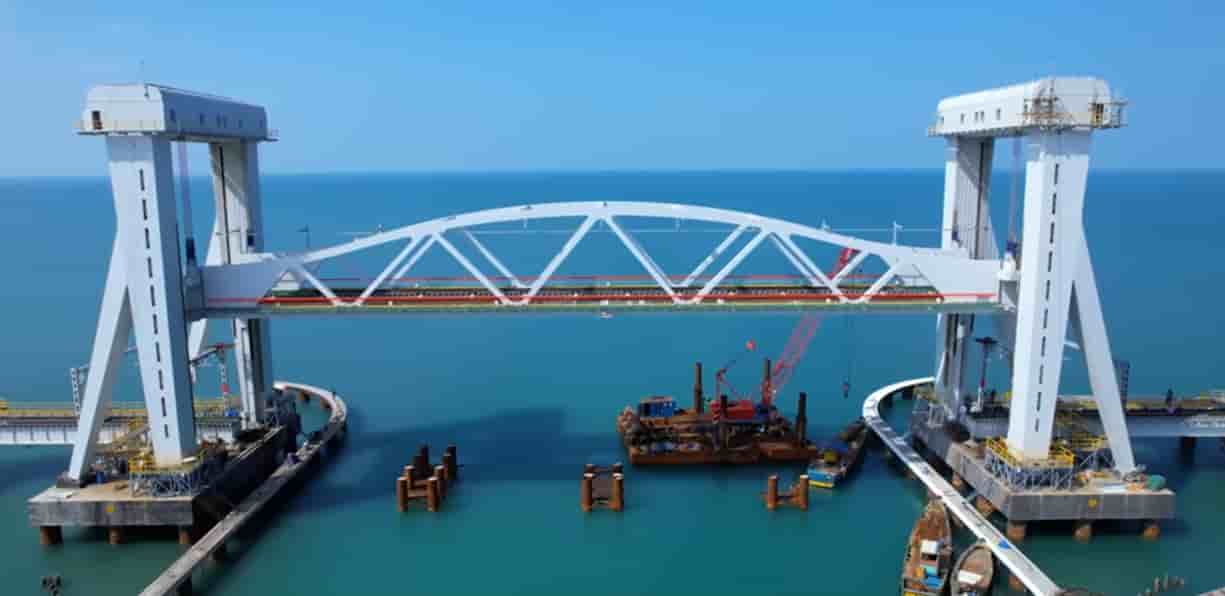
The New Pamban Bridge, popularly referred to as the Rameshwaram Folding Bridge, marks a major milestone in India’s railway and maritime infrastructure. Connecting mainland India to Rameswaram, the bridge has been designed as a modern replacement for the historic Pamban Bridge.
What makes this project unique is its vertical lift mechanism, which allows a section of the bridge to be raised to let ships pass underneath—something never seen before in India at this scale.
Background and Need for the New Bridge
The original Pamban Bridge, inaugurated in 1914, served as India’s first sea bridge and remained a crucial rail link for over a century. However, due to aging infrastructure, increasing maintenance challenges, and the need for faster and safer train movement, the necessity for a modern replacement became evident.
The new bridge was conceptualised to:
- Enhance safety and durability
- Support higher train speeds
- Improve maritime navigation
This led to the development of the New Pamban Bridge, incorporating advanced engineering and modern design.
Key Features of the Rameshwaram Folding Bridge
Vertical Lift Mechanism
The most striking feature of the bridge is its 72.5-metre-long vertical lift span. Unlike the old bridge, which had a manually operated opening system, the new structure uses an automated lift mechanism that raises the central span vertically.
This allows large vessels to pass through without disrupting rail operations for extended periods.
Modern Engineering and Design
The bridge spans approximately 2.07 kilometres over the sea and has been constructed using corrosion-resistant materials to withstand harsh marine conditions.
Key design elements include:
- Automated control systems
- High-strength steel structure
- Advanced monitoring for safety
These features ensure long-term durability and reduced maintenance requirements.
Improved Rail Connectivity
The new bridge supports faster train speeds compared to the old Pamban Bridge, significantly improving connectivity between mainland Tamil Nadu and Rameswaram.
This is particularly important given Rameswaram’s status as a major religious and tourist destination.
Strategic and Cultural Importance
Rameswaram holds immense religious significance as it is home to the Ramanathaswamy Temple, one of the holiest pilgrimage sites in India.
The improved rail connectivity provided by the new bridge is expected to:
- Facilitate smoother travel for pilgrims
- Boost tourism in the region
- Strengthen local economic activity
The bridge thus plays a vital role not just in infrastructure but also in preserving cultural and religious connectivity.
Construction and Challenges
Building a sea bridge with a vertical lift mechanism presented several challenges:
- Working in a high-salinity marine environment
- Ensuring structural stability against strong winds and tides
- Integrating advanced mechanical systems for the lift span
Engineers had to adopt specialised construction techniques and materials to ensure the bridge could withstand these conditions over time.
Comparison with the Old Pamban Bridge
While the old Pamban Bridge was a marvel of its time, the new bridge represents a significant technological upgrade.
Feature | Old Pamban Bridge | New Folding Bridge |
Opening Mechanism | Manual | Automated vertical lift |
Speed Capacity | Limited | Higher train speeds |
Maintenance | High | Reduced due to modern materials |
Durability | Aging structure | Designed for long-term use |
This transition highlights India’s progress in adopting modern engineering solutions.
Economic and Regional Impact
The Rameshwaram Folding Bridge is expected to contribute significantly to regional development.
Boost to Tourism
With improved connectivity, more tourists and pilgrims are expected to visit Rameswaram, benefiting local businesses and hospitality sectors.
Enhanced Trade and Mobility
The bridge ensures uninterrupted rail connectivity, supporting the movement of goods and people more efficiently.
Environmental Considerations
Given its location in a sensitive marine ecosystem, the project incorporated measures to minimise environmental impact. Efforts were made to:
- Reduce disturbance to marine life
- Ensure sustainable construction practices
- Monitor ecological balance during and after construction
Final Perspective
The Rameshwaram Folding Bridge, or New Pamban Bridge, stands as a symbol of India’s engineering advancement and its commitment to modernising critical infrastructure. By combining innovative design with strategic importance, the bridge not only enhances connectivity but also preserves a vital cultural link to one of the country’s most significant pilgrimage destinations.
It represents the seamless blending of tradition and technology—honouring the legacy of the old bridge while paving the way for a more efficient and resilient future.