


N. Rangaswamy: The Man Who Came Back Five Times
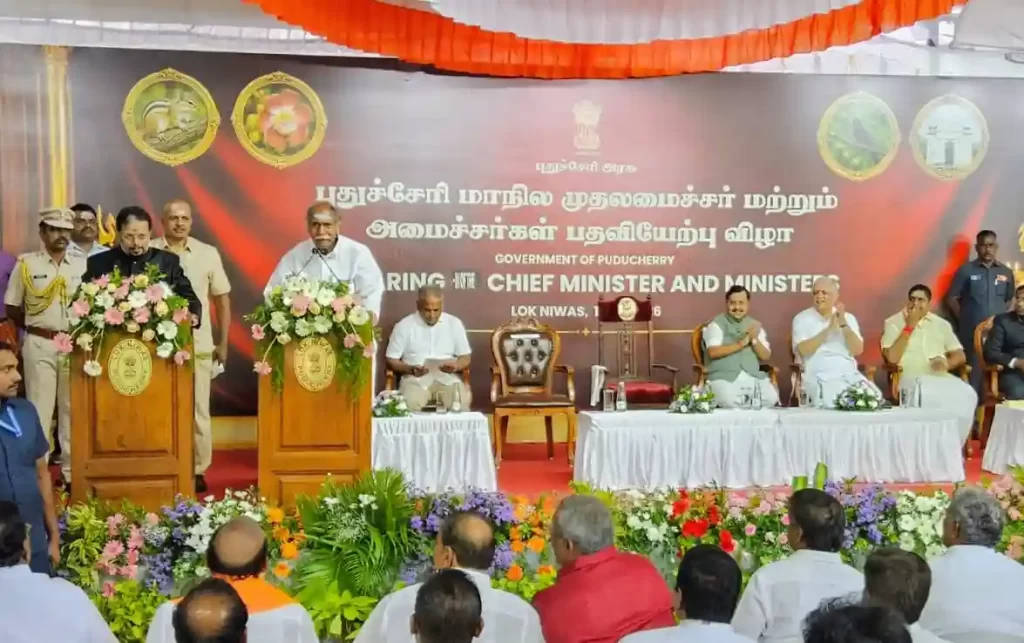
IntroductionIn a country where political careers are won and lost in single terms, N. Rangaswamy has done something that no other leader in Puducherry’s history has managed, and very few across India can claim. At 75 years old, he has been sworn in as Chief Minister of the Union Territory for the fifth time.Following the victory of the AINRC-led NDA combine in the recent assembly elections, N. Rangaswamy was sworn in as the Chief Minister of Puducherry for a record fifth term at Lok Nivas on May 13, 2026. The swearing-in ceremony was held at the Puducherry Lok Bhavan, where Lieutenant Governor K. Kailasanathan administered the oath of office and secrecy to Rangaswamy and the newly inducted ministers.PM Modi, in his message, said: “Congratulations to Thiru N. Rangaswamy on taking oath as Puducherry’s Chief Minister. He has made a mark as an experienced and effective administrator who has strengthened Puducherry’s growth journey. Looking forward to working with him for the people’s well-being.”Five terms. Two different parties. Three different political eras. One relentlessly resilient man. The story of N. Rangaswamy is, in many ways, the story of Puducherry itself.The Beginning: Born in Puducherry, Rooted in Its PeopleNatesan Krishnasamy Gounder Rangaswamy was born on 4 August 1950 in Puducherry to parents Natesan Krishnasamy and Panchali. He completed his Bachelor of Commerce from Tagore Arts College and Bachelor of Laws from Dr. Ambedkar Government Law College.He is a trained lawyer who never lost the habits of the courtroom: patience, precision, and the ability to read a room. Those qualities would serve him far better in the chamber of the Puducherry assembly than in any court.Rangaswamy began his political journey with the Congress, winning from Thattanchavady in 1991. He served as a cabinet minister for nearly a decade before becoming Chief Minister in 2001. He was elected again from the same constituency during the 1996, 2001, and 2006 assembly elections. In 1996, Rangaswamy was appointed as Co-operative Minister. In 2000, he became Education Minister.Those ministerial years were not glamorous. Education and cooperative affairs are not the portfolios that attract headlines. They are, however, the portfolios that build grassroots credibility. Rangaswamy used them to do exactly that, cultivating the kind of direct public relationship — house visits, welfare distributions, personal accessibility — that would sustain him through every political crisis that followed.The First Two Terms: Congress and the Dawn of Welfare PoliticsDuring his long stint as Chief Minister from 2001, Rangaswamy brought in developmental reforms in the tiny Union Territory. Housing subsidy for hut dwellers, free breakfast for school children, financial assistance for students in professional colleges, and a host of other infrastructural reforms consolidated his popularity.His approach was simple and had a clear logic: Puducherry is small. What it lacks in size, it compensates with the intensity of its political engagement. Welfare programmes that deliver tangible benefits directly and visibly to voters work here with a directness that is harder to achieve in larger states. Rangaswamy understood this instinctively and governed accordingly.He served as Chief Minister from 2001 to 2006 and again from 2006 to 2008 as a Congress leader. The back-to-back terms were a sign of confidence from both the Congress leadership and the Puducherry electorate. But the Congress gave, and the Congress could also take away.The Fall and the Reinvention: From Congress to AINRCRangaswamy stepped down as Chief Minister in August 2008 after internal issues within the party. Citing irreconcilable differences, he formed his own party, the AINRC.The departure from Congress was not merely a political move. It was, by every account of those who witnessed it, a deeply personal rupture. Rangaswamy had given the Congress party in Puducherry his best years, built its base, and won it elections. To be pushed out by internal maneuvering — by colleagues within his own party rather than by voters — was a humiliation that would have broken less resilient politicians.Instead, it produced something remarkable. He formed his own party, AINRC, and on 7 February 2011 launched the All India N.R. Congress as a breakaway from the Indian National Congress.The audacity of the move should not be understated. Puducherry’s political landscape at the time was dominated by the Congress and the DMK-aligned AIADMK. Breaking away from the Congress in a territory where it had deep roots, building a new party from scratch, and then winning an election within months — this is what political resilience looks like in practice.In the assembly elections held in April 2011, AINRC contested the elections in an alliance with the Jayalalithaa-led AIADMK and won 15 out of the 17 seats it contested. AINRC formed the government independently, with the support of an Independent, which enabled it to get a majority in the 30-seat assembly. Rangaswamy won from the Kadirkamam Assembly constituency and was sworn in as Chief Minister of Puducherry for the third time on 16 May 2011.The Setback of 2016 and the Road BackThe 2016 election was the low point of Rangaswamy’s career. AINRC, no longer in alliance with the AIADMK, contested alone. Though Rangaswamy won from the Indira Nagar Assembly constituency, the party won only eight seats in the assembly. Hence, Rangaswamy resigned as Chief Minister on 6 June 2016. He later served as the leader of the opposition in the Puducherry assembly from August 2016 to February 2021.Five years in opposition. For a man who had been Chief Minister three times, the leader of the opposition bench is a dramatically different vantage point. He used those years the way he had always used difficult periods — to rebuild the ground-level network, to remain accessible, and to wait.The wait ended in dramatic fashion. After the Puducherry government led by V. Narayanasamy lost a trust vote in the assembly in February 2021, the 2021 legislative assembly elections were held in April 2021. AINRC became part of the National Democratic Alliance and allied with the Bharatiya Janata Party and the AIADMK. The NDA won 16 seats, with AINRC winning 10 of the 16 seats it contested.Rangaswamy was sworn in
Assembly Election Results 2026: Five States, Four Verdicts, One Seismic Political Shift
IntroductionThe verdict is in. The five simultaneous assembly elections held across India in April 2026 — in Assam, Kerala, Tamil Nadu, West Bengal, and the Union Territory of Puducherry — delivered their final results on counting day, May 4, 2026, and the political map of India looks meaningfully different today from what it did a month ago.Three of the five contests produced changes of government. Two of the three changes were historic by any measure. In West Bengal, 15 years of Trinamool Congress rule ended as the BJP swept to a majority of 206 seats in one of the most dramatic transfers of power any Indian state has witnessed since the early 1980s. In Tamil Nadu, a film star’s two-year-old party destroyed the 59-year dominance of the Dravidian duopoly, producing the state’s first-ever hung assembly. In Kerala, the Congress-led United Democratic Front routed a two-term Left government and returned to power with its best result since 1977. Assam and Puducherry returned their incumbents with comfortable margins.Together, the five results carry consequences for Indian politics that will be felt well beyond state boundaries, with the 2029 general election now firmly in view.West Bengal: The Fall of a 15-Year FortressThe ResultThe BJP won 206 seats in the 294-member West Bengal Legislative Assembly, clearing the 148-seat majority mark by a margin of 58 seats. The Trinamool Congress, which had governed the state continuously since 2011, was reduced to 76 seats — a collapse from the 213 seats it had won in 2021. Congress and the Left together won the remaining seats.The Election Commission ordered a repoll in the Falta constituency due to EVM tampering, scheduled for May 21, with results on May 24. One seat, Falta in South 24 Parganas, has results pending.What HappenedMamata Banerjee won her own Bhabanipur constituency, surviving a challenge from Suvendu Adhikari in a closely watched count that saw multiple lead reversals through the day before she eventually held on by a margin of 7,184 votes. Adhir Ranjan Chowdhury, the veteran Congress leader, lost from his traditional Baharampur stronghold, one of the starkest individual reversals of the day.The voter turnout was a record 92.6 percent across both phases. That extraordinary participation figure produced a result that defied most pre-election predictions of a close contest. The BJP crossed the majority mark in early counting and never looked back.The BJP’s Salt Lake headquarters in Kolkata broke into celebrations well before the afternoon counts were completed. The Election Commission, anticipating violence, banned all victory processions and rallies across the state following the result. Despite that ban, incidents of unrest were reported in multiple districts, with a TMC office vandalized and set alight in the Barabani constituency as counting trends turned heavily against the ruling party.A VVPAT slip controversy had emerged the night before counting, when hundreds of printed slips were found discarded near a roadside in the Subhashnagar area of Madhyamgram, from booth number 29 of the Noapara constituency. The incident prompted demands for an inquiry but did not delay counting.Why It HappenedAnti-incumbency after 15 years in power was the structural force underlying the result. Several compounding factors sharpened its impact. A recruitment scandal in government examinations, concerns about law and order, and questions about job creation had eroded public confidence during the incumbent government’s final two years. The Special Intensive Revision of electoral rolls, which resulted in the deletion of 91 lakh voters from West Bengal’s rolls, became the most politically charged controversy of the campaign, with the TMC accusing the BJP of engineering the exercise and the BJP counter-alleging that the TMC’s opposition to SIR was motivated by its dependence on undocumented voters. The controversy turned citizenship and identity into the dominant electoral themes, replacing the governance record debate that the TMC had wanted to fight on.Why It MattersWest Bengal holds 42 Lok Sabha seats. It is one of the largest states in India by parliamentary representation, and the BJP has historically underperformed in its Lok Sabha tally relative to its assembly vote share in the state. A government in Kolkata changes that structural equation ahead of 2029 in a way nothing else could.Tamil Nadu: The End of a 59-Year Dynasty — and a Hung AssemblyThe ResultTamil Nadu produced the most extraordinary result of the five elections. The final seat count in the 234-member assembly was:Tamilaga Vettri Kazhagam (TVK): 108 seatsDMK-led Secular Progressive Alliance (SPA): 73 seats (DMK: 59, INC: 5, others: 9)NDA led by AIADMK: 53 seats (AIADMK: 47, BJP: 1, others: 5)The majority mark is 118. No party or alliance crossed it. Tamil Nadu produced a hung assembly for the first time in its history.TVK, a party formed in February 2024 and contesting its first election, emerged as the single largest party. It beat both the DMK and AIADMK alliances in seat count but fell 10 seats short of forming a government on its own.Government FormationFollowing the declaration of results, Vijay invited the Indian National Congress to join a coalition government. Congress, which had won only 5 seats as part of the DMK-led SPA, accepted the invitation and formally left the DMK-led Secular Progressive Alliance, entering a new TVK-INC alliance. On May 6, 2026, Vijay met the Governor of Tamil Nadu, Rajendra Vishwanath Arlekar, and staked claim to form the government. He is expected to be sworn in as Chief Minister in the coming days.The Individual StoryThe personal stories from the counting day deserve particular mention. Vijay himself won both constituencies he contested, Perambur and Tiruchirappalli East, making him the clear face of government formation. Outgoing Chief Minister M. K. Stalin lost his Kolathur seat, which he had won three times consecutively. Deputy CM Udhayanidhi Stalin also lost his constituency. Fifteen ministers from the outgoing DMK cabinet were defeated. AIADMK general secretary Edappadi K. Palaniswami, however, retained his Edappadi seat with the widest winning margin in the state.Why It HappenedAnalysts identified several factors. TVK successfully targeted the youth vote, women voters, urban voters, and first-time voters across caste and religious lines. Anti-incumbency against the DMK government, widely