
Introduction
In a country where political careers are won and lost in single terms, N. Rangaswamy has done something that no other leader in Puducherry's history has managed, and very few across India can claim. At 75 years old, he has been sworn in as Chief Minister of the Union Territory for the fifth time.
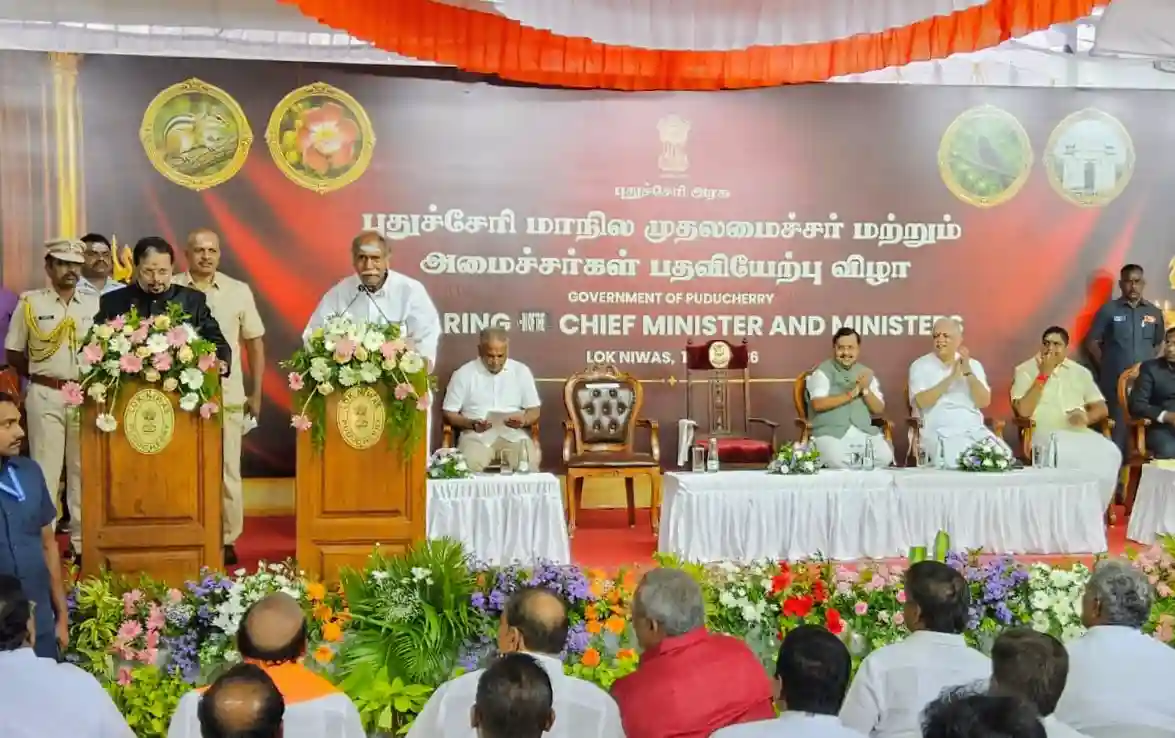
Following the victory of the AINRC-led NDA combine in the recent assembly elections, N. Rangaswamy was sworn in as the Chief Minister of Puducherry for a record fifth term at Lok Nivas on May 13, 2026. The swearing-in ceremony was held at the Puducherry Lok Bhavan, where Lieutenant Governor K. Kailasanathan administered the oath of office and secrecy to Rangaswamy and the newly inducted ministers.
PM Modi, in his message, said: "Congratulations to Thiru N. Rangaswamy on taking oath as Puducherry's Chief Minister. He has made a mark as an experienced and effective administrator who has strengthened Puducherry's growth journey. Looking forward to working with him for the people's well-being."
Five terms. Two different parties. Three different political eras. One relentlessly resilient man. The story of N. Rangaswamy is, in many ways, the story of Puducherry itself.
The Beginning: Born in Puducherry, Rooted in Its People
Natesan Krishnasamy Gounder Rangaswamy was born on 4 August 1950 in Puducherry to parents Natesan Krishnasamy and Panchali. He completed his Bachelor of Commerce from Tagore Arts College and Bachelor of Laws from Dr. Ambedkar Government Law College.
He is a trained lawyer who never lost the habits of the courtroom: patience, precision, and the ability to read a room. Those qualities would serve him far better in the chamber of the Puducherry assembly than in any court.
Rangaswamy began his political journey with the Congress, winning from Thattanchavady in 1991. He served as a cabinet minister for nearly a decade before becoming Chief Minister in 2001. He was elected again from the same constituency during the 1996, 2001, and 2006 assembly elections. In 1996, Rangaswamy was appointed as Co-operative Minister. In 2000, he became Education Minister.
Those ministerial years were not glamorous. Education and cooperative affairs are not the portfolios that attract headlines. They are, however, the portfolios that build grassroots credibility. Rangaswamy used them to do exactly that, cultivating the kind of direct public relationship — house visits, welfare distributions, personal accessibility — that would sustain him through every political crisis that followed.
The First Two Terms: Congress and the Dawn of Welfare Politics
During his long stint as Chief Minister from 2001, Rangaswamy brought in developmental reforms in the tiny Union Territory. Housing subsidy for hut dwellers, free breakfast for school children, financial assistance for students in professional colleges, and a host of other infrastructural reforms consolidated his popularity.
His approach was simple and had a clear logic: Puducherry is small. What it lacks in size, it compensates with the intensity of its political engagement. Welfare programmes that deliver tangible benefits directly and visibly to voters work here with a directness that is harder to achieve in larger states. Rangaswamy understood this instinctively and governed accordingly.
He served as Chief Minister from 2001 to 2006 and again from 2006 to 2008 as a Congress leader. The back-to-back terms were a sign of confidence from both the Congress leadership and the Puducherry electorate. But the Congress gave, and the Congress could also take away.
The Fall and the Reinvention: From Congress to AINRC
Rangaswamy stepped down as Chief Minister in August 2008 after internal issues within the party. Citing irreconcilable differences, he formed his own party, the AINRC.
The departure from Congress was not merely a political move. It was, by every account of those who witnessed it, a deeply personal rupture. Rangaswamy had given the Congress party in Puducherry his best years, built its base, and won it elections. To be pushed out by internal maneuvering — by colleagues within his own party rather than by voters — was a humiliation that would have broken less resilient politicians.
Instead, it produced something remarkable. He formed his own party, AINRC, and on 7 February 2011 launched the All India N.R. Congress as a breakaway from the Indian National Congress.
The audacity of the move should not be understated. Puducherry's political landscape at the time was dominated by the Congress and the DMK-aligned AIADMK. Breaking away from the Congress in a territory where it had deep roots, building a new party from scratch, and then winning an election within months — this is what political resilience looks like in practice.
In the assembly elections held in April 2011, AINRC contested the elections in an alliance with the Jayalalithaa-led AIADMK and won 15 out of the 17 seats it contested. AINRC formed the government independently, with the support of an Independent, which enabled it to get a majority in the 30-seat assembly. Rangaswamy won from the Kadirkamam Assembly constituency and was sworn in as Chief Minister of Puducherry for the third time on 16 May 2011.
The Setback of 2016 and the Road Back
The 2016 election was the low point of Rangaswamy's career. AINRC, no longer in alliance with the AIADMK, contested alone. Though Rangaswamy won from the Indira Nagar Assembly constituency, the party won only eight seats in the assembly. Hence, Rangaswamy resigned as Chief Minister on 6 June 2016. He later served as the leader of the opposition in the Puducherry assembly from August 2016 to February 2021.
Five years in opposition. For a man who had been Chief Minister three times, the leader of the opposition bench is a dramatically different vantage point. He used those years the way he had always used difficult periods — to rebuild the ground-level network, to remain accessible, and to wait.
The wait ended in dramatic fashion. After the Puducherry government led by V. Narayanasamy lost a trust vote in the assembly in February 2021, the 2021 legislative assembly elections were held in April 2021. AINRC became part of the National Democratic Alliance and allied with the Bharatiya Janata Party and the AIADMK. The NDA won 16 seats, with AINRC winning 10 of the 16 seats it contested.
Rangaswamy was sworn in as the Chief Minister of Puducherry for the fourth time on 7 May 2021 with the support of the BJP and independents.
The Fifth Term: The Record Completed
The 2026 Puducherry assembly election, held on April 9, returned the NDA to power with a comfortable majority.
In the 30-member assembly, the NDA has the support of 18 MLAs, two more than the majority mark. Rangaswamy's AINRC emerged as the dominant force within the alliance with 12 MLAs. The Bharatiya Janata Party has four legislators, while the AIADMK and the Latchiya Jananayaga Katchi have one member each.
Contesting from the Thattanchavady constituency, Rangaswamy secured victory with a margin of 4,441 votes over E. Vinayagam of the Neyam Makkal Kazhagam. He also contested from Mangalam and won there. Having won from two constituencies, he retains the seat of his choice.
On May 8, Rangaswamy met the Lieutenant Governor and staked a claim to form the government. He submitted letters of support from the elected MLAs seeking permission to form the government.
Along with him, BJP MLA A. Namassivayam and AINRC MLA Malladi Krishna Rao were sworn in as ministers. The other three ministers will be inducted at a later stage. Political observers view the continuation of the Rangaswamy-led administration as a sign of political stability in Puducherry, especially at a time when regional parties continue to play a crucial role in the Union Territory's governance.
The Man Behind the Record: "Junior Kamaraj"
Rangaswamy has earned two nicknames that together capture him completely. He is called "Junior Kamaraj," compared to former Tamil Nadu Chief Minister K. Kamaraj for his straightforward political style and hands-on approach to administration. He is also known as "Makkal Mudhalvar," meaning "people's chief minister," a term used in political and media discourse to describe his connection with the citizens of Puducherry.
The Kamaraj comparison is not flattery. K. Kamaraj, who led Tamil Nadu and later the Congress nationally, was famous for his austerity, his proximity to ordinary people, and his instinct for political timing. Rangaswamy shares those qualities without the national scale. He is a deeply local leader who has never sought a national role and has never appeared to want one.
The AINRC's ideology centres on pragmatic regionalism, emphasising inclusive governance, social justice, and development tailored to Puducherry's diverse communities, with a balance of traditional values and modern progress. Core principles include prioritising welfare programmes in education, healthcare, and youth empowerment; fostering agricultural and industrial growth; ensuring transparent administration and grassroots participation; and promoting sustainable environmental practices alongside equitable resource distribution to uplift marginalised sections. Unlike ideologically rigid national parties, AINRC operates as a flexible, personality-led entity driven by Rangaswamy's emphasis on efficient, corruption-free local administration rather than broader national doctrines.
The Challenges Ahead
The fifth term arrives with familiar challenges and a few new ones.
In the 2025-26 budget, Rangaswamy announced a tax-free outlay of Rs 13,600 crore, including Rs 1,000 monthly financial aid for college students and enhanced subsidies for farmers — 75% for general category and 90% for Scheduled Castes. The administration launched the Puducherry One Time Regularisation Scheme for Unpermitted Constructions and Deviations on July 21, 2025, to address unauthorised buildings.
The structural challenge of governing a Union Territory, rather than a full state, remains the most persistent frustration of his career. Puducherry's elected government must work within the framework of the Lieutenant Governor's office, which holds concurrent authority and has at times produced friction. Tensions with the Lieutenant Governor in 2025, including Rangaswamy's boycott of office over administrative disputes, drew opposition claims of neglecting public duties.
The longstanding demand for statehood is the single most important constitutional aspiration shared across Puducherry's political spectrum. The Puducherry assembly has passed multiple resolutions seeking full statehood. The demand remains unresolved and is unlikely to be addressed in the near term, but Rangaswamy will be expected to continue pressing it as part of the NDA's agenda in negotiations with New Delhi.
Employment generation, particularly for the educated youth, infrastructure development in the four geographically separated regions of Puducherry, Karaikal, Mahe, and Yanam, and the management of Puducherry's unique economic character — part industrial, part tourism, strongly reliant on its French cultural heritage — are the day-to-day governance priorities.
Five Terms: What the Record Means
Rangaswamy holds the distinction of being the longest-serving Chief Minister in Puducherry's history, with non-consecutive terms totalling over 16 years, including stints from 2001 to 2008 under Congress and 2011 to 2016 leading AINRC, before returning in alliance with the National Democratic Alliance following the 2021 elections.
The five terms span three distinct political eras: the Congress era, the AINRC-alone era, and the NDA coalition era. In each, Rangaswamy adapted his approach, his alliances, and his positioning while keeping his core identity — the accessible, welfare-oriented, locally rooted administrator — entirely intact.
What has sustained him is not ideology in the conventional sense. It is the relationship between a politician and a community that has watched him for more than three decades and has, repeatedly, chosen him again. In a Union Territory of barely 1.5 million people, that kind of personal political trust is built slowly and lost permanently. That Rangaswamy has maintained it across 35 years of public life, through three parties and five terms, is the most credible explanation for a record that, by definition, no one has ever broken before.