


BRICS Foreign Ministers’ Meeting, New Delhi: A Bloc Divided by the War It Could Not Name
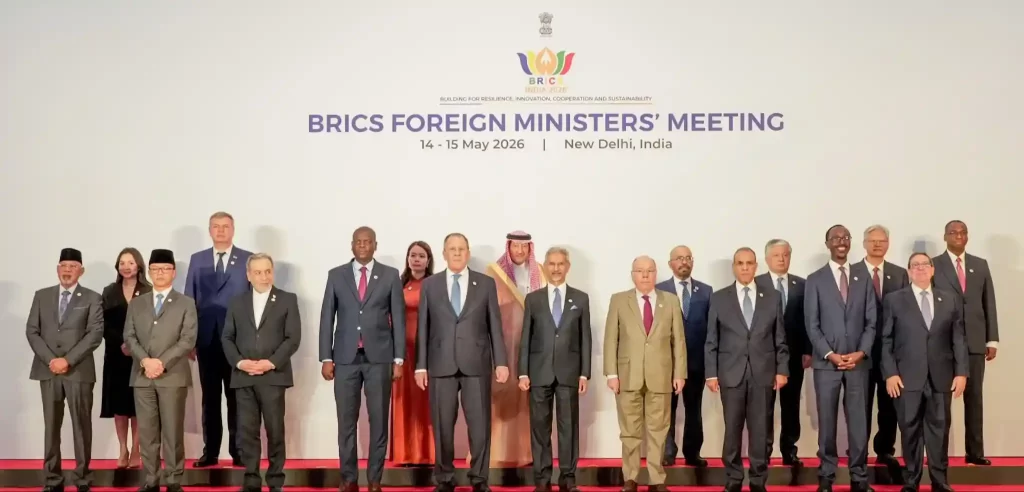
IntroductionWhen India’s External Affairs Minister S. Jaishankar took the chair at Bharat Mandapam in New Delhi, he was presiding over the most consequential BRICS Foreign Ministers’ Meeting since the bloc’s expansion. Eleven member states sat around the table. The agenda was India’s: global institutional reform, South-South cooperation, economic resilience, and the priorities of the developing world. The problem that arrived uninvited was the Iran war.Top diplomats from BRICS nations, including rivals Iran and the United Arab Emirates, failed to issue a joint statement after a two-day meeting in New Delhi, exposing divisions within the bloc over the war in Iran. Host nation India instead released a Chair’s Statement and Outcome Document, saying there were “differing views among some members” as regards the situation in the West Asia and Middle East region.The inability to produce a joint declaration — the standard diplomatic deliverable of any ministerial meeting — was not a procedural failure. It was a substantive one, and it went to the heart of what BRICS is, what it has become after its 2024-2025 expansion, and whether it can function as a coherent voice for the Global South when its own members are on opposite sides of an active war.The Meeting: Who Was There and What Was PlannedThe meeting was held at Bharat Mandapam under India’s 2026 chairship. It followed a preparatory ministerial held on September 26, 2025, on the sidelines of UNGA 80, where India as the incoming chair had set out its agenda.Those in attendance included Indonesia’s Foreign Minister Sugiono, Iran’s Foreign Minister Abbas Araghchi, South Africa’s Foreign Minister Ronald Lamola, Russia’s Foreign Minister Sergei Lavrov, India’s External Affairs Minister S. Jaishankar, Brazil’s Foreign Minister Mauro Vieira, Egypt’s Foreign Minister Badr Abdelatty, Ethiopia’s Foreign Minister Gedion Timothewos, China’s Ambassador to India Xu Feihong, and UAE’s Minister of State for Foreign Affairs Khalifa bin Shaheen Al Marar. Uganda’s Foreign Minister Odondo Jeje Abubakha was also present as a representative of the bloc’s outreach partners.India’s intended agenda was carefully constructed to avoid precisely the kind of confrontation that ultimately occurred. India’s chairship theme — Building for Resilience, Innovation, Cooperation and Sustainability — framed the meeting. Ministers reaffirmed BRICS’s three pillars: political and security cooperation, economic and financial cooperation, and people-to-people exchanges. They repeated the bloc’s commitment to openness, equality, and consensus.What the Chair’s Statement CoveredDespite the headline failure to produce a joint declaration, the Chair’s Statement and Outcome Document ran to 63 paragraphs covering a wide range of issues where agreement was possible.The Chair’s Statement gave most space to reform of global institutions: the United Nations and its Security Council, the IMF, the World Bank, and the WTO. Members argued that present structures do not reflect contemporary realities and favour developed Western powers. The statement reiterated support for a multipolar order and for greater representation of Africa, Asia, and Latin America in global decision-making.On economic matters, the ministers called for resilient supply chains, fair trade, reform of the global financial architecture, expansion of local-currency trade, and stronger South-South cooperation. The bloc opposed unilateral sanctions, protectionism, and trade barriers, and backed a rules-based multilateral trading system centred on the WTO.The document also covered cooperation on artificial intelligence, digital infrastructure, cybersecurity, climate change, energy transition, health security, food security, and innovation-led growth. Initiatives endorsed included the BRICS Grain Exchange, cross-border payment systems, and a stronger role for the New Development Bank and the Contingent Reserve Arrangement.On geopolitics, the ministers discussed West Asia, Gaza, Lebanon, Sudan, Syria, and Yemen, but could not agree on language for the Iran war. The text instead set out general principles: diplomacy, humanitarian access, ceasefires, protection of civilians, and respect for international law. The ministers strongly condemned terrorism, including the Pahalgam attack of April 22, 2025, and called for closer counter-terrorism cooperation.On Palestine specifically, the Chair’s Statement had four paragraphs on Palestine, including one recognising a two-state solution with East Jerusalem as the capital of an independent Palestine. The ministers recalled that the Gaza Strip is an inseparable part of the Occupied Palestinian Territory and reaffirmed the right of the Palestinian people to self-determination, including the right to an independent State of Palestine.The Fault Line: Iran vs. the UAE Inside the Same BlocThe meeting’s collapse into a Chair’s Statement rather than a joint declaration had a specific cause, a specific pair of actors, and a specific set of paragraphs that could not be reconciled.The central dispute was over how BRICS should describe the war involving Iran, the US, and Israel. Iran wanted the grouping to condemn US-Israeli attacks on it, while accusing the UAE — a fellow BRICS member and US ally — of direct involvement in military operations against Iran.On the first day of talks, Iranian Foreign Minister Abbas Araghchi called upon BRICS member states and the international community to explicitly condemn violations of international law by the United States and Israel, including their illegal aggression against Iran, to prevent the politicisation of international institutions, and to take concrete action to halt warmongering and bring an end to the impunity of those who violated the UN Charter.Araghchi explicitly accused the UAE of being “directly involved in the aggression against my country.” Tehran views the UAE and Saudi Arabia not as neutral neighbours but as “hostile bases” because they host critical US military infrastructure and failed to condemn the initial US-Israeli strikes on Iran.The UAE’s response was unequivocal. UAE’s Minister of State for Foreign Affairs Khalifa bin Shaheen Al Marar categorically rejected the allegations levelled by Iran and condemned what he termed “unjustified attacks” on civilian infrastructure. He defended UAE sovereignty against Iran’s charges in his national statement. “Despite numerous international and regional resolutions and condemnations, Iran has continued its terrorist attacks against the UAE and other countries in the region, in clear disregard of the international consensus,” he said.It is learnt that Iran had an issue specifically with paragraphs 26 and 29 of the proposed joint statement — the paragraphs covering Palestine and the Red Sea respectively. However, Araghchi, without naming the UAE, blamed a country
India AI Impact Summit 2026: Detailed Agenda for Global AI Action in New Delhi
New Delhi, February 9, 2026 – India gears up for the India AI Impact Summit 2026, set for February 16-20 at Bharat Mandapam, Pragati Maidan, New Delhi, the primary venue for the India AI Impact Summit 2026, which will host the main events on February 19-20.Hosted by the Ministry of Electronics and Information Technology (MeitY), this first Global South edition, billed by Union Minister Ashwini Vaishnaw as the “largest yet,” transitions AI discourse from vision to verifiable impact under the “Three Sutras”: People, Planet, and Progress.Some sources mention a broader program across February 16-20, potentially using additional Delhi venues like Sushma Swaraj Bhawan for side events, sessions, or exhibitions. Bharat Mandapam, one of India’s largest convention centers, was upgraded by NDMC for this flagship gathering. Chief Guests and Stellar LineupPrime Minister Narendra Modi serves as the Chief Guest, inaugurating on February 16 with a keynote and hosting a leaders’ dinner. Expected heads of government include representatives from Singapore, the UAE, and Brazil (15-20 total), plus 50+ ministers. Key speakers feature Google’s Sundar Pichai, Anthropic’s Dario Amodei, Microsoft’s Satya Nadella, and Indian luminaries like Nandan Nilekani (Infosys co-founder) and Ola’s Bhavish Aggarwal. Over 40 CEOs from Reliance, TCS, and global firms join, along with a Chinese delegation, signaling a thaw in collaboration. Event Schedule and Dialogues Feb 16: Inauguration, Modi address, CEO roundtable.Feb 17-18: Plenary sessions and seven “Chakras” (working groups) on core topics.Feb 19: Startup showcase (500+ ventures), AI model launches, bilateral dialogues.Feb 20: Closing with actionable declarations.Expect 500+ parallel sessions, hackathons, and exhibitions. Dialogues include G20-style tracks on AI ethics, public-private partnerships, and Global South priorities. Participating Governments in India AI Impact Summit 2026 The summit, hosted by India’s Ministry of Electronics and Information Technology (MeitY) under the IndiaAI Mission, expects involvement from over 100 countries. Key highlights:High-Level Representation: 15-20 heads of government and 50+ ministers confirmed, including from Singapore, UAE, Brazil, and others.China: Delegation attending after India’s formal invitation, signaling AI collaboration.Preceding Hosts: Builds on summits by UK (2023 Bletchley), South Korea (2024 Seoul), France (2025 Paris).Collaborators: NITI Aayog (India’s policy think tank), state governments like Uttarakhand (pre-summit host), and international bodies (ITU, World Economic Forum).Global Engagement: Multinational working groups across Chakras, with US, UK, EU, and ASEAN nations active in prep consultations. Key Topics and Seven ChakrasThe India AI Impact Summit 2026 is structured around three foundational “Sutras” (People, Planet, Progress) that guide its discussions, with seven interconnected “Chakras” (working groups) translating these into specific, actionable themes.Core SutrasPeople: Focuses on human-centric AI, including safeguarding rights, enhancing access to services (e.g., healthcare, education), building user trust, workforce reskilling amid job impacts, and ensuring equitable benefits across societies.Planet: Addresses sustainable AI deployment, such as energy-efficient models, responsible resource use (e.g., reducing GPU/data center power demands), and AI applications for climate action, environmental monitoring, and resilience.Progress: Emphasizes inclusive innovation, capacity-building, productivity gains in sectors like agriculture and manufacturing, economic growth, and bridging the AI divide for the Global South. Seven Chakras (Key Discussion Topics)These working groups, involving 100+ countries, cover:AI governance and ethical frameworks.Trust and safety protocols for AI models (e.g., bias mitigation, transparency).AI’s impact on work and future jobs.Sector-specific applications (healthcare, agriculture, industry).Innovation and scalable solutions.Sustainability and environmental integration.Equitable access, inclusion, and development outcomes.Sessions will also spotlight IndiaAI Mission launches, startup innovations, and global standards, prioritizing “on-ground” results over regulations. What to Expect in India AI Summit?MeitY leads with partners like NITI Aayog, NASSCOM, World Economic Forum, and ITU. Corporate backers include Google, Microsoft, NVIDIA (GPU focus), and Indian firms like Tata and Adani (data centers). Governments from US, UK, EU, and ASEAN collaborate. Attendees (10,000+), policymakers, researchers, startups, NGOs, can expect networking zones, live demos (e.g., edge AI), policy labs, and a “Global AI Talent Fair.” Launches include indigenous foundational models under the Rs 10,370 crore IndiaAI Mission. India’s Strategic Push Amid HurdlesEchoing Bletchley (2023), Seoul (2024), and Paris (2025), India’s summit prioritizes “on-ground” wins for 1.4 billion people, as per Secretary S. Krishnan. AI could add $500B to GDP (NASSCOM), but challenges like GPU imports persist—eased by US trade deals and data center tax holidays to 2047. Budget 2026-27 tweaks fund nuclear-powered AI infra, as Vaishnaw eyes energy self-reliance.Vaishnaw hailed “phenomenal” global buy-in, with NDMC upgrading venues. Beyond talks, expect MoUs on compute sharing, talent visas, and sustainable AI pacts, positioning India as an AI diplomacy hub.This summit promises not just dialogue, but deliverables: inclusive, green AI for humanity’s progress.Video credit: YT@/Digital India
New Delhi Book Fair 2026: A Literary Celebration Bringing Readers and Writers Together
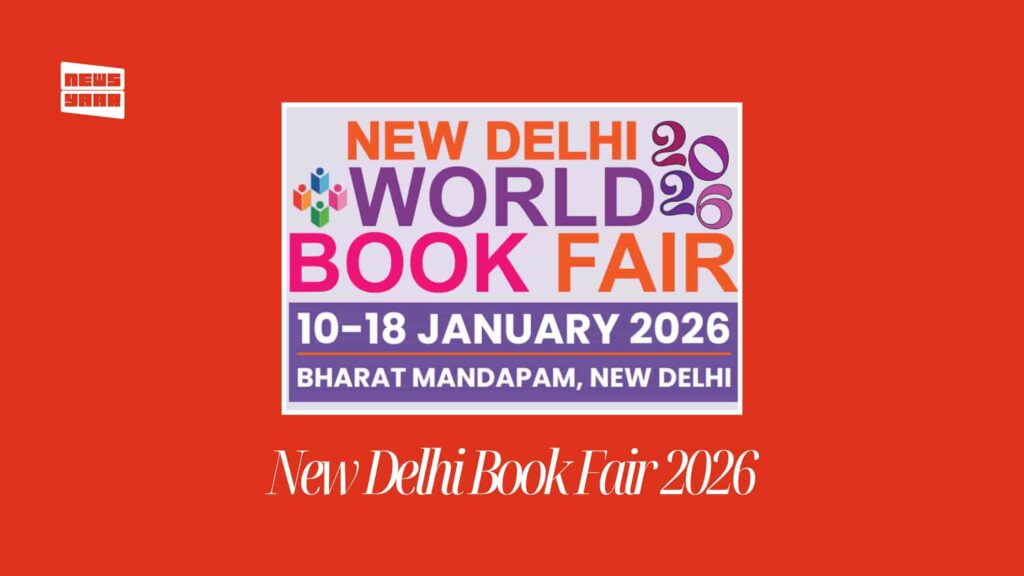
The Delhi Book Fair once again transformed the national capital into a vibrant hub of literature, ideas, and storytelling. Known as one of India’s most loved literary events, the fair attracted book lovers, authors, publishers, and students from across the country, reaffirming Delhi’s place as a cultural and intellectual centre. Event Details Dates: January 10–18, 2026 (9 days) Venue: Bharat Mandapam (Halls 2–6), Pragati Maidan, New Delhi Timings: 11:00 AM – 8:00 PM daily Entry: Free for all visitors Stepping into the fair felt like entering a world woven from stories, ideas, and imagination. The event showcased an incredible variety of books across genres, from fiction and non-fiction to academic texts, children’s books, self-help, and regional language publications, catering to readers of all ages and interests.An iconic venue, the fair offered a rich mix of books across genres, ranging from fiction, non-fiction, academic texts, children’s literature, self-help, and regional language publications. A Paradise for Book Lovers Walking into the Delhi Book Fair felt like stepping into a world made entirely of stories. Hundreds of stalls showcased books in English, Hindi, and several Indian languages, ensuring there was something for every reader. From bestselling novels and classic literature to competitive exam guides and research material, the fair catered to readers of all ages.Special sections dedicated to children remained a major attraction, with colourful books, comics, and activity corners encouraging young minds to develop a love for reading. Authors, Discussions, and Cultural Exchange Beyond book shopping, the Delhi Book Fair served as a platform for author interactions, panel discussions, and book launches. Renowned writers, emerging voices, and publishers engaged in conversations around literature, education, publishing trends, and the future of reading in a digital age.These sessions provided readers with a chance to connect directly with authors, understand their creative journeys, and gain insights into the evolving literary landscape.In a time when online content dominates, the fair stood as a reminder of the lasting value of printed books and structured learning. Keeping the Reading Culture Alive Despite the rise of e-books and digital platforms, the Delhi Book Fair highlighted that the charm of physical books remains strong. The event brought together people from diverse backgrounds, united by a shared love for reading, learning, and storytelling.Publishers also offered attractive discounts, making books more accessible and encouraging readers to build personal libraries. Delhi Book Fair: More Than Just an Event The Delhi Book Fair is not just about buying books; it is about celebrating ideas, creativity, and knowledge. It continues to inspire curiosity, promote literacy, and strengthen India’s reading culture.As the fair concludes, it leaves behind shelves full of new books and minds filled with fresh perspectives, proving once again that stories still matter, and always will.