


India’s First Semi-High-Speed Rail Corridor: The Ahmedabad–Dholera Project Set to Transform Gujarat
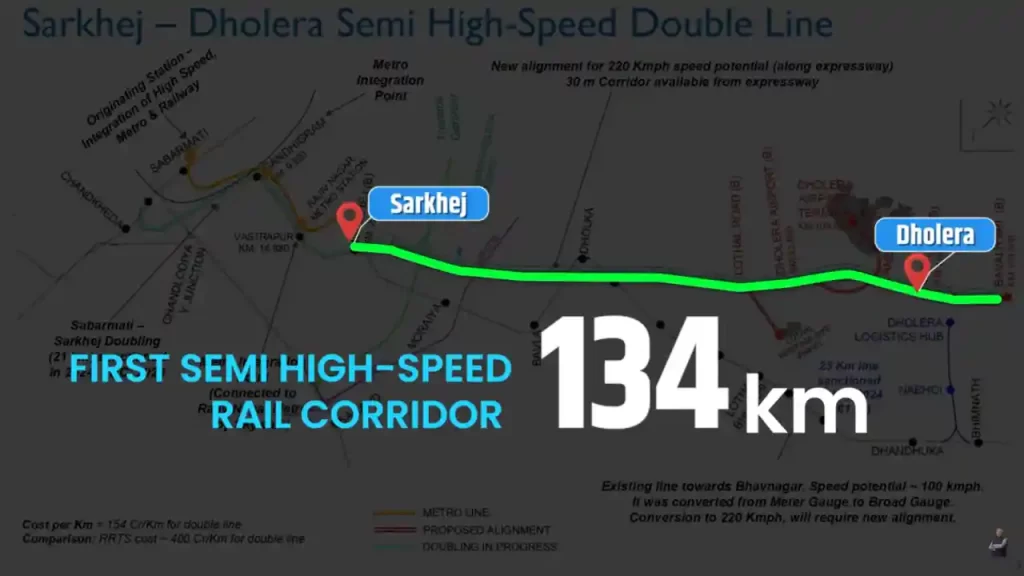
In a landmark decision that marks a new chapter in India’s railway modernization, the Cabinet Committee on Economic Affairs (CCEA), chaired by Prime Minister Narendra Modi, approved the ₹20,667 crore Ahmedabad (Sarkhej)–Dholera Semi High-Speed Double Line Rail Project on May 13, 2026. This 134-kilometer corridor will be Indian Railways’ first semi-high-speed rail project developed entirely with indigenously engineered technology, embodying the nation’s “Aatmanirbhar Bharat” vision while setting a reference model for phased semi-high-speed rail expansion across the country. By slashing travel time between Ahmedabad and Dholera to under an hour, potentially as fast as 34 minutes from Sarkhej to Dholera and 48 minutes from Sabarmati to Dholera, the corridor will enable comfortable daily commuting, same-day business trips, and seamless connectivity to Dholera Special Investment Region (SIR), the upcoming Dholera International Airport, and the Lothal National Maritime Heritage Complex.The project, implemented under the PM Gati Shakti National Master Plan, emphasizes multi-modal connectivity and logistical efficiency through integrated planning and stakeholder consultations. It will expand Indian Railways’ network by approximately 134 km, enhance mobility for around 284 villages with a combined population of 5 lakh people, and support both passenger and freight movement. Officials projecting completion by 2030–31 highlight that trains will operate at speeds up to 200 kmph, with the line designed for 220 kmph, making it a pioneering initiative that will accelerate industrial growth, strengthen Dholera’s position as a smart city and investment hub, and significantly boost employment and regional development under the government’s vision for a New India.Indigenous Technology and the Aatmanirbhar Bharat VisionThis historic corridor is planned with indigenously developed technology, reflecting the government’s strategic push toward “Aatmanirbhar Bharat” and reducing dependence on foreign systems for critical infrastructure. By relying on domestic engineering expertise, the project showcases India’s capability to design and deploy semi-high-speed rail systems without external dependency, setting a benchmark for future railway expansions. The Railways Ministry stated that this initiative will act as a pioneer model for phased semi-high-speed rail expansion across the country, demonstrating how indigenous innovation can drive large-scale infrastructure development while maintaining cost efficiency and technological sovereignty.The emphasis on indigenous technology also aligns with Prime Minister Modi’s vision of making people in the region “Atmanirbhar” through comprehensive development that enhances employment and self-employment opportunities. By integrating local engineering firms, manufacturing units, and research institutions into the project’s execution, the corridor will foster a domestic ecosystem capable of delivering next-generation rail infrastructure, transferring skills, and creating high-value jobs in Gujarat and beyond.Transforming Connectivity: Ahmedabad, Dholera SIR, Airport, and LothalThe corridor will provide seamless connectivity to Ahmedabad, the Dholera Special Investment Region (SIR), the upcoming Dholera International Airport, and the Lothal National Maritime Heritage Complex (NHMC), creating a multi-modal transport network that integrates rail, air, and maritime infrastructure. Dholera SIR, being developed as a major industrial and manufacturing hub, will gain direct access to Ahmedabad’s urban and economic infrastructure, enabling businesses to locate operations in Dholera while maintaining easy access to Ahmedabad’s markets, logistics networks, and skilled workforce. The upcoming Dholera Airport will further enhance connectivity, positioning the region as a hub for aviation, trade, and tourism, while the Lothal National Maritime Heritage Complex will benefit from improved rail access, promoting cultural tourism and heritage preservation.Connecting Ahmedabad with Dholera will drastically cut passenger travel time, enabling comfortable daily commuting and same-day return trips. This semi-high-speed railway will not only bring two cities closer but also connect people living hundreds of kilometres away, fostering greater social and economic integration across the region. Government estimates suggest the project will improve mobility for nearly 284 villages with a combined population of around 5 lakh people, boosting employment opportunities, enabling access to education and healthcare, and strengthening regional development under the PM Gati Shakti National Master Plan.Industrial Growth, Logistics Efficiency, and Economic ImpactThe corridor is expected to support both passenger and freight movement, improving access to Dholera SIR and enhancing logistics efficiency for industries operating in the region. By providing faster and more reliable rail transport, the project will reduce logistics costs, minimize dependency on road transport, and enable manufacturers to move goods more efficiently between Ahmedabad, Dholera, and other industrial hubs. This will accelerate industrial growth, attract investment to Dholera SIR, and strengthen the region’s position as a leading smart city and investment destination, contributing to Gujarat’s and India’s broader economic development goals.The project is aligned with Prime Minister Modi’s vision of a New India, which emphasizes comprehensive development that enhances employment and self-employment opportunities. By improving connectivity to 284 villages and enabling easier access to urban markets, education, and healthcare, the corridor will empower rural communities, create new economic opportunities, and support the government’s goal of inclusive growth. The semi-high-speed rail project will also facilitate the movement of people, goods, and services seamlessly, integrating regional economies and fostering greater economic integration across Gujarat.Environmental Sustainability and Climate GoalsAs an environment-friendly and energy-efficient mode of transportation, the rail corridor will contribute significantly to India’s climate goals by reducing oil consumption and lowering carbon emissions. Official projections estimate the project will reduce oil imports by 0.48 crore litres and lower CO₂ emissions by 2 crore kg, equivalent to planting 10 lakh trees, demonstrating its potential to mitigate environmental impact while supporting sustainable development. By encouraging rail-based travel and logistics instead of road transport, the corridor will reduce greenhouse gas emissions, lower air pollution, and promote cleaner, greener transportation aligned with India’s long-term climate commitments.The environmental benefits extend beyond emission reductions. The project will minimize land degradation and habitat disruption associated with road expansion, reduce noise pollution in urban and rural areas, and promote sustainable urban planning by integrating rail infrastructure with smart city development in Dholera. This aligns with the PM Gati Shakti National Master Plan’s focus on enhancing multi-modal connectivity and logistical efficiency through integrated planning, ensuring that infrastructure development balances economic growth with environmental sustainability.Project Timeline, Speed, and Operational HighlightsThe 134-km broad-gauge semi-high-speed rail corridor is targeted for completion by 2030–31, with trains expected to operate at speeds up to 200 kmph, while the line is
India’s Semiconductor Manufacturing Story: How New Chip Plants Are Transforming the Country’s Technological Future

IntroductionSemiconductors are often described as the “new oil” of the digital economy. These tiny electronic chips serve as the brains behind modern technology, powering smartphones, computers, automobiles, telecommunications equipment, medical devices, defence systems, artificial intelligence platforms, and industrial machinery. In an increasingly digital world, access to semiconductors has become a matter not only of economic growth but also of national security and technological sovereignty.For years, India remained heavily dependent on imported semiconductors despite being one of the world’s largest consumers of electronic products and a major hub for chip design services. While Indian engineers contributed significantly to global semiconductor design, the country lacked large-scale manufacturing facilities capable of producing chips domestically.The global semiconductor shortage that emerged during and after the COVID-19 pandemic exposed the vulnerabilities of this dependence. Supply chain disruptions affected industries worldwide, delaying automobile production, consumer electronics manufacturing, and critical infrastructure projects. The crisis prompted governments across the globe to invest heavily in domestic semiconductor capabilities.India responded by launching an ambitious strategy aimed at building a complete semiconductor ecosystem. Over the last few years, this vision has begun to materialise through a series of major investments, policy initiatives, and the launch of new semiconductor manufacturing and packaging facilities across the country.Today, India’s semiconductor story is no longer about future possibilities—it is increasingly about projects under construction, facilities being established, and the emergence of a domestic chip manufacturing ecosystem.Why Semiconductors MatterModern economies run on semiconductors. Every smartphone contains multiple chips. Electric vehicles depend on semiconductors for battery management, safety systems, and autonomous features. Data centres, cloud computing infrastructure, artificial intelligence applications, telecommunications networks, and defence technologies all rely on advanced semiconductor components.As digitalisation accelerates worldwide, demand for semiconductors continues to grow rapidly.Industry estimates suggest that India’s semiconductor consumption could exceed $100 billion annually in the coming years. This growth is being driven by:Expansion of the electronics manufacturing sectorRising smartphone penetrationGrowth of electric vehiclesDeployment of 5G networksArtificial intelligence and cloud computing adoptionIncreasing digitisation of public servicesWithout domestic manufacturing capabilities, India would remain vulnerable to external supply disruptions and geopolitical uncertainties.The Semiconductor Mission: India’s Strategic PushRecognising the strategic importance of semiconductors, the Government of India launched the India Semiconductor Mission (ISM) as part of a broader effort to strengthen the country’s electronics manufacturing sector.The government announced incentive packages worth tens of thousands of crores aimed at attracting investments in semiconductor fabrication, assembly, testing, packaging, and display manufacturing.The objective was not merely to establish individual factories but to create a complete semiconductor ecosystem involving:Chip fabrication plants (fabs)Assembly and packaging facilitiesDesign centresResearch and development infrastructureTalent development programsSupply chain networksThe initiative marked one of the largest industrial policy interventions in India’s recent history.Tata Electronics and the Dholera Semiconductor FabOne of the most significant milestones in India’s semiconductor journey came with the announcement of a semiconductor fabrication facility by Tata Electronics in partnership with Taiwan-based Powerchip Semiconductor Manufacturing Corporation (PSMC).The facility is being established at Dholera in Gujarat, a location that has emerged as a key industrial hub under India’s infrastructure development plans.The project represents India’s first major commercial semiconductor fabrication plant and involves an investment estimated at over ₹91,000 crore.The facility is expected to manufacture chips used in:AutomobilesConsumer electronicsCommunication systemsComputing devicesIndustrial applicationsIndustry experts consider the Dholera fab a landmark development because semiconductor fabrication represents the most technologically complex and capital-intensive segment of the semiconductor value chain.For decades, only a handful of countries such as Taiwan, South Korea, the United States, Japan, and China have possessed significant semiconductor fabrication capabilities.The Dholera project signals India’s entry into this highly strategic domain.Micron Technology’s Semiconductor Facility in GujaratAnother major development has been the investment by American semiconductor giant Micron Technology.Micron announced a substantial investment in a semiconductor assembly and testing facility in Sanand, Gujarat.The facility focuses on:AssemblyTestingMarkingPackaging (ATMP)These activities are critical parts of semiconductor manufacturing and represent an important step toward building a complete semiconductor ecosystem.The project has attracted significant attention because it marks one of the largest semiconductor investments by a global company in India.Commercial production is expected to play a crucial role in integrating India into global semiconductor supply chains.Semiconductor Expansion in AssamIndia’s semiconductor ambitions are not limited to western India.The Tata Group has also announced a semiconductor assembly and testing facility in Assam, making the northeastern state an unexpected but important participant in the country’s technology manufacturing push.The project is expected to generate thousands of direct and indirect jobs while promoting industrial development in a region historically less associated with high-technology manufacturing.The facility demonstrates the government’s effort to geographically diversify semiconductor investments rather than concentrating them in a few industrial clusters.For Assam, the project represents one of the most significant industrial investments in recent history.Additional Semiconductor Projects Across IndiaRecent years have witnessed multiple semiconductor-related announcements involving both domestic and international players.Several projects have been proposed in areas such as:Semiconductor packagingCompound semiconductorsDisplay manufacturingAdvanced electronics productionCompanies have expressed interest in participating across different stages of the semiconductor value chain, creating the foundations of a broader manufacturing ecosystem.These investments indicate growing confidence in India’s policy framework and long-term market potential.Why Global Companies Are Looking at IndiaSeveral factors have contributed to India’s emergence as a preferred destination for semiconductor investments.Growing Domestic MarketIndia is among the world’s fastest-growing markets for electronics and digital technologies.The rapid adoption of smartphones, connected devices, electric vehicles, and digital services creates substantial domestic demand for semiconductors.China Plus One StrategyGlobal companies are increasingly seeking to diversify manufacturing operations beyond China.The strategy, often referred to as “China Plus One,” has encouraged businesses to establish additional production bases in countries such as India, Vietnam, and Mexico.India has emerged as a major beneficiary of this shift.Government IncentivesGenerous fiscal incentives, capital subsidies, and infrastructure support have significantly improved the attractiveness of semiconductor investments.The government has committed substantial financial resources to reduce the high costs associated with semiconductor manufacturing.Skilled WorkforceIndia already possesses one of the world’s largest pools of semiconductor design talent.Many global semiconductor companies operate research and design centres in cities such as Bengaluru, Hyderabad, Noida, and Pune.This existing talent base provides a strong foundation for manufacturing expansion.Challenges Facing
PM Modi Inaugurates Ahmedabad-Dholera Expressway

Imagine zipping from the bustling heart of Ahmedabad to the rising star of Dholera in just 45 minutes, instead of a bumpy two-hour crawl. That dream roared to life on Tuesday when Prime Minister Narendra Modi cut the ribbon on the stunning Ahmedabad-Dholera Expressway, a sleek, Rs 5,100 crore marvel of engineering that’s set to supercharge Gujarat’s economy.These developments focus on roads, railways, semiconductors, renewable energy, and urban mobility.Ahmedabad-Dholera Expressway Now OpenPM Modi inaugurated the Ahmedabad-Dholera Expressway on March 31.Cost: Over Rs 5,100 crore.Type: Access-controlled highway.Length: Approximately 110 km.Travel time: Reduces from 2 hours to 45 minutes.Speed limit: Up to 120 kmph.Benefits: Improves connectivity to Dholera Special Investment Region (DSIR), boosts industrial growth, and supports economic development.Road and Highway ProjectsThe Prime Minister laid foundation stones for key road upgrades:Four-lane Idar-Badoli bypass with paved shoulders.Upgrade of Dholavira–Mauvana–Vauva–Santalpur section (Package II) of National Highway 754K to a two-lane with paved shoulders.These projects aim to reduce travel time, enhance safety, and support logistics.Flyovers for Urban Traffic ReliefTwo flyovers were addressed to ease congestion in Gandhinagar and Ahmedabad:Inaugurated: Flyover at PDPU Junction on Gandhinagar-Koba-Ahmedabad Airport Road (handles over 1.4 lakh vehicles daily).Foundation laid: Flyover at Bhaijipura Junction on Gandhinagar-Koba-Airport Road (includes parking facilities below).These will cut commute times to the airport and state capital.Keynes Semicon Plant InauguratedPM Modi inaugurated the Keynes Semicon plant in Sanand, Ahmedabad.Milestone: Second semiconductor plant in India to start commercial manufacturing.Initial product: Advanced Intelligent Power Modules (IPMs) with 17 chips each.Applications: Automotive and industrial power systems.Client: Alpha & Omega Semiconductor (California-based).Full capacity: 6.33 million units per day.This strengthens India’s semiconductor sector.Railway Infrastructure UpgradesDedicated to the nation:Kanalus-Jamnagar doubling project (28 km, part of 111.20 km Rajkot-Kanalus project).Quadrupling of the Gandhidham–Adipur section (10.69 km).These improve train frequency and freight movement.Renewable Energy BoostPM Modi inaugurated Khavda Pooling Station-2 and associated transmission systems.Capacity: Evacuates 4.5 GW of renewable energy.Role: Supports Gujarat’s solar and wind power grid.Gujarat now leads India in solar power generation, as highlighted by the PM.PM Modi’s Remarks on Gujarat’s ProgressDuring the public address, PM Modi highlighted Gujarat’s leadership in renewable energy. He recalled establishing a multi-technology solar park in 2010 as Chief Minister, which laid the foundation for the state’s solar growth.Broader ImpactThe projects cover connectivity, industry, green energy, healthcare, and tourism. They align with national goals for infrastructure and sustainable development. Official sources confirm all details from the Prime Minister’s Office and the Gujarat government announcements.
Dholera: India’s First Greenfield Smart City Taking Shape in Gujarat
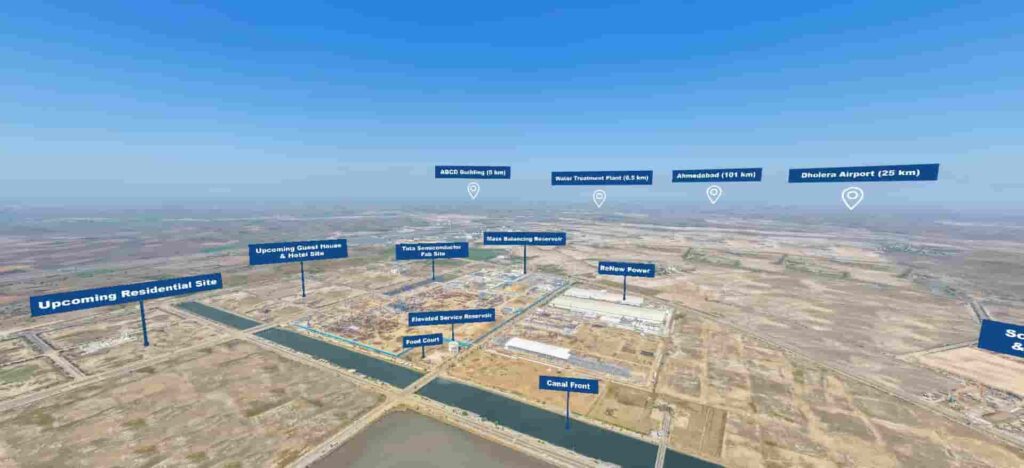
Dholera has emerged as one of India’s most ambitious urban development projects, envisioned as the country’s first greenfield smart city under the Delhi-Mumbai Industrial Corridor (DMIC). Located in Gujarat’s Ahmedabad district, Dholera is being developed from scratch with a focus on sustainable infrastructure, advanced technology, and industrial growth, positioning it as a future economic powerhouse.The project reflects India’s long-term vision of creating next-generation urban centres that can support rapid industrialisation while maintaining environmental balance and efficient governance.Vision Behind Dholera Smart CityUnlike traditional cities that evolve over time, Dholera has been planned as a greenfield city, meaning it is being built on previously undeveloped land with a fully integrated master plan.The objective behind Dholera is to:Decongest existing metropolitan citiesCreate a global manufacturing and investment hubProvide world-class infrastructure for industries and residentsDrive economic growth through planned urbanisationThe city is a key node of the Delhi Mumbai Industrial Corridor, one of India’s largest infrastructure initiatives aimed at boosting industrial development between Delhi and Mumbai.Strategic Location and ConnectivityDholera’s location gives it a strong strategic advantage. It lies around 100 kilometres from Ahmedabad and is well connected through major transport networks.The city is being linked via:The Ahmedabad-Dholera ExpresswayProposed metro rail connectivityDedicated freight corridorsProximity to ports along the western coastOne of the most important infrastructure components supporting the city is the Dholera International Airport, which is expected to enhance both domestic and international connectivity, making Dholera a globally accessible hub.Infrastructure and Smart City FeaturesDholera is being developed with a focus on future-ready infrastructure, incorporating smart technologies and sustainable systems.The city’s planning includes:Underground utility systems (electricity, water, telecom)Smart traffic management and surveillance systemsHigh-speed internet and digital connectivityIntegrated command and control centresThe infrastructure is designed to ensure efficiency, reduce congestion, and provide a high quality of life for residents and businesses.Industrial and Economic PotentialOne of the primary goals of Dholera is to function as a major industrial hub. Large tracts of land have been allocated for manufacturing, logistics, and commercial activities.The city is expected to attract:Domestic and international investorsManufacturing units across sectorsTechnology and innovation-driven industriesSpecial economic zones and industrial clusters are being planned to encourage exports and boost employment opportunities.Sustainability and Environmental PlanningA key highlight of Dholera is its focus on sustainability. The city is being designed to minimise environmental impact while supporting large-scale development.This includes:Use of renewable energy sources such as solar powerEfficient water management and recycling systemsGreen spaces and eco-friendly urban planningThe emphasis on sustainability aligns with global trends in urban development, making Dholera a model for future smart cities in India.Phased Development and Current ProgressThe development of Dholera is being carried out in phases, with initial focus on activating core infrastructure and industrial zones.The Activation Area—considered the first phase of development—has already seen progress in terms of:Road networksUtility infrastructureLand allocation for industriesAs infrastructure continues to develop, the city is gradually moving from planning to implementation, with increasing interest from investors and businesses.Challenges and ExpectationsWhile the vision for Dholera is ambitious, the project also faces challenges such as:Attracting sustained investmentEnsuring timely infrastructure developmentCreating residential demand alongside industrial growthThe success of the city will depend on how effectively these challenges are managed over time.A Glimpse into India’s Urban FutureDholera represents a shift in India’s approach to urbanisation—moving towards planned, technology-driven, and sustainable cities rather than unstructured expansion.As the project progresses, it is expected to serve as a benchmark for future smart city initiatives across the country.Dholera is not just a city under construction; it is a long-term vision of how India aims to balance growth, infrastructure, and sustainability. With its strategic location, advanced planning, and industrial focus, it has the potential to redefine urban development and emerge as a major economic hub in the years to come.