


Modi at G7 Summit 2026: Maritime Security, Global Solidarity, and International Relations
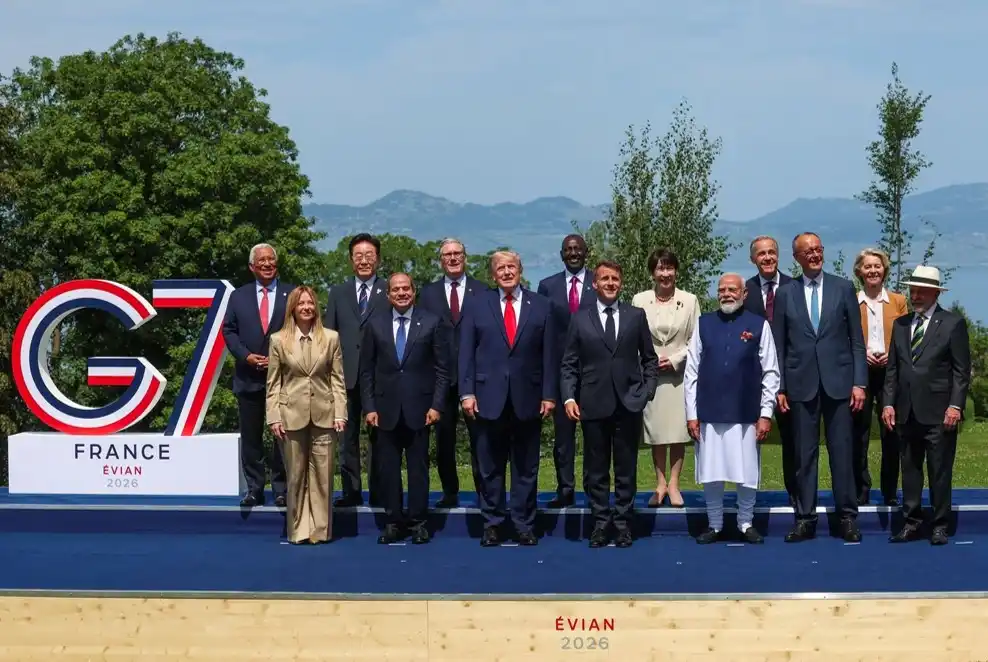
Prime Minister Narendra Modi delivered a powerful address at the 52nd G7 Summit in Evian-les-Bains, France, on Tuesday, June 16, 2026, voicing India’s firm concern over disruptions to maritime trade through the Strait of Hormuz and highlighting that several Indian civilians lost their lives during the West Asia conflict. Speaking at the outreach session on “Forging New Partnerships and Rebuilding International Solidarity,” Modi emphasized that lasting solutions to conflicts can only be achieved through dialogue, diplomacy, and international cooperation, while calling for the safety of seafarers who connect all nations through global maritime trade.The summit, held from June 15 to 17 on the shores of Lake Geneva, brings together leaders of France, Britain, Canada, Germany, Italy, Japan, and the United States alongside the European Union, with India invited as a partner country for its 13th participation and PM Modi’s 7th consecutive attendance. During his extensive diplomatic outreach on the sidelines, Modi held bilateral meetings with Canadian Prime Minister Mark Carney, British Prime Minister Keir Starmer, UAE President Sheikh Mohamed bin Zayed Al Nahyan, Kenyan President William Ruto, Egyptian President Abdel Fattah El-Sisi, Japanese Prime Minister Sanae Takaichi, and South Korean President Lee Jae-myung, while also exchanging greetings with U.S. President Donald Trump ahead of their scheduled bilateral meeting.Maritime Security and the Strait of Hormuz: India’s Core ConcernPM Modi’s remarks on the need to protect seafarers came amid growing anger in India over the deaths of three Indian crew members in a U.S. military attack on a merchant vessel off the coast of Oman last week. The U.S. Central Command said it had taken action against three vessels, Marivex on June 8, Settebello on June 9, and Jalveer on June 11, alleging that they were attempting to violate the U.S. blockade of Iranian ports. Modi raised this issue a day before his bilateral talks with President Trump, underscoring how conflicts in West Asia have disrupted global trade and caused loss of life.“We welcome the progress made in peace efforts in West Asia. This conflict has caused loss of life and property in our friendly countries in the region. Disruptions to maritime trade through the Strait of Hormuz have affected the global economy. Several Indian civilians have also lost their lives,” Modi said during his address. “It is our responsibility to ensure the safety of the seafarers who connect all nations through global maritime trade. We must ensure that maritime routes remain secure and that seafarers can perform their duties without fear,” he added.Modi’s concerns reflect India’s strategic dependence on the Strait of Hormuz, one of the world’s most critical maritime chokepoints for oil shipments and global commerce. As a major importer of energy and a nation with significant maritime trade volumes, disruptions in Hormuz directly impact India’s economic security, energy prices, and the safety of its nationals working in global shipping. The deaths of three Indian mariners in the U.S. strike have heightened domestic pressure on the government to address maritime security and protect Indian citizens abroad.Trust as the Ultimate Strategic Asset: Modi’s Vision for International RelationsIn his address, Modi underscored the importance of trust in international relations, saying that confidence among nations has become a more valuable strategic asset than minerals, technology, or markets. He argued that in an increasingly interconnected world, where energy, food, health, cyber, and economic security are closely linked, stronger international partnerships are essential for humanity’s progress and prosperity. Warning that trade and technology were being used to pursue narrow interests, Modi said such practices had contributed to a growing trust deficit in the international system.Modi wrote in an X post: “Shared my thoughts at the Outreach Session on ‘Forging New Partnerships and Rebuilding International Solidarity’ at the G7 Summit in Evian. In a world that is getting more interconnected and interdependent than ever before, this subject becomes all the more vital.” His emphasis on trust reflects India’s diplomatic philosophy that international cooperation must be founded on mutual respect, reciprocity, and shared interests rather than coercion or unilateralism.The trust deficit Modi highlighted is particularly relevant in the current global context, where geopolitical tensions, trade restrictions, technology bans, and security concerns have led nations to prioritize national interests over collective action. As the G7 discusses issues ranging from AI access to critical minerals supply chains, India’s call for trust-based partnerships offers an alternative framework that emphasizes inclusivity, cooperation, and shared prosperity for all nations, not just the wealthy few.Bilateral Outreach: Strengthening India’s Strategic PartnershipsIndia-Canada: Forward-Looking Strategic PartnershipDuring his meeting with Canadian Prime Minister Mark Carney, PM Modi and his counterpart welcomed the positive momentum in India-Canada relations and reaffirmed their commitment to building a forward-looking strategic partnership. The two leaders reviewed progress in economic cooperation, including commercial arrangements relating to Liquefied Natural Gas (LNG), Liquefied Petroleum Gas (LPG), and metallurgical coal. They expressed satisfaction over ongoing negotiations for a Comprehensive Economic Partnership Agreement, with both sides aiming to conclude the pact this year.The leaders also welcomed growing cooperation in science and technology, defence, finance, and migration. To further strengthen defence and security ties, the two countries agreed to launch negotiations on a General Security of Information Agreement. PM Modi expressed India’s support for Canada becoming a Dialogue Partner of the Indian Ocean Rim Association, and both leaders announced the establishment of Raisina Americas as a platform to enhance dialogue and cooperation.India-UK: Vision 2035 and Comprehensive Economic PartnershipDuring his meeting with British Prime Minister Keir Starmer, PM Modi reviewed progress in India-UK relations under Vision 2035. The two leaders welcomed cooperation across trade, defence, technology, education, and people-to-people ties, looking forward to the early implementation of the Comprehensive Economic and Trade Agreement. They expressed satisfaction over the strong education partnership, noting recent progress in establishing campuses of British universities in India, including the University of Liverpool in Bengaluru and the Universities of York and Bristol in Mumbai.The leaders exchanged views on regional and global developments and reaffirmed their commitment to further strengthening the India-UK Comprehensive Strategic Partnership, demonstrating how both nations are working to deepen their bilateral
PM Modi Launches Five-Nation Tour to Secure Energy, Tech Ties Amid Iran War
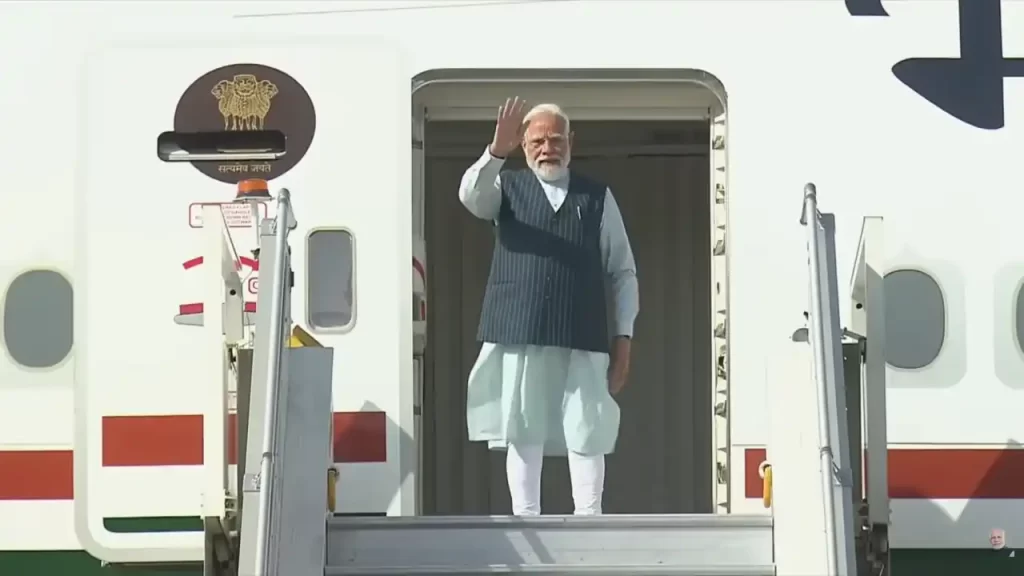
Prime Minister Narendra Modi has begun a massive five-nation tour starting in the United Arab Emirates (UAE). The trip runs from May 15 to May 20, 2026. It includes visits to the UAE, the Netherlands, Sweden, Norway, and Italy. The Prime Minister travels at a critical time when the ongoing war between the US and Iran has disrupted global shipping routes. Tensions around the Strait of Hormuz have caused oil prices to rise. This tour aims to secure India’s energy supply and strengthen technology partnerships. The visit comes right after India and the European Union signed a historic free trade agreement. Modi calls this deal the “mother of all deals.”The journey highlights India’s effort to build strong economic ties while managing global instability. Experts say diplomacy can reduce market panic, but oil prices will stay high until the war ends. Until then, India must focus on energy security and protecting its economy from rising costs.Visit to UAE: Fortifying Energy and Strategic TiesPM Modi landed in the UAE on May 15 to meet President Sheikh Mohamed bin Zayed Al Nahyan. Since 2014, Modi has visited the UAE seven times. President Sheikh Mohamed has visited India five times. Their relationship has only grown stronger over the years. The UAE has remained one of India’s most reliable energy partners even during this Gulf crisis. Long-term oil and gas supply agreements protect India’s energy security.Two important Memorandums of Understanding (MoUs) are likely to be signed during this visit. One deals with Liquefied Petroleum Gas (LPG). The other focuses on Strategic Petroleum Reserves. These deals will help India store more fuel for emergencies. Bilateral trade between India and the UAE crossed $101.25 billion in the last financial year. Both nations aim to double this trade to $200 billion by 2032. The UAE is India’s seventh-largest investor, with over $25 billion in cumulative investment.The UAE also hosts the largest group of Indian expatriates in the world. Over 4.5 million Indians live there. They form the backbone of the UAE economy. The leaders will discuss their welfare and safety. Remittances from these workers help India’s foreign exchange reserves. A Local Currency Settlement system allows trade in Indian Rupees and UAE Dirhams. This reduces dependence on the US dollar.Netherlands: Chip Deals and Water TechnologyThe Prime Minister arrived in the Netherlands from May 15 to 17. This is only his second visit since 2017. The partnership focuses on “innovation meets scale.” Dutch technology combines with India’s massive market size. Areas like semiconductors, water management, hydrogen, and maritime tech are key.A major business highlight is the agreement between Tata Electronics and ASML Netherlands. They will sign a deal to equip a semiconductor fabrication plant in Dholera, Gujarat. This boosts India’s chip-making capabilities. PM Modi and the Dutch Prime Minister visited the Afsluitdijk Dam together. This site shows cooperation in clean energy and sustainable fisheries. The Netherlands is India’s largest trading partner in Europe. Trade reached $27.8 billion in FY 2024-25. It is also India’s fourth-largest investor.The PM addressed the Indian community of over 90,000 NRIs. The visit also reached out to over 200,000 Surinami Hindustanis, the largest Indian-origin group in mainland Europe. Both nations are streamlining migration and mobility. Tourism between the two countries is set to grow.Sweden: Defense, AI, and Strategically De-risking from ChinaModi visited Sweden after an eight-year gap. He last went there in April 2018 for the first India-Nordic Summit. Sweden invests over 3 percent of its GDP in research and development. It ranks among the top innovators in Europe. Sweden has taken a firm stance to reduce its reliance on China. They removed Chinese vendors from their telecom networks. This makes India a key strategic partner.Bilateral trade reached $7.75 billion in 2025. Over 280 Swedish companies work in India. A major project is the Saab manufacturing plant in Jhajjar. Saab is building its first Carl-Gustaf weapon plant outside Sweden here. This is India’s first 100 percent FDI-driven defense project. Sweden also holds large critical mineral deposits. This helps India secure supply chains for electric vehicles and defense electronics.A new Statement of Intent created the Sweden-India Technology and AI Corridor (SITAC). It covers 6G, Artificial Intelligence, quantum computing, and life sciences. Over 80 Swedish companies attended the AI Impact Summit 2026. The Maharashtra government signed an MoU for electric boat investment worth Rs 1,990 crore.Norway: First Solo Visit in 43 Years and Arctic TechThis trip marks the first standalone visit by an Indian Prime Minister to Norway in 43 years. Modi attended the third India-Nordic Summit in Oslo. This summit places India in a high tier of Nordic engagement, joining only the United States. The India-EFTA TEPA agreement is now in force. It promises $100 billion in investment and one million jobs over 15 years.Norway’s sovereign wealth fund, the world’s largest at $2 trillion, has invested nearly $30 billion in India. Indian shipyards now hold 11 percent of Norwegian ship orders. Cochin Shipyard is building eco-friendly vessels for Norway. An MoU between GRSE and Kongsberg Maritime will deliver India’s first indigenous Polar Research Vessel.ISRO antennas at Svalbard became operational in 2026. They support India’s Arctic research. Norwegian tunneling technology helps the Char Dham railway project. Clean energy cooperation will diversify India’s energy mix. Norway also sees opportunities for Indian talent due to its aging population.Italy: Strategic Partnership and Submarine CablesPM Modi travels to Italy from May 19 to 21. He meets Prime Minister Giorgia Meloni to reaffirm their strategic partnership. The visit follows the Joint Strategic Plan of Action 2025-29. Italy views India as a major power and an indispensable partner.Italy champions the India-Middle East-Europe Economic Corridor (IMEEC). A new submarine cable, Sparkle-Airtel Blue-Raman, connects Genoa to India. This secures supply chains and boosts energy security. Bilateral trade reached $16.77 billion in 2025. The target is 20 billion euros by 2029. Tata Motors acquired the Iveco Group for 3.8 billion euros. This is the largest Indian investment in Italy. Italy opened a SIMEST office in Delhi to support SMEs.Energy Crisis and Global ImpactThe Iran war has caused
Adani, Leonardo Sign Strategic Deal for Helicopter Manufacturing in India
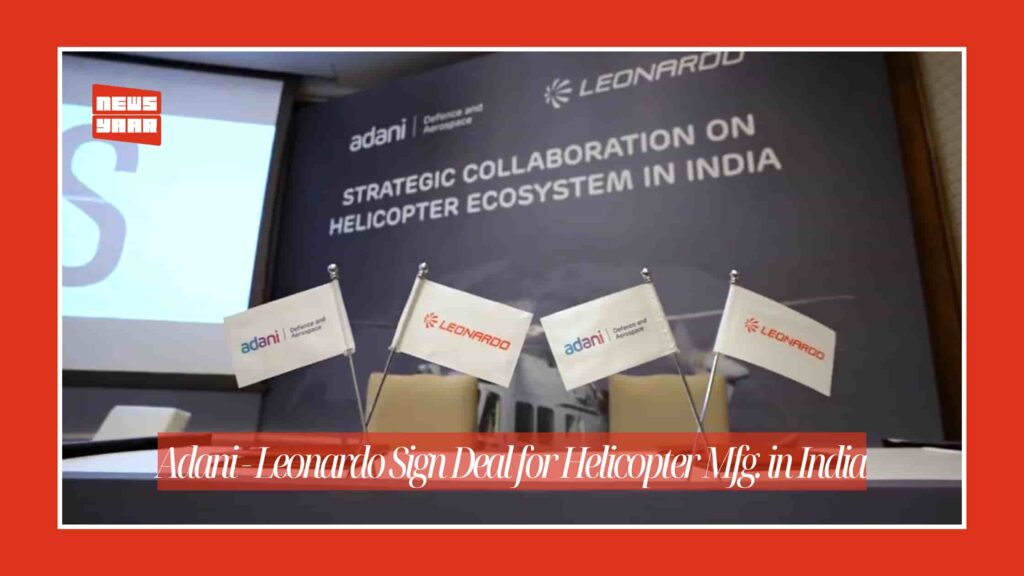
In a significant development for India’s defence and aerospace sector, Adani Defence & Aerospace, the defence arm of India’s Adani Group, and Leonardo, the Italian aerospace and defence giant, have signed a strategic Memorandum of Understanding (MoU) to establish a comprehensive helicopter manufacturing ecosystem in India. The partnership, announced in early February 2026, represents a milestone in the country’s bid to enhance indigenous manufacturing capabilities, support national security requirements and reduce dependence on imports for military rotorcraft. Overview of the Agreement The MoU was signed in New Delhi by Ashish Rajvanshi, CEO of Adani Defence & Aerospace, and Stefano Villanti, Senior Vice President – Helicopters at Leonardo, in the presence of senior officials including India’s Defence Secretary Rajesh Kumar Singh and Director General of Acquisition, A. Anbarasu. The agreement lays the foundation for collaborative efforts to develop, manufacture, sustain and support a range of helicopter platforms in India. Under the pact, both parties will work to build an integrated helicopter production base that encompasses not just manufacturing, but also assembly, maintenance, repair and overhaul (MRO) capabilities, pilot training infrastructure and a phased transfer of technology to Indian industry. Focus on Key Helicopter Platforms The partnership is expected to centre initially on the production of Leonardo’s AW169M and AW109 TrekkerM helicopter models — platforms designed for multi-role utility in military, parapublic, law enforcement and support missions. These models are chosen for their versatility, modern avionics and suitability for diverse operational environments. The strategic intent is to position India as a hub for helicopter manufacturing in the Asia-Pacific region, with future potential expansion into civil applications once the defence ecosystem is established. Market analysts believe that India’s armed forces may require more than 1,000 helicopters over the coming decade, making this collaboration timely for meeting long-term demand while promoting domestic capabilities. Strategic Importance and Government Alignment The Indo-Italian partnership aligns closely with the Government of India’s “Make in India” and “Aatmanirbhar Bharat” (self-reliant India) initiatives, which seek to strengthen the domestic defence industrial base, attract foreign direct investment and develop advanced technological and manufacturing expertise within the country. By facilitating technology transfer, indigenous production and high-skill job creation, the collaboration is expected to contribute to broader policy goals of reducing import dependency in critical defence platforms while improving operational readiness and supply chain resilience for the Indian Armed Forces. Economic and Industrial Impact Industry observers note that the agreement could catalyse growth in India’s aerospace sector by: Creating an integrated manufacturing ecosystem for helicopters and related aerospace products Fostering technology transfer and skill development for Indian engineers and technicians Boosting local supply chains and components manufacturing **Generating high-value employment opportunities across engineering, production and MRO segments Supporting ancillary industries such as avionics, composite materials and specialised tooling The collaboration also has potential spill-over effects into civil aviation and emergency services, where helicopter platforms play a key role in operations such as medical evacuation, disaster relief, law enforcement support and search-and-rescue missions. Context: Rising Demand for Helicopters India’s demand for helicopters spans both military and civilian needs. The Indian armed forces regularly modernise and expand their rotary-wing fleets to address border security, rapid deployment, logistics and humanitarian tasks. Meanwhile, civil sectors including tourism, offshore operations and corporate transport increasingly require reliable and versatile helicopter platforms, driving overall growth in the rotorcraft market. Broader Aerospace Strategy of Adani Defence & Aerospace This strategic tie-up with Leonardo complements other moves by Adani Defence & Aerospace to broaden its footprint in India’s aerospace landscape. For instance, the company recently signed a separate MoU with Brazilian aerospace firm Embraer to explore the establishment of an integrated regional transport aircraft manufacturing ecosystem, aiming to set up assembly lines and develop supply chain and pilot training infrastructure in support of India’s broader aviation ambitions. These partnerships reflect Adani’s evolving role in advancing India’s capabilities in both fixed-wing and rotary-wing aviation manufacturing — a sector historically dominated by public-sector enterprises and foreign imports. Industry and Market Reaction The announcement has been met with cautious optimism in industry circles and on financial markets. Shares of Leonardo saw a modest uptick following the news, signalling investor confidence in the strategic growth potential of expanded manufacturing operations in India. Analysts have highlighted that structured collaborations between Indian private industry and global aerospace leaders could accelerate the development of high-end manufacturing competencies domestically. Challenges and Future Prospects While the MoU lays a strategic roadmap, experts note that detailed implementation will require further clarity on timelines, investment commitments, facility locations and regulatory approvals. Establishing an end-to-end helicopter manufacturing ecosystem — from component production to final assembly and life-cycle support — is capital-intensive and requires strong coordination between industry partners, government bodies and defence stakeholders. Nevertheless, the Adani-Leonardo partnership is widely seen as a transformational step in India’s defence manufacturing strategy, reinforcing the country’s march towards self-reliance and technological maturity in aerospace.
Olympic Winter Games 2026: Milano Cortina 2026 — A Historic Global Sporting Spectacle

The 2026 Winter Olympics, officially known as the XXV Olympic Winter Games and commonly branded as Milano Cortina 2026, is an international multi-sport winter event taking place in northern Italy from 6 February to 22 February 2026 with some competitions beginning as early as 4 February 2026. This edition marks a milestone in Olympic history — the first Winter Olympics co-hosted by two cities, Milan and Cortina d’Ampezzo, under a unified organisational framework. Host Selection and SignificanceItaly secured the Games following a successful joint bid by Milan and Cortina d’Ampezzo at the 134th International Olympic Committee (IOC) Session in June 2019, defeating a competing bid from Stockholm–Åre (Sweden). Milano Cortina 2026 represents the third Winter Olympics in Italy — following Cortina d’Ampezzo in 1956 and Turin in 2006 — and marks a renewed celebration of winter sport in a region long intertwined with alpine traditions and sporting heritage.The official motto of the Games is “IT’s Your Vibe”, reflecting a blend of Italian cultural energy, local identity and global sporting spirit.Dates and CeremoniesOfficial Dates: 6 February 2026 to 22 February 2026Opening Ceremony: 6 February 2026 at San Siro (Milano San Siro Olympic Stadium) in Milan, with performances celebrating Italian art and culture and featuring global artists.Closing Ceremony: 22 February 2026 at the Verona Arena, a historic Roman amphitheatre — the first Olympic closing ceremony held at a UNESCO World Heritage site.The opening ceremony celebrates unity and international cooperation, while the closing ceremony traditionally honours athletes, volunteers and the Olympic spirit.Participation and ScopeThe 2026 Winter Olympics is expected to be one of the most expansive in Winter Games history:Participating Nations: ~92 countries with representation under their national flags.Athletes: Around 2,900 competitors from around the world.Sports Disciplines: 16 winter sports across eight major categories.Medal Events: 116 medal events spread across ice and snow disciplines.The Games are anticipated to be the most geographically spread-out Winter Olympics ever staged, with competition venues spanning multiple regions of northern Italy — from metropolitan Milan to the alpine slopes of the Dolomites and valleys of Lombardy and Veneto.Competition Venues and SportsMilan:San Siro Stadium: Host of the Opening Ceremony.Milano Ice Skating Arena: Figure skating and short-track speed skating.Milano Ice Park / Speed Skating Stadium: Long-track speed skating and select ice hockey events.Milano Santagiulia Ice Hockey Arena: Ice hockey and Para ice hockey (future Paralympics).Cortina d’Ampezzo and Surroundings:Tofane Alpine Ski Centre: Women’s Alpine skiing.Cortina Sliding Centre: Bobsleigh, skeleton and luge.Cortina Para Snowboard Park: Para snowboard events.Other Alpine Locations:Bormio (Stelvio): Men’s Alpine skiing.Livigno: Freestyle skiing and snowboarding.Val di Fiemme / Predazzo and Tesero: Nordic combined, cross-country skiing, ski jumping and biathlon.This multi-venue approach brings seasonal sports to iconic alpine landscapes while integrating urban and mountain cultural settings.Sports and EventsThe 2026 Winter Olympics features:Alpine skiingBiathlonBobsleighCross-country skiingCurlingFigure skatingFreestyle skiingIce hockeyLugeNordic combinedShort track speed skatingSkeletonSki jumpingSnowboardingSpeed skatingSki mountaineering — making its Olympic debut at the Winter Games.A total of 116 Olympic medals are contested, showcasing both traditional and emerging winter sports disciplines.Historic and Cultural ContextThe 2026 Games highlight several historic and cultural facets:First co-hosted Winter Olympics by two cities, Milan and Cortina.Alpine heritage: Cortina d’Ampezzo previously hosted the Winter Olympics in 1956, reinforcing Italy’s legacy in winter sport.Olympic inclusion: The Games continue efforts to expand global representation, with nations such as Benin, Guinea-Bissau and the United Arab Emirates making their Winter Olympics debuts.Gender balance: Milano Cortina aims for near gender parity with record female participation.Opening Ceremony and Global EngagementThe Opening Ceremony in Milan at San Siro Stadium will feature artistic performances by international and Italian cultural figures, elaborate choreography, lighting of the Olympic flame and the Parade of Nations. The ceremony emphasizes unity and celebration of diversity, underlining the Olympic values of peace, fair play and cultural exchange.Medal Design and SymbolismThe official Olympic medals for Milano Cortina 2026 were unveiled in Venice prior to the Games. Produced by Italy’s state mint, they incorporate symbolic inscriptions and designs that celebrate the athlete’s journey and the spirit of competition.Challenges and Environmental ConsiderationsWhile the Games embody global sporting ideals, they have also faced scrutiny over environmental and infrastructural challenges. Critics have highlighted issues related to construction delays and extensive use of artificial snow, prompting broader discussions about sustainability, resource impact and the ecological footprint of large-scale sporting events.Why Milano Cortina 2026 MattersMilano Cortina 2026 stands as a major milestone in Winter Olympic history:It reinforces Italy’s global role in international sport through heritage, culture and modern event management.It expands the global winter sports landscape by introducing new events and drawing nations with emerging winter sport programmes.It highlights sustainability, inclusion and gender equality as core principles.As athletes compete across snow and ice for two weeks of world-class competition, Milano Cortina 2026 represents both a celebration of athletic excellence and a testament to the unifying power of sport in a complex world.Watch Live Ceremony: https://www.olympics.com/en/milano-cortina-2026/videos/opening-ceremony-ceremonies-milano-cortina-2026