One Remark. One Week. Twenty Million Followers.
It started with a judge. It became a movement. And then the government tried to shut it down — which, as anyone who has followed internet culture for five minutes could have predicted, only made it louder.
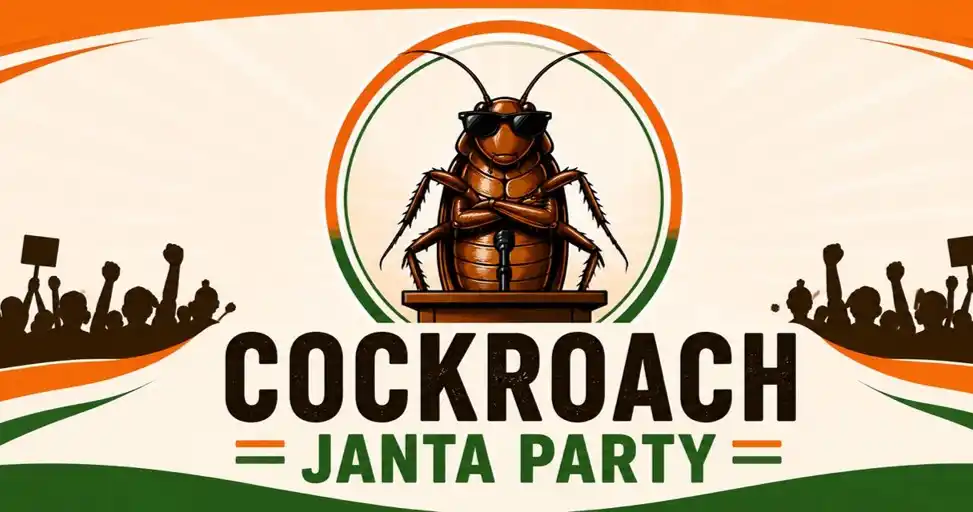
The Cockroach Janta Party, or CJP, is an Indian satirical political movement founded on May 16, 2026 by Abhijeet Dipke, a political communications strategist who formerly worked with the Aam Aadmi Party. Within days of its launch, the fake party had garnered more followers on some social media platforms than India's main political parties. The CJP's Instagram account surpassed the BJP's 8.7 million Instagram followers within four days of launch, reaching 10.9 million by May 21, over 14 million by May 22, and 22.8 million as of May 26.
To put that in perspective: the BJP has been around for over 40 years. The CJP has been around for less than two weeks.
Where It All Started: A Judge, a Courtroom, and a Word That Detonated
On May 15, 2026, Chief Justice of India Surya Kant compared some unemployed youth to "cockroaches" and "parasites of society" during a Supreme Court hearing on fake professional credentials, according to The Wire.
The context, as the Chief Justice later clarified, was specific. Kant tried to put a lid on the controversy, insisting he hadn't referred to unemployed youth in general as vermin, just those who get jobs by faking degrees. "What I had specifically criticized were those who have entered professions like the bar with the aid of fake and bogus degrees," he said.
The clarification was accurate. The damage was already done.
Gen Z and millennial social media users adopted the moniker as a satirical badge of protest against unemployment and inflation. Because here is the thing about calling India's unemployed youth cockroaches in 2026: the youth unemployment crisis is not a fringe issue. It is the defining economic anxiety of an entire generation. When you hand that generation a slur and a Wi-Fi connection, you do not get contrition. You get a movement.
The Man Who Built the Movement in 24 Hours
Abhijeet Dipke, an Indian student studying public relations at Boston University, launched the online party on May 16 — turning the judge's purported insult into a symbol of youth anger. The pseudo-party describes itself as a "political front of the youth, by the youth, for the youth" and a "Voice of the Lazy and Unemployed."
The party's website went live on May 16 under the tagline "Voice of the Lazy and Unemployed." Dipke used artificial intelligence tools like Claude and ChatGPT to design the website and the manifesto. AI-generated images were used to promote the movement across issues.
The name "Cockroach Janta Party" is a play on the ruling party, the Bharatiya Janata Party. The founder claims that CJP is not affiliated with any political organisation. That last point matters. This is not Congress in disguise. It is not an AAP operation. It is not an opposition front. It is something that established political commentary in India genuinely does not have a framework for: a purely organic, social media-native, Gen Z-first satirical movement that is angry at everyone.
Dipke said: "We have to understand that five years ago nobody was ready to speak up against Modi or the government. The times are changing."
The Manifesto: Satire With Real Demands Inside
The CJP is self-described satire. But its manifesto is not a joke. The Cockroach Janta Party manifesto has five demands: first, no Rajya Sabha seat for any retiring Chief Justice; second, the Chief Election Commissioner to be held accountable under UAPA for deleted voter rolls; third, women's reservation raised to 55 percent; fourth, time-bound Election Commission action on vote deletion; and fifth, political literacy for India's youth.
In its manifesto, the Cockroach Janta Party said it will cancel the licences of "all media houses owned by Ambani and Adani" — referring to two of India's richest men, Mukesh Ambani and Gautam Adani, who own prominent television channels and are seen as being close to Modi — "to make way for a truly independent media."
Read that list again. The SIR voter roll deletions that dominated the West Bengal and Tamil Nadu election campaigns. Women's reservation, which Parliament passed but failed to implement. Judicial accountability. Media independence. Political literacy. These are not troll demands. These are the actual policy grievances of a generation that watched the 2026 elections unfold and concluded that the system was not working for them.
The movement has also engaged in offline activities, with volunteers participating in protests and clean-up drives dressed in cockroach costumes. A cockroach cleaning up a city. The metaphor practically writes itself.
The Government's Response: A Masterclass in How Not to Handle Satire
Here is where the story pivots from funny to serious.
On May 21, 2026, MeitY directed X to withhold the CJP's @CJP_2029 account under Section 69A of the Information Technology Act, 2000, citing Intelligence Bureau inputs on national security. No public order was issued. The blocking order remains confidential under Rule 16 of the Information Technology Blocking Rules.
The IB cited "national security concerns" and a threat to the "sovereignty of India."
Union Minister Sukanta Majumdar alleged that 49 percent of CJP followers are from Pakistan and only 9 percent are from India. However, a screen recording from Dipke shows that over 94 percent of the audience is Indian.
The government did not ban the manifesto text directly, but it blocked every platform the manifesto was published on: X withheld under Section 69A on May 21, the Instagram account hacked on May 23, and the .org website blocked by MeitY on May 23. The CJP continues to operate at an alternative domain.
By moving to block the account, the government ended up validating the very criticism the satire sought to make. A parody page that might otherwise have remained a passing internet joke suddenly acquired political significance because of official intervention. In trying to suppress ridicule, the authorities amplified it.
This is a lesson as old as the internet and apparently still being learned: nothing makes a meme go more viral than a government banning it.
In Court: The Legal Battle
CJP founder Abhijeet Dipke filed a writ petition challenging the Central Government's order under Section 69A of the IT Act, which had withheld the satirical group's official X handle citing "national security grounds." He had earlier also claimed that the party's Instagram and X accounts were being hacked before getting suspended. Senior advocate Akhil Sibal represented Dipke.
Sibal noted that the petitioner was fine if specific offensive posts remained blocked, and highlighted that Dipke is currently out of the country and still receiving death threats.
The Delhi High Court sought responses from the Centre and social media platform X. The court declined to order the immediate restoration of the account, observing that the matter carried wider legal and constitutional implications that required detailed examination. Justice Purushaindra Kumar Kaurav directed the Review Committee constituted under the IT framework to examine Dipke's challenge and place its findings on record.
The court orally said that the "entire activity per se is offending, that is why this case is slightly different."
A separate petition had also been filed in the Supreme Court of India, seeking investigation by the CBI into activities of the party, along with investigation into fake advocates and fraudulent law degrees.
Why This Matters Beyond the Memes
South Asia has seen a number of youth-led movements against anger over corruption and inequality. The CJP arrives in a specific Indian context that makes it more than a copycat of Bangladesh's 2024 quota protests or Sri Lanka's Aragalaya.
India in 2026 has a youth unemployment problem that official statistics consistently undercount and that every young Indian in every tier-2 and tier-3 city understands in their bones. It has just concluded an election cycle in which 91 lakh voters were deleted from electoral rolls in one state alone. It has a Women's Reservation Bill on the books that will not produce a single reserved seat until at least 2029. It has a media landscape that a significant portion of the under-35 population does not trust.
The CJP did not create any of these grievances. It just gave them a logo, a cockroach mascot, and an Instagram account that 22 million people followed in under two weeks.
Senior Congress leader Shashi Tharoor pointed out that the episode "confirms to us the extent to which there is frustration and dissatisfaction that the public can express through being able to tap into an initiative like this."
Though the movement is not registered as a political party with the Election Commission of India, it campaigns against broader societal, economic, and political issues affecting the Indian youth. Whether it ever becomes a real party — whether it even needs to — is the wrong question. The right question is what happens to 22 million angry young people when the meme cycle eventually moves on. The answer to that question will be determined not by social media but by whether any established political force bothers to address the substance underneath the satire.
For now, the cockroaches are in court. The government is defending the constitutionality of silencing a joke. And somewhere in Boston, a 20-something with a laptop and Claude credits is watching 22 million people follow an account he built in an afternoon.
The times are, as Abhijeet Dipke said, changing.