
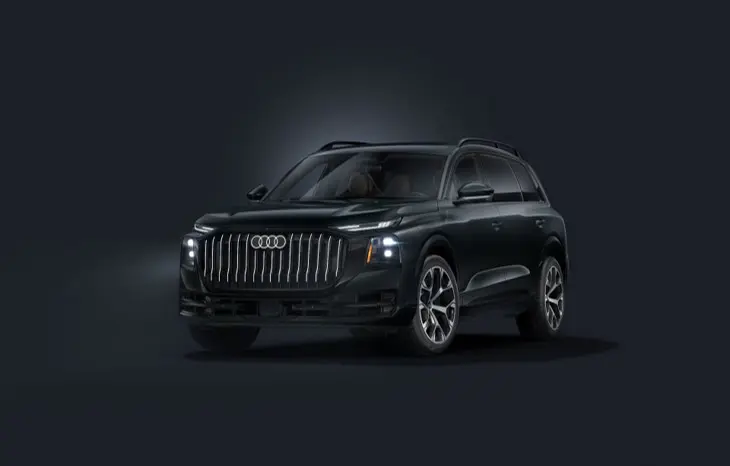
Audi has officially unveiled the Q9, its largest SUV yet and the first model in the company's history to carry the Q9 nameplate. Positioned above the Q7, the new SUV becomes the flagship of Audi's portfolio and marks the German automaker's entry into the full-size luxury SUV segment dominated by models such as the BMW X7 and Mercedes-Benz GLS.
The Q9 was unveiled globally on July 29, 2026, after Audi had released details of its interior earlier in the year. The production version combines a large three-row cabin with premium materials, advanced digital technology, sophisticated chassis systems and a choice of six- or seven-seat configurations.
For India, however, the Q9 is still a future product. Audi India has confirmed that the model is part of its upcoming product strategy, with the Q9 expected to reach the Indian market in 2027. Recent reports indicate that the India launch is planned for the second quarter of 2027, although Audi has not yet announced final Indian pricing or specifications.
Audi Enters the Full-Size SUV Segment
The Q9 fills a gap that has existed in Audi's SUV line-up for years.
The company already sells the Q7, which occupies the upper end of its SUV range, while the Q8 serves as a more design-oriented luxury SUV. However, Audi did not previously have a model directly positioned against the BMW X7 and Mercedes-Benz GLS in the full-size luxury SUV category.
The Q9 changes that.
At 5.31 metres long, the Q9 is the largest production Audi ever built. It has a 3.14-metre wheelbase, giving engineers considerable room to prioritise passenger space, especially in the second and third rows.
Audi is positioning the model not simply as a larger Q7, but as its new flagship SUV.
The company's CEO, Gernot Döllner, described the Q9 as the new flagship of the Audi portfolio, while the company says the model is intended to raise the brand's premium positioning at the top end of the market.
Design: A New Direction for Audi's Largest SUV
The Q9 adopts a new interpretation of Audi's SUV design language.
Its proportions are dominated by its sheer size, but Audi has attempted to maintain the brand's relatively restrained design character rather than giving the SUV an excessively aggressive appearance.
At the front, the Q9 features a large grille with the familiar four-ring badge, positioned between a distinctive split-headlamp arrangement. The lighting elements are integrated into a wider front design that gives the SUV a broad stance.
The rear receives another significant technology highlight: curved digital OLED rear lights. Audi describes these as a world first for a production vehicle. The lighting system can display different signatures and uses digital technology to create a distinctive rear appearance.
The Q9 can also be equipped with wheels measuring up to 23 inches, reinforcing its positioning as a large luxury SUV.
The Largest Audi Panoramic Roof Yet
One of the most distinctive elements of the Q9's design is its large panoramic roof.
Audi says the Q9 features its largest panoramic sunroof, with a surface area of approximately 1.5 square metres. The roof can be configured with switchable transparency, allowing occupants to alter the amount of light entering the cabin.
The feature is part of Audi's broader focus on creating a spacious and lounge-like interior rather than treating the third row simply as additional seating.
The large glass area also contributes to the perception of space inside the cabin.
Six- and Seven-Seat Configurations
The Audi Q9 will be offered with flexible seating arrangements.
The standard configuration provides seven seats, arranged across three rows.
Audi will also offer a six-seat configuration, replacing the second-row bench with individual seats. This arrangement is designed for customers who prioritise second-row comfort and a more executive-style cabin experience.
The third row has also received attention. Audi has designed the cabin to make access to the rearmost seats easier, addressing one of the common compromises associated with large three-row SUVs.
This flexibility means the Q9 can serve different purposes, from family transportation to chauffeur-driven travel.
Electrically Operated Doors
The Q9 introduces another unusual feature for Audi: electrically operated doors.
Audi says the model is its first vehicle to offer electrical operation for all four doors. The system is intended to make entry and exit easier while adding to the premium experience expected from a flagship model.
The feature is particularly relevant to a vehicle of this size, where ease of access becomes an important part of everyday usability.
Interior Focuses on Space and Comfort
The Q9's interior is one of its strongest selling points.
Audi has designed the cabin around the idea of a spacious, quiet and technologically advanced environment for long-distance travel.
The second row can be equipped with individually adjustable electric seats, while the front seats can offer functions such as heating, ventilation and massage depending on configuration.
Audi has also incorporated extensive storage areas into the cabin.
The centre console includes wireless charging facilities, while USB-C ports can provide charging power of up to 100 watts.
The luggage compartment also receives an aluminium rail system that allows luggage and cargo to be secured using adjustable hooks and anchors.
This is particularly useful in a three-row SUV, where luggage capacity and cargo management can become complicated when all seats are occupied.
Audi's New Digital Experience
The Q9 follows Audi's latest approach to in-car technology, with a multi-screen digital cockpit.
The dashboard features a large curved display arrangement and a dedicated screen for the front passenger. Audi's objective is to create a digital environment that combines vehicle controls, navigation, entertainment and connectivity without relying exclusively on traditional physical controls.
The passenger display allows the front passenger to interact with selected functions independently of the driver.
This approach is increasingly common among luxury manufacturers as they turn the cabin into a connected digital environment rather than treating infotainment as a standalone system.
Premium Audio System
Audi is also placing considerable emphasis on the Q9's audio experience.
The SUV can be equipped with a Bang & Olufsen 4D sound system, designed to provide an immersive audio experience throughout the cabin. Audi has positioned the system as part of the vehicle's broader focus on comfort and in-car entertainment.
For a vehicle expected to be used frequently for long journeys, features such as advanced audio, connected services and rear-seat comfort are becoming increasingly important in the luxury SUV segment.
Powertrain: Diesel at Launch in Europe
The Q9's powertrain strategy is particularly notable because Audi has launched the European version initially with a diesel engine.
The European-market Q9 is powered by a 3.0-litre V6 TDI diesel engine producing 220 kW, or 299 PS, and up to 630 Nm of torque.
The engine is paired with a 48-volt mild-hybrid system, which can provide additional electrical assistance and improve efficiency during certain driving conditions.
The mild-hybrid system can temporarily provide additional power during acceleration, while energy recuperation allows some energy normally lost during braking to be recovered.
The engine is paired with an eight-speed Tiptronic automatic transmission, while Audi's quattro all-wheel-drive system is standard.
The combination is designed to provide the kind of effortless low-speed torque required by a large luxury SUV.
The Q9's American Powertrain Options
The Q9's powertrain line-up differs by market.
For North America, Audi has also presented the Q9 with a 2.9-litre turbocharged V6 producing 429 hp, while the performance-oriented SQ9 uses a 4.0-litre twin-turbo V8 developing 591 hp.
The SQ9 is currently positioned primarily for the US market, and Audi has not confirmed that the same specification will be offered in every international market.
This is important when discussing the Q9 because specifications should not be treated as identical across all countries.
Chassis and Driving Technology
Despite its considerable dimensions, Audi has equipped the Q9 with technologies intended to improve its handling and manoeuvrability.
The SUV uses adaptive air suspension, which can alter the vehicle's ride height and suspension characteristics depending on driving conditions and selected modes.
All-wheel steering is available as an option, helping reduce the turning circle at lower speeds while improving stability at higher speeds.
For a vehicle measuring more than five metres in length, this technology is particularly useful in urban environments.
The Q9 is also capable of towing up to 3.5 tonnes, making it relevant not only as a luxury family SUV but also as a long-distance towing vehicle.
Safety and Driver Assistance
As Audi's flagship SUV, the Q9 comes with an extensive package of active and passive safety technologies.
The vehicle uses cameras, sensors and radar-based systems to monitor the surrounding environment and support the driver.
Depending on the market and specification, the assistance systems can help with functions such as:
- Adaptive cruise control
- Lane assistance
- Parking assistance
- Surround-view monitoring
- Emergency braking
- Traffic-sign recognition
- Blind-spot monitoring
Audi has also placed considerable emphasis on lighting technology.
The Q9's advanced lighting systems are designed not only to improve visibility but also to communicate information to other road users through different lighting signatures.
A Practical Luxury SUV
Although the Q9 is positioned as a premium flagship, Audi has not ignored practicality.
The three-row configuration gives it the flexibility to carry larger families, while the optional six-seat configuration targets customers who place greater emphasis on rear-seat comfort.
The vehicle also provides a range of storage solutions, including the adjustable cargo rail system in the luggage compartment.
For customers using the Q9 as an executive vehicle, the second-row seating configuration could be particularly significant.
For families, meanwhile, the seven-seat layout provides greater flexibility.
Q9 vs Audi Q7
The Q9 does not replace the Q7 in Audi's global SUV line-up.
Instead, it sits above it.
The Q7 remains a large luxury SUV designed around a balance of performance, practicality and premium equipment. The Q9 takes the concept further by offering greater dimensions, more cabin space and a higher level of equipment.
The Q9 is also positioned more directly against full-size luxury SUVs such as the BMW X7 and Mercedes-Benz GLS.
This creates a clearer hierarchy within Audi's SUV portfolio:
Q7: Large premium SUV
Q8: Sportier, design-focused luxury SUV
Q9: Full-size flagship luxury SUV
Competition: BMW X7 and Mercedes-Benz GLS
The Q9 enters a segment that has already been established by BMW and Mercedes-Benz.
The BMW X7 and Mercedes-Benz GLS have become important products in the full-size luxury SUV category, particularly in markets such as the United States, China and parts of Asia.
Audi's decision to introduce the Q9 is therefore a strategic move to compete directly in this segment.
The Q9's key selling points will be its size, Audi's quattro all-wheel-drive system, technology-heavy interior and emphasis on passenger comfort.
The competition, however, is well established, meaning Audi will need to differentiate the Q9 beyond simply offering another large luxury SUV.
Pricing
In Germany, the Audi Q9 starts at €108,400 for the Q9 TDI quattro.
That places it firmly in the luxury SUV category and gives an indication of where Audi intends to position the vehicle globally.
The Indian price will be substantially different once taxes, import duties, logistics and the final specification are taken into account.
Audi has not yet announced the official India price, so current online estimates should not be treated as confirmed figures.
When Will Audi Q9 Launch in India?
The Q9 has not yet been launched in India.
Audi India has confirmed that the Q9 is among the new models planned as part of its strategy to expand its presence in the Indian luxury-car market. The company has said it plans to introduce the Q9 in India by 2027.
Reports currently point towards an India launch in the second quarter of 2027, but Audi has not yet announced the exact launch date, Indian specifications or final pricing.
This distinction is important because the Q9's European and North American specifications may not necessarily be identical to the version eventually sold in India.
Why the Q9 Matters for Audi
The Q9 is more than another addition to Audi's SUV range.
It represents Audi's attempt to strengthen its position at the very top of the luxury market.
For years, the German manufacturer had the Q7 as its largest mainstream SUV, while competitors had increasingly moved towards even larger models.
The Q9 closes that gap.
The model also demonstrates how Audi is redefining the idea of a flagship vehicle. Instead of relying solely on the traditional luxury sedan format, the company is placing a large three-row SUV at the top of its portfolio.
This reflects a wider shift in the luxury automobile market, where SUVs have become increasingly important to premium manufacturers.
What the Q9 Means for the Indian Luxury SUV Market
India is a relatively small market compared with Europe, China and the United States for ultra-luxury SUVs, but demand for premium three-row vehicles has been growing.
The Q9 could appeal to customers looking for a large German luxury SUV with substantial road presence, high levels of technology and a spacious cabin.
Its biggest challenge in India will be its size.
At more than 5.3 metres long, the Q9 is considerably larger than many SUVs commonly used on Indian roads. However, the Indian luxury-car market already has customers for vehicles such as the Mercedes-Benz GLS, BMW X7 and other full-size SUVs.
Audi's existing Q7 customer base could also provide a natural audience for the new model.
A New Flagship for Audi
The Audi Q9 marks a significant expansion of the company's SUV ambitions.
With its 5.31-metre length, three-row cabin, six- and seven-seat configurations, advanced lighting technology, electrically operated doors, panoramic roof and premium digital cockpit, the Q9 is designed to compete at the highest end of the luxury SUV market.
Its launch also shows how Audi is increasingly using technology and passenger experience as important elements of its flagship strategy.
The initial European version combines a 3.0-litre V6 diesel with mild-hybrid assistance, while other markets receive different powertrain options, including the powerful SQ9 in North America.
For Indian buyers, the Q9 remains a vehicle to watch rather than one currently available for purchase. Audi has confirmed its India plans for 2027, but the company is yet to disclose the exact Indian launch date, specification and price.
If Audi can successfully translate the Q9's combination of space, technology and luxury into the Indian market, the model could become an important new contender in the country's growing full-size luxury SUV segment.