
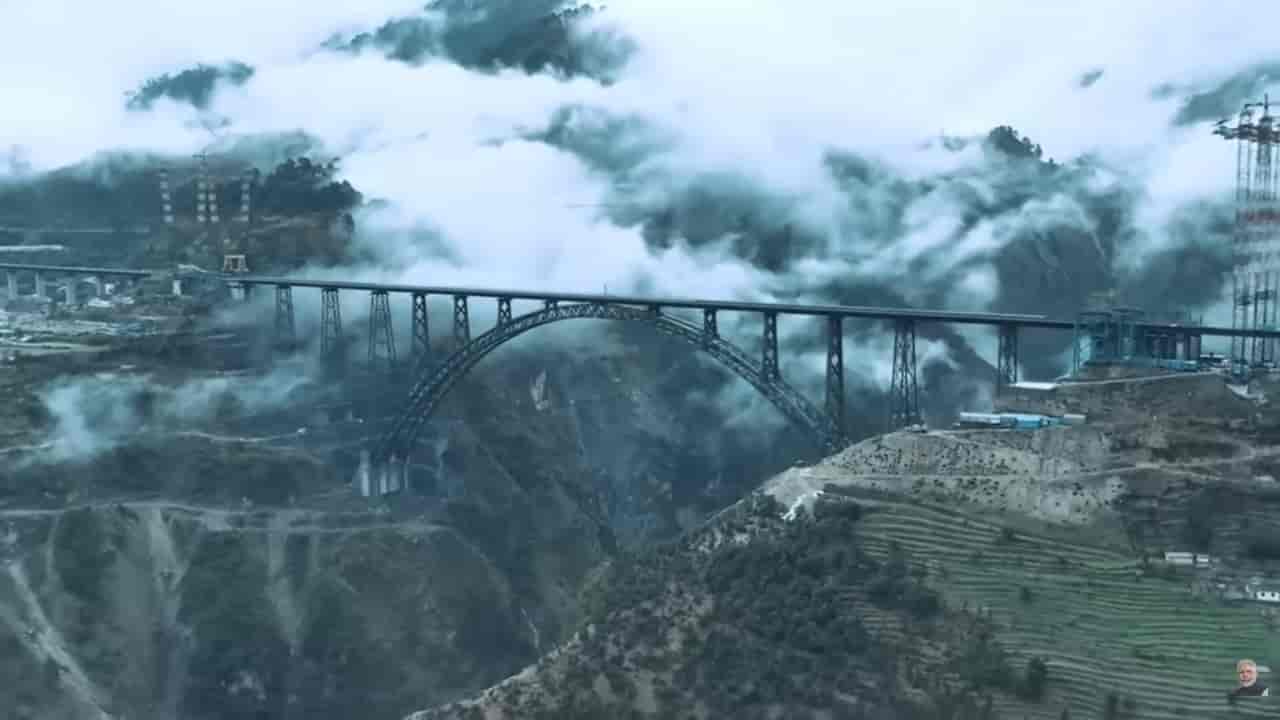
The Chenab Bridge, built across the Chenab River in the Union Territory of Jammu and Kashmir, stands as one of the most remarkable feats of modern engineering in India. Constructed as part of the ambitious Udhampur–Srinagar–Baramulla Rail Link (USBRL), the bridge has gained global attention for its height, design complexity, and strategic importance.
Often described as a symbol of India’s infrastructural progress in difficult terrain, the Chenab Bridge is now recognized as the world’s highest railway bridge, surpassing even iconic structures like the Eiffel Tower in height from its base.
Location and Strategic Importance
The Chenab Bridge is located between Bakkal and Kauri in the Reasi district of Jammu and Kashmir, spanning the deep gorge of the Chenab River. The region is known for its rugged Himalayan terrain, seismic sensitivity, and challenging weather conditions, making construction extremely demanding.
The bridge is a crucial component of the USBRL project, which aims to provide all-weather rail connectivity to the Kashmir Valley, linking it with the rest of India. This connectivity is expected to significantly improve:
- Transportation and logistics
- Tourism and economic activity
- Strategic and defence mobility in the region
Record-Breaking Height and Structure
The Chenab Bridge stands at an astonishing height of 359 metres above the riverbed, making it the highest railway bridge in the world. For perspective, it is about 35 metres taller than the Eiffel Tower.
The total length of the bridge is approximately 1,315 metres, and it is designed as a steel arch bridge, a structure chosen specifically to withstand the extreme conditions of the region.
Engineering and Design Features
The bridge has been designed to endure some of the harshest environmental and geological challenges. Key features include:
High Wind Resistance
The structure is capable of withstanding wind speeds of up to 260 km/h, ensuring safety even in extreme weather conditions.
Seismic Safety
Given that the region falls in a high seismic zone, the bridge has been engineered to withstand earthquakes of significant magnitude, making it structurally resilient.
Blast-Proof Design
Considering its strategic importance, the bridge has been designed with blast-resistant features, adding an additional layer of security.
Longevity
The structure has an estimated lifespan of over 120 years, reflecting the durability of materials and engineering precision used in its construction.
Construction Challenges
Building the Chenab Bridge was not just an engineering task but a logistical and environmental challenge.
- The remote and mountainous location made transportation of materials extremely difficult.
- Extreme temperatures, landslides, and high winds frequently disrupted construction work.
- Specialised equipment and techniques were required to construct the massive steel arch over a deep gorge.
Advanced technologies such as cable cranes, incremental launching, and precision welding were used to complete the structure.
The project involved collaboration between Indian Railways and several international engineering firms, highlighting the global scale of expertise required.
Role in the USBRL Project
The Indian Railways has undertaken the USBRL project to connect Kashmir via rail for the first time in history. The Chenab Bridge is considered the most critical and iconic segment of this project.
Once fully operational, the rail link is expected to:
- Reduce travel time between Jammu and Srinagar
- Provide reliable connectivity in all seasons
- Boost regional integration and development
Economic and Social Impact
The completion of the Chenab Bridge is expected to have far-reaching effects:
- Tourism Boost: Easier access to Kashmir could significantly increase tourist inflow.
- Trade and Commerce: Improved logistics will benefit local businesses and industries.
- Employment Opportunities: Infrastructure development will generate jobs in the region.
- Regional Connectivity: It will reduce isolation and improve access to essential services.
A Symbol of Modern India
Beyond its technical specifications, the Chenab Bridge represents a broader narrative of India’s infrastructural ambition and capability. Constructed in one of the most challenging terrains in the world, it reflects the country’s ability to execute large-scale projects with precision and resilience.
It also stands as a testament to the dedication of engineers, workers, and planners who turned a seemingly impossible vision into reality.
The Chenab Bridge is not just a railway structure—it is a landmark achievement that has redefined engineering possibilities in India, while playing a pivotal role in connecting the Kashmir Valley to the national railway network.