


Australia Win T20 Women’s World Cup: Beth Mooney’s Masterclass Lifts the Seven-Time Champions Again
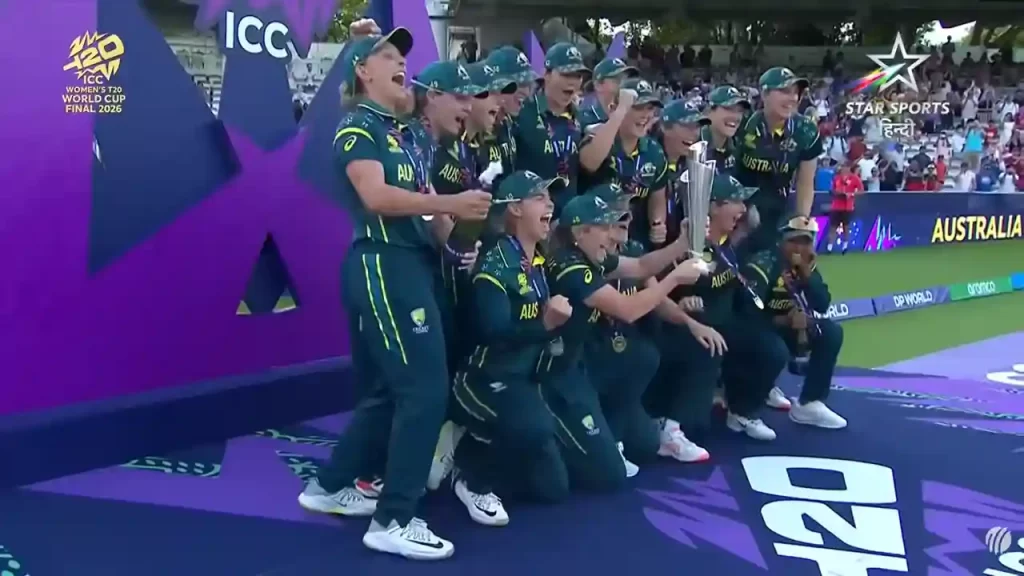
Australia added another glittering chapter to their women’s cricket legacy by defeating England by seven wickets in the final of the ICC Women’s T20 World Cup 2026 at Lord’s. In front of a record crowd of 28,887, they chased down 151 with 17 balls to spare, powered by a calm, authoritative innings from Beth Mooney and a ruthless collective effort that once again showed why Australia remains the benchmark in women’s cricket.The victory was more than just another trophy. It was Australia’s seventh T20 World Cup title and their 14th women’s World Cup overall, a reminder that their dominance is not built on one generation, but on a system that keeps producing players who understand how to perform when the pressure is highest.A final decided by controlEngland entered the final with a perfect home record in Women’s World Cup finals and with six wins from six in the tournament, but Australia quickly took control by doing what they have done so often over the years: winning the key phases. Their bowling unit kept England on a tight leash, taking wickets at regular intervals and denying the hosts any real momentum through most of the innings.Lucy Hamilton gave Australia the early breakthrough by removing Amy Jones, while Annabel Sutherland dismissed Danni Wyatt-Hodge, the tournament’s leading run-scorer. Kim Garth, Sophie Molineux, and Hamilton all contributed to a disciplined attack that prevented England from turning a decent platform into a commanding one.England’s resistance came lateEngland’s innings was built around Nat Sciver-Brunt, who returned from injury to anchor the middle order, and Freya Kemp, whose brisk unbeaten 44 off 28 gave the home side late lift. Their unbroken 80-run stand gave England respectability, but the total of 150 for 4 never quite felt out of Australia’s reach, especially after the early wickets had taken the sting out of the innings.That was the subtle but crucial difference in the final. England had moments of resistance, but Australia controlled the game long enough that those moments never became momentum. In finals, that is often what separates champions from challengers.Money makes finals look familiarIf Australia were calm with the ball, Beth Mooney was even calmer with the bat. She top-scored with 64 off 49 balls, mixing timing, placement, and smart strike rotation with the kind of composure that has made her one of the most reliable big-match batters in world cricket.This was not an isolated performance. It was Mooney’s third half-century in a Women’s T20 World Cup final, following her previous match-winning efforts in 2020 and 2023, and it underlined how often she rises when the stakes are highest. Alongside Phoebe Litchfield’s rapid 48, Mooney helped set up a 100-run partnership that broke England’s resistance and made the chase look far less complicated than it actually was.The chase never really driftedAustralia’s pursuit began with intent when Georgia Voll hit the first ball of the innings for four, setting a tone that England never quite managed to disrupt. Even after Voll fell early, Mooney and Litchfield took command, pushing Australia to 62 for 1 in the powerplay and then accelerating further as the target came into clearer view.Their 100-run partnership off 67 balls was the decisive passage of the match. Litchfield struck two sixes and six fours in her 48, while Mooney kept the innings steady from the other end, ensuring Australia never had to take desperate risks. By the time England struck late, the result was already effectively settled.Another title, another statementThe win reaffirmed Australia’s extraordinary consistency in women’s cricket. They have now won seven of eight Women’s T20 World Cup finals, and their overall haul of 14 women’s World Cup titles across formats places them in a class of their own. What makes that record especially impressive is not just the number of trophies, but the way the team keeps evolving. This latest title came after a period in which Australia missed out on ICC glory in other formats, yet they returned to the summit here with a refreshed side, a new captain in Sophie Molineux, and the same ruthless tournament instinct that has defined them for years.For England, the final was a disappointment, but not a collapse of identity. Charlotte Edwards admitted that her side was outplayed, and the numbers backed that up. England were never quite able to dominate the opening overs, and against a team like Australia, that usually means the chase becomes nearly impossible. Still, England’s campaign was strong enough to show that they remain a top-tier side. Sciver-Brunt’s return from injury, Wyatt-Hodge’s tournament run, and Kemp’s fighting cameo all pointed to a team with enough talent to contend, even if they were not quite sharp enough on the night that mattered most.Why this win mattersAustralia’s title is not just another addition to the trophy cabinet. It reinforces a broader truth about women’s cricket: sustained excellence is built on depth, clarity of role, and the ability to handle pressure in knockout games. Australia had all three, and the final at Lord’s only highlighted how complete their model remains.For Beth Mooney, the tournament was another personal triumph, and for Australia it was another team-wide statement that the standard in women’s cricket is still measured against them. In a world-class final at one of the sport’s most iconic venues, they were simply better where it mattered most.Video: ICC