


India’s Semiconductor Manufacturing Story: How New Chip Plants Are Transforming the Country’s Technological Future
IntroductionSemiconductors are often described as the “new oil” of the digital economy. These tiny electronic chips serve as the brains behind modern technology, powering smartphones, computers, automobiles, telecommunications equipment, medical devices, defence systems, artificial intelligence platforms, and industrial machinery. In an increasingly digital world, access to semiconductors has become a matter not only of economic growth but also of national security and technological sovereignty.For years, India remained heavily dependent on imported semiconductors despite being one of the world’s largest consumers of electronic products and a major hub for chip design services. While Indian engineers contributed significantly to global semiconductor design, the country lacked large-scale manufacturing facilities capable of producing chips domestically.The global semiconductor shortage that emerged during and after the COVID-19 pandemic exposed the vulnerabilities of this dependence. Supply chain disruptions affected industries worldwide, delaying automobile production, consumer electronics manufacturing, and critical infrastructure projects. The crisis prompted governments across the globe to invest heavily in domestic semiconductor capabilities.India responded by launching an ambitious strategy aimed at building a complete semiconductor ecosystem. Over the last few years, this vision has begun to materialise through a series of major investments, policy initiatives, and the launch of new semiconductor manufacturing and packaging facilities across the country.Today, India’s semiconductor story is no longer about future possibilities—it is increasingly about projects under construction, facilities being established, and the emergence of a domestic chip manufacturing ecosystem.Why Semiconductors MatterModern economies run on semiconductors. Every smartphone contains multiple chips. Electric vehicles depend on semiconductors for battery management, safety systems, and autonomous features. Data centres, cloud computing infrastructure, artificial intelligence applications, telecommunications networks, and defence technologies all rely on advanced semiconductor components.As digitalisation accelerates worldwide, demand for semiconductors continues to grow rapidly.Industry estimates suggest that India’s semiconductor consumption could exceed $100 billion annually in the coming years. This growth is being driven by:Expansion of the electronics manufacturing sectorRising smartphone penetrationGrowth of electric vehiclesDeployment of 5G networksArtificial intelligence and cloud computing adoptionIncreasing digitisation of public servicesWithout domestic manufacturing capabilities, India would remain vulnerable to external supply disruptions and geopolitical uncertainties.The Semiconductor Mission: India’s Strategic PushRecognising the strategic importance of semiconductors, the Government of India launched the India Semiconductor Mission (ISM) as part of a broader effort to strengthen the country’s electronics manufacturing sector.The government announced incentive packages worth tens of thousands of crores aimed at attracting investments in semiconductor fabrication, assembly, testing, packaging, and display manufacturing.The objective was not merely to establish individual factories but to create a complete semiconductor ecosystem involving:Chip fabrication plants (fabs)Assembly and packaging facilitiesDesign centresResearch and development infrastructureTalent development programsSupply chain networksThe initiative marked one of the largest industrial policy interventions in India’s recent history.Tata Electronics and the Dholera Semiconductor FabOne of the most significant milestones in India’s semiconductor journey came with the announcement of a semiconductor fabrication facility by Tata Electronics in partnership with Taiwan-based Powerchip Semiconductor Manufacturing Corporation (PSMC).The facility is being established at Dholera in Gujarat, a location that has emerged as a key industrial hub under India’s infrastructure development plans.The project represents India’s first major commercial semiconductor fabrication plant and involves an investment estimated at over ₹91,000 crore.The facility is expected to manufacture chips used in:AutomobilesConsumer electronicsCommunication systemsComputing devicesIndustrial applicationsIndustry experts consider the Dholera fab a landmark development because semiconductor fabrication represents the most technologically complex and capital-intensive segment of the semiconductor value chain.For decades, only a handful of countries such as Taiwan, South Korea, the United States, Japan, and China have possessed significant semiconductor fabrication capabilities.The Dholera project signals India’s entry into this highly strategic domain.Micron Technology’s Semiconductor Facility in GujaratAnother major development has been the investment by American semiconductor giant Micron Technology.Micron announced a substantial investment in a semiconductor assembly and testing facility in Sanand, Gujarat.The facility focuses on:AssemblyTestingMarkingPackaging (ATMP)These activities are critical parts of semiconductor manufacturing and represent an important step toward building a complete semiconductor ecosystem.The project has attracted significant attention because it marks one of the largest semiconductor investments by a global company in India.Commercial production is expected to play a crucial role in integrating India into global semiconductor supply chains.Semiconductor Expansion in AssamIndia’s semiconductor ambitions are not limited to western India.The Tata Group has also announced a semiconductor assembly and testing facility in Assam, making the northeastern state an unexpected but important participant in the country’s technology manufacturing push.The project is expected to generate thousands of direct and indirect jobs while promoting industrial development in a region historically less associated with high-technology manufacturing.The facility demonstrates the government’s effort to geographically diversify semiconductor investments rather than concentrating them in a few industrial clusters.For Assam, the project represents one of the most significant industrial investments in recent history.Additional Semiconductor Projects Across IndiaRecent years have witnessed multiple semiconductor-related announcements involving both domestic and international players.Several projects have been proposed in areas such as:Semiconductor packagingCompound semiconductorsDisplay manufacturingAdvanced electronics productionCompanies have expressed interest in participating across different stages of the semiconductor value chain, creating the foundations of a broader manufacturing ecosystem.These investments indicate growing confidence in India’s policy framework and long-term market potential.Why Global Companies Are Looking at IndiaSeveral factors have contributed to India’s emergence as a preferred destination for semiconductor investments.Growing Domestic MarketIndia is among the world’s fastest-growing markets for electronics and digital technologies.The rapid adoption of smartphones, connected devices, electric vehicles, and digital services creates substantial domestic demand for semiconductors.China Plus One StrategyGlobal companies are increasingly seeking to diversify manufacturing operations beyond China.The strategy, often referred to as “China Plus One,” has encouraged businesses to establish additional production bases in countries such as India, Vietnam, and Mexico.India has emerged as a major beneficiary of this shift.Government IncentivesGenerous fiscal incentives, capital subsidies, and infrastructure support have significantly improved the attractiveness of semiconductor investments.The government has committed substantial financial resources to reduce the high costs associated with semiconductor manufacturing.Skilled WorkforceIndia already possesses one of the world’s largest pools of semiconductor design talent.Many global semiconductor companies operate research and design centres in cities such as Bengaluru, Hyderabad, Noida, and Pune.This existing talent base provides a strong foundation for manufacturing expansion.Challenges Facing
PM Modi Inaugurates Micron’s Semiconductor ATMP Facility in Sanand
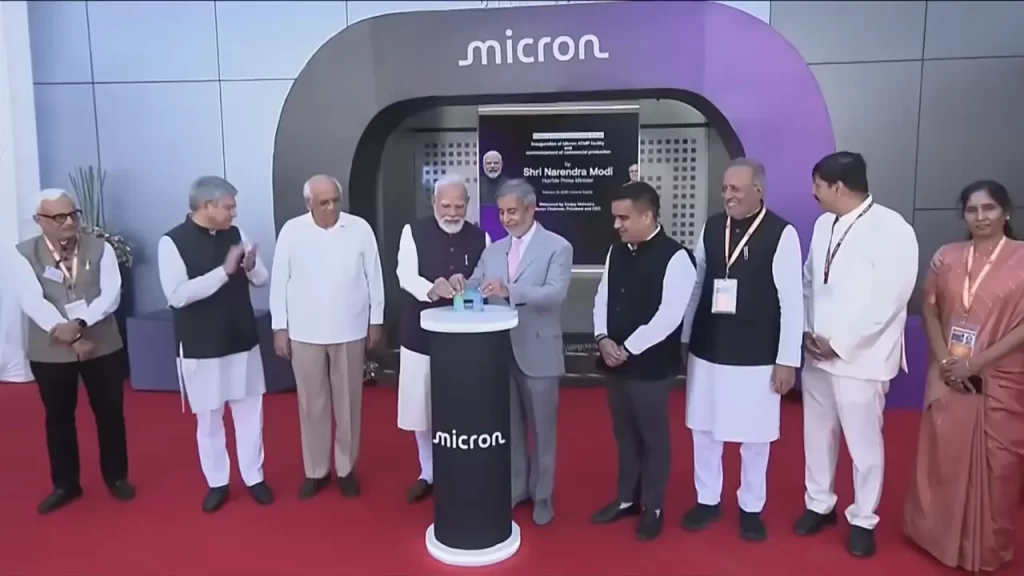
Prime Minister Narendra Modi inaugurated Micron Technology’s state-of-the-art Semiconductor Assembly, Test, and Packaging (ATMP) facility in Sanand, Gujarat, on February 28, 2026, marking India’s entry into commercial semiconductor production. This $2.75 billion milestone, the first of its kind in the country, converts advanced DRAM and NAND wafers into finished memory products for AI, data centers, and mobiles, positioning India as a key player in the global chip value chain.From MoU to Production: Lightning-Fast ExecutionThe project’s speed exemplifies India’s “New India” mindset. Signed in June 2023, groundbreaking occurred in September 2023, pilot machines installed by February 2024, and commercial production began in February 2026, just 33 months end-to-end. PM Modi highlighted streamlined regulations, like Advanced Pricing Agreements (APAs) cleared in months versus 3-5 years elsewhere, crediting clear intent and nation-first dedication.The Sanand plant boasts over 500,000 sq ft of cleanroom, one of the world’s largest single-floor ATMP cleanrooms, ISO 9001:2015 certified, LEED Gold-bound, and zero-liquid discharge via water-saving tech. First made-in-India memory modules shipped to Dell for local laptops, with tens of millions of chips expected in 2026, scaling to hundreds of millions in 2027.Micron CEO Sanjay Mehrotra, at the event with Gujarat CM Bhupendra Patel, Union Minister Ashwini Vaishnaw, and US Ambassador Sergio Gor, called it a “proud moment” building resilient AI ecosystems. Vaishnaw termed it “historic,” shifting India from chip consumer to manufacturing hub under PM Modi’s leadership.Microchips: The Oil of the 21st CenturyPM Modi framed semiconductors as the bridge from the Industrial Revolution to the AI era: “If oil regulated the last century, microchips will regulate this one.” Launched amid COVID chaos via the Semiconductor Mission, early seeds now yield fruit. India approved 10 projects under Semicon India; three more ramp up soon in Uttar Pradesh, Assam, Odisha, and Punjab, creating a pan-India ecosystem beyond factories, encompassing machines, design, R&D, logistics, and skills.Budget 2026’s India Semiconductor Mission 2.0 targets the full value chain, spurring domestic demand for materials amid booming gadget adoption. Electronics production and exports surged manifold in 11 years; “Make in India” now powers automobiles, mobiles, and tech.Sanand mirrors its auto-hub transformation, now anchoring semiconductors alongside chemicals, petrochemicals, and skill centers. Gujarat’s policies on approvals, land, and utilities boost investor faith; Dholera and Sanand emerge as Western India’s chip clusters.India-US Partnership Powers Global Supply ResilienceThe facility underscores deepening India-US ties in AI and chips, including the Pax Silica agreement from the recent AI Summit for critical minerals. The two largest democracies secure supply chains amid geopolitical flux. PM Modi messaged investors: “India is ready, reliable, delivers, capable, competitive, committed.”Micron’s Gujarat push builds talent via PDEU, Namtech, nationwide universities, and govt skills programs, focusing on STEM, advanced manufacturing, digital/AI literacy. Sustainability integrates health, safety, and eco-commitments.Broader Semiconductor Ecosystem BoomThis ATMP unit complements fabs like Tata’s in Dholera and others, addressing AI-driven memory demand. India’s electronics journey, from IT services to hardware, accelerates Viksit Bharat. Key Project MetricsDetailsKey Project MetricsDetailsInvestment$2.75B (Micron + govt)Cleanroom Size500,000+ sq ft (world’s largest single-floor ATMP)Output 2026Tens of millions of chipsOutput 2027Hundreds of millionsTimelineMoU Jun’23 → Production Feb’26States InvolvedGujarat, UP, Assam, Odisha, PunjabGlobal PartnersUS (Micron, Dell), via Pax SilicaA Tech Leadership LeapFrom software superpower to hardware contender, the nation builds self-reliant ecosystems fueling AI, mobiles, EVs. As PM Modi envisioned post-AI Summit, this hardware milestone cements technology leadership, inviting the world to co-create in a reliable, scalable hub.