


Quad Foreign Ministers’ Meeting 2026: Reinforcing Indo-Pacific Unity Amid Global Turbulence
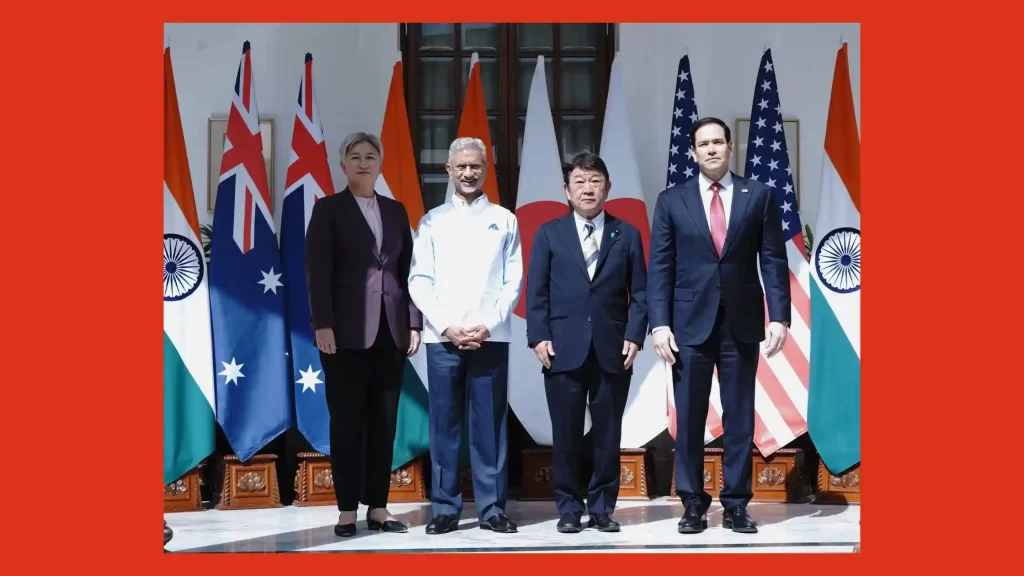
The Quad Foreign Ministers’ Meeting convened in New Delhi on May 26, 2026, bringing together the Foreign Ministers of Australia, India, and Japan, along with U.S. Secretary of State Marco Rubio, for a critical dialogue amid unprecedented global challenges and opportunities. Hosted by India’s External Affairs Minister S. Jaishankar, the third such engagement since President Donald Trump began his tenure reaffirmed the grouping’s continued relevance despite rapid geopolitical developments. The ministers agreed to firm up numerous initiatives spanning maritime security, critical minerals cooperation, energy security, and the first-ever Quad infrastructure project to build a port in Fiji, demonstrating that the Quad remains valid and viable as a cornerstone of Indo-Pacific stability.The meeting took place after a 10-month hiatus, following earlier speculation about the Quad’s continued survival. Before the gathering, analysts debated whether the grouping had become moribund without summit-level engagement, with some comparing its architecture to the Five Eyes intelligence-sharing group and arguing that sub-leader meetings create vital “habits of cooperation” essential for sustaining momentum. The successful conclusion of this four-way ministerial proved these concerns unfounded, as the four nations reaffirmed traditional areas of emphasis while addressing new challenges, including the proliferation of online scam centres in Southeast Asia, repercussions from the West Asia crisis, and rising tensions in the East and South China Seas.A Free and Open Indo-Pacific: Reaffirming Core PrinciplesThe Joint Statement opened with a powerful acknowledgment that the Quad convenes at a time of not only great challenges but also unprecedented opportunities. In the midst of conflicts, geopolitical tensions, and strains on global supply chains, the ministers reaffirmed that peace, stability, and prosperity of the Indo-Pacific hinge on upholding international law and the peaceful resolution of disputes. They committed to defending the rule of law, sovereignty, and territorial integrity while recognizing the immense potential of innovation, emerging technologies, and trusted partnerships to drive economic prosperity across the Indo-Pacific and beyond. The statement strongly opposed any destabilizing or unilateral actions seeking to change the status quo, including by force or coercion, which escalate tensions and undermine regional peace and stability.The ministers affirmed support for a free and open Indo-Pacific that allows countries to develop resilience and strengthen capacity to determine their own paths. Developments in key maritime regions underscored the vulnerability of critical sea lanes and risks posed to uninterrupted commerce flow, with disruptions carrying significant implications for global fuel, food, and fertilizer security as well as seafarer safety. The Quad discussed the West Asia situation, reaffirming support for ongoing diplomatic efforts and hope for lasting peace while reiterating the importance of adhering to UNCLOS regarding navigational rights, freedoms, and safety of global commerce through the Strait of Hormuz and Red Sea.Maritime Security: Three New Initiatives Strengthen Domain AwarenessOn Indo-Pacific maritime security, the Quad agreed on three groundbreaking initiatives, including the Indo-Pacific Maritime Surveillance Collaboration (IPMSC), the Quad Indo-Pacific Partnership for Maritime Domain Awareness (IPMDA), and continuation of the Quad-at-Sea Ship Observer Mission. India operationalized the Indian Ocean Region programme of IPMDA through the Information Fusion Centre – Indian Ocean Region in Gurugram, and partners will work to develop a Common Operational Picture across the Indo-Pacific by drawing upon existing IPMDA efforts. The IPMSC, integrating the latest technological developments, will augment IPMDA by enabling Quad partners to share real-time information and provide enhanced vessel pictures supporting a free and open Indo-Pacific region.Following the success of the first-ever Quad-at-Sea Ship Observer Mission from Palau to Guam in July 2025, India will host the next edition to strengthen interoperability and knowledge-sharing for addressing unlawful maritime activities. The ministers expressed serious concerns about developments in the East China Sea and South China Sea, opposing destabilizing unilateral actions, including force or coercion, threatening regional peace. They expressed grave concern regarding dangerous and coercive actions, including interference with offshore resource development, repeated obstruction of freedom of navigation and overflight, dangerous military aircraft and coast guard maneuvers, unsafe use of water cannons and flares, and ramming or blocking actions in the South China Sea, alongside deep concern about militarization of disputed features.Critical Minerals and Energy Security: Building Resilient Supply ChainsThe Quad announced the Quad Critical Minerals Framework, guiding how partners can leverage economic policy tools and coordinate investment with the private sector to strengthen critical minerals supply chains, including mining, processing, and recycling. The ministers reiterated grave concerns over economic coercion and non-market policies, including arbitrary export restrictions, price manipulation, and disruptions, particularly on critical minerals impacting global supply chains and critical industrial sectors. They underscored the importance of diversified and reliable global supply chains and the need to avoid reliance on any one country, recognizing that economic security is fundamental to Quad partners and the Indo-Pacific region.Recognizing shifts in the global energy landscape, the Quad launched the Quad Initiative on Indo-Pacific Energy Security to cooperate on energy security and resilience. Partners will work together to ensure open, well-functioning, and stable energy markets with resilient and diversified supply chains. Disruptions to global energy product markets and important downstream derivatives like fertilizers fall heavily on the Indo-Pacific region, making maintaining open trade flows in essential goods critical for regional security and prosperity. Following the successful Quad Ports of the Future Partnership Conference hosted by India in October 2025, the Quad countries will work with Fiji’s government to advance port infrastructure and associated activities in the country, marking the first-ever Quad infrastructural project.Humanitarian Assistance and Terrorism: Condemning Attacks, Strengthening ResponseThe Quad unequivocally condemned terrorism in all its forms, including cross-border terrorism and the horrific terrorist attacks perpetrated at Pahalgam in India on April 22, 2025, and Bondi Beach in Australia on December 14, 2025. The ministers called for decisive and sustained international efforts to combat terrorism according to international law, including action against globally proscribed terrorists and terror entities and their proxies, affiliates, sponsors, and financiers. They remain deeply concerned about the proliferation of online scam centres within Southeast Asia linked to transnational crime, including human trafficking, drug trafficking, sexual extortion, illicit financing, and cybercrime, committing to deepening cooperation, particularly in law enforcement and regulatory engagement.The Quad
Pravasi Bharatiya Divas 2026: Celebrating the Diaspora’s Enduring Bond with India
Pravasi Bharatiya Divas (PBD), observed annually on January 9, honors the pivotal contributions of the Indian diaspora to India’s progress, marking Mahatma Gandhi’s return from South Africa in 1915 after 21 years, a moment that fueled India’s independence movement. While 2026 marks a non-convention year following the 18th biennial PBD Convention in Bhubaneswar, Odisha (January 8-10, 2025), themed “Diaspora’s Contribution to a Viksit Bharat,” global events and local initiatives continue to strengthen ties with over 35 million Non-Resident Indians (NRIs) and Persons of Indian Origin (PIOs) across 200+ countries.Launched in 2003 by the Government of India, PBD has evolved into a flagship platform since 2015 in its biennial convention format, promoting engagement amid India’s position as home to the world’s largest diaspora. Valued at more than 35 million strong, this community drives diplomacy, trade, technology transfer, and cultural exchange, channeling over USD 120 billion in annual remittances, making India the global top recipient.Objectives and ImpactPBD 2026 emphasizes reconnecting overseas Indians with their roots while leveraging their potential for national growth. Key goals include building trust through direct interactions with Indian leaders and policymakers, encouraging investments in startups, infrastructure, healthcare, and education, and promoting skill-sharing from global experiences. It preserves Indian culture, languages, and traditions among second- and third-generation diaspora members while recognizing achievements through the Pravasi Bharatiya Samman Awards.The impact resonates deeply: it bolsters the diaspora’s global identity, enhances economic participation, and provides grievance redressal forums. By honoring their role in nation-building, PBD motivates sustained contributions, from business ventures to cultural preservation, positioning the diaspora as a bridge for a “Viksit Bharat” (Developed India).Dubai’s Vibrant CelebrationIn the UAE, home to one of the largest Indian communities, the Indian Business and Professional Council (IBPC) Dubai, alongside the Consulate General of India, hosted a standout cultural and thought-leadership evening blending World Hindi Day and PBD observances. The event drew Pravasi Bharatiya Award recipients like IBPC Chairman Siddharth Balachandran and veteran leader Vasu Shroff, highlighting Dubai’s stature as a hub for Indian professional excellence and exchange.Balachandran underscored the UAE’s diverse Indian tapestry, advocating for appreciation of regional languages alongside Arabic to foster coexistence. IBPC Vice Chairman Sunil Sinha stressed language in heritage preservation, while Consul Sunil Kumar urged youth involvement in cultural safeguarding. Dr. Sahitya Chaturvedi, IBPC Secretary General, addressed in Sanskrit, sharing his passion for linguistic promotion. The evening featured poetry recitals, an IBPC member Kavi Sammelan, and musical tributes to Hindi poetry, capturing the diaspora’s vibrant spirit.Looking AheadAs a non-convention year, 2026 relies on embassy-led events worldwide for reflection and dialogue, with the next major gathering slated for the 19th PBD in 2027. Smaller regional interactions may emerge, though official Ministry of External Affairs details remain pending. Amid cricket’s dominance and emerging sports like cycling (e.g., Pune Grand Tour), PBD uniquely spotlights the diaspora’s quiet power in remittances, innovation, and soft diplomacy.This observance reaffirms India’s strategic embrace of its global family, turning historical homecomings into modern partnerships for progress.