


Bharat Innovates 2026: Showcasing India’s Deep-Tech Ambitions on the Global Stage
IntroductionAs countries around the world compete to lead the next wave of technological innovation, India has increasingly positioned itself not only as a hub for software and digital services but also as a growing centre for deep-tech research and entrepreneurship. Bharat Innovates 2026, held in Nice, France, marked an important step in that journey by providing Indian startups, researchers and academic institutions with a global platform to showcase indigenous technologies and build international partnerships.Organised under the Ministry of Education with strategic guidance from the Office of the Principal Scientific Adviser to the Government of India, Bharat Innovates 2026 brought together India’s innovation ecosystem—including startups, higher educational institutions, investors, industry leaders and policymakers—to demonstrate the country’s capabilities in emerging technologies. The initiative reflected India’s broader vision of transforming itself from a technology consumer into a global technology developer and exporter.What is Bharat Innovates 2026?Bharat Innovates 2026 is India’s first large-scale international deep-tech showcase designed to present the country’s most promising innovations before a global audience. The event featured around 120 carefully selected deep-tech startups, research institutions and universities working across strategic technology sectors.Unlike traditional startup exhibitions that primarily focus on fundraising, Bharat Innovates was conceived as a global accelerator to facilitate research collaborations, pilot projects, technology commercialisation, manufacturing partnerships and international market access. It also sought to strengthen links between Indian innovators and investors, industries, universities and governments from around the world. Why the Initiative MattersIndia has emerged as one of the world’s fastest-growing startup ecosystems, with thousands of technology companies working in areas such as artificial intelligence, biotechnology, space technology, robotics and semiconductor design. However, many deep-tech startups often face challenges in accessing international markets, research partnerships and long-term investments.Bharat Innovates 2026 was designed to bridge this gap by providing a dedicated international platform where Indian innovators could directly interact with global venture capital firms, multinational corporations, research organisations and government agencies.The initiative also highlights a shift in India’s innovation strategy. Instead of focusing only on information technology services, the country is increasingly investing in technologies that require advanced scientific research, intellectual property development and long-term industrial applications. Key Focus AreasThe event showcased innovations across a wide range of strategic sectors that are expected to shape the future global economy.Artificial Intelligence and machine learning emerged as major focus areas, with startups presenting solutions in healthcare diagnostics, language technologies, automation and industrial applications.Space technology formed another important segment, reflecting India’s growing capabilities following the success of missions such as Chandrayaan and Aditya-L1. Several startups demonstrated satellite technologies, earth observation solutions and launch-related innovations.Other sectors included:Semiconductor technologiesDefence and aerospaceBiotechnologyClimate and clean energyQuantum technologiesAdvanced manufacturingRobotics and automationAgritech and food securityHealthcare technologiesThe diversity of innovations reflected the growing maturity of India’s research and startup ecosystemIndia-France CollaborationOne of the defining aspects of Bharat Innovates 2026 was its role in strengthening technology cooperation between India and France.The event was inaugurated by Prime Minister Narendra Modi and French President Emmanuel Macron during the India-France Year of Innovation. Both leaders emphasised the importance of collaborative research, innovation-driven economic growth and stronger partnerships in emerging technologies.France has become an important strategic partner for India in areas such as defence, aerospace, artificial intelligence and clean energy. Bharat Innovates expanded this cooperation by creating opportunities for joint research projects, technology transfer and industrial collaboration between institutions from both countries. Opportunities for Indian StartupsFor participating startups, Bharat Innovates represented far more than an exhibition.The event provided opportunities to pitch technologies before global investors, establish commercial partnerships, explore international markets and collaborate with universities and research laboratories.Many startups working in advanced technologies often require long-term funding and access to specialised expertise rather than traditional venture capital alone. By bringing together investors, research institutions and industry leaders under one platform, Bharat Innovates aimed to accelerate the commercialisation of Indian innovations.The initiative also sought to encourage Indian startups to think globally from the early stages of product development instead of limiting themselves to domestic markets. Role of Higher Educational InstitutionsUniversities and research institutions formed a significant part of Bharat Innovates 2026.Premier institutions including the Indian Institutes of Technology (IITs), research laboratories and innovation centres showcased technologies developed through academic research. Projects ranged from healthcare solutions and advanced materials to artificial intelligence, defence technologies and sustainable engineering.The participation of academic institutions reflected the growing emphasis on translating scientific research into commercially viable technologies and supporting innovation-driven entrepreneurship within higher education.Supporting the Vision of Atmanirbhar BharatBharat Innovates also aligns closely with the Government of India’s vision of Atmanirbhar Bharat by promoting indigenous innovation in strategically important sectors.Rather than depending entirely on imported technologies, India is encouraging domestic research, intellectual property creation and advanced manufacturing capabilities.This approach has become particularly important in sectors such as semiconductors, defence equipment, artificial intelligence, cybersecurity and quantum technologies, where technological self-reliance is increasingly viewed as a strategic necessity.Through initiatives such as Bharat Innovates, the government aims to strengthen India’s position as both an innovation hub and a technology exporter.Challenges AheadWhile Bharat Innovates represents an important milestone, several challenges remain.Deep-tech startups typically require larger investments, longer development timelines and stronger research infrastructure compared to conventional technology startups. Commercialising advanced scientific innovations also involves regulatory approvals, manufacturing capabilities and sustained industry collaboration.Maintaining global competitiveness will require continued investment in research and development, stronger university-industry partnerships and policies that encourage innovation while supporting entrepreneurs through different stages of growth.Looking AheadBharat Innovates 2026 represents more than a single international event. It reflects India’s broader ambition to become a leading contributor to global technological advancement.As emerging technologies continue to reshape industries worldwide, initiatives that connect Indian researchers and startups with international partners are expected to play an increasingly important role in driving innovation-led economic growth.By providing a global platform for indigenous technologies, Bharat Innovates has the potential to strengthen India’s innovation ecosystem and accelerate the transition from research laboratories to commercial markets.ConclusionBharat Innovates 2026 marked a significant milestone in India’s efforts to establish itself as a global centre for deep-tech innovation. By bringing together startups, researchers, universities, investors and policymakers on an international platform, the initiative showcased the growing capabilities
French President Macron’s India Visit Strengthens Tech and Defense Ties
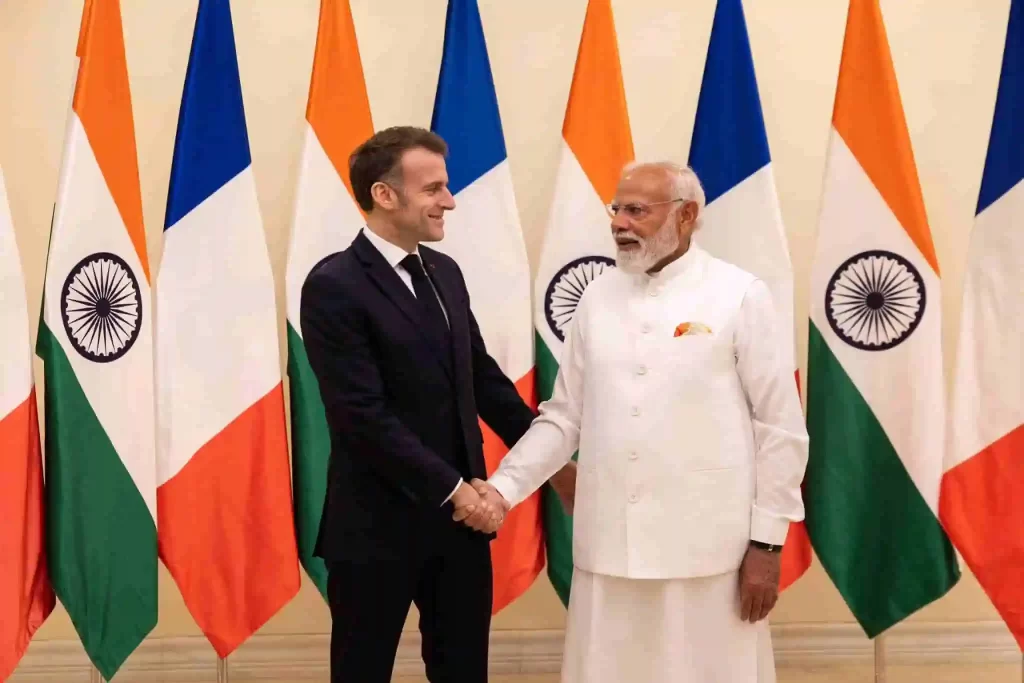
French President Emmanuel Macron and his wife, Brigitte Macron, completed a successful three-day official visit to India from February 17 to 19, 2026. This marked President Macron’s fourth trip to India since 2017 and built on the strong friendship between the two nations. The visit highlighted shared goals in technology, defense, and innovation. It followed Prime Minister Narendra Modi’s trip to France in February 2025 and came one year after the AI Action Summit in Paris. Both leaders focused on the Horizon 2047 Roadmap, a plan set in 2023 to guide ties until India’s 100th Independence anniversary.Mumbai Welcomes Leaders with Tribute and Cultural LaunchThe visit kicked off in Mumbai, India’s bustling financial hub, on February 17. President Macron and Mrs. Macron first paid heartfelt tribute to the victims of the 2008 terrorist attacks at the iconic Taj Mahal Palace hotel. This emotional moment honored those lost in the tragic events and underscored the shared commitment to fight terrorism. Later that morning, they joined a special lunch focused on the film industry. Indian and French cultural figures, filmmakers, and Bollywood stars gathered to celebrate creative exchanges between the two countries.In the afternoon, President Macron met Prime Minister Modi for in-depth bilateral talks at the Residence of the Governor of Maharashtra in Lok Bhavan. The leaders reviewed progress in their strategic partnership and discussed ways to expand it into new areas like defense, space, and digital technology. They addressed regional and global issues, including cooperation in the Indo-Pacific region. Around 5:15 PM, they jointly inaugurated the India-France Year of Innovation 2026 at the majestic Gateway of India. This year-long initiative will feature events across both nations to boost collaboration in innovation, research, startups, and people-to-people ties. The two leaders then addressed a lively gathering of business leaders, innovators, researchers, and entrepreneurs from India and France.On February 18, President Macron engaged with Indian investors during a dynamic round-table discussion. He shared insights on economic opportunities and partnership potential. He also gave an exclusive interview to popular Indian podcaster Raj Shamani, reaching young audiences with talks on leadership and global challenges. That evening, he flew to New Delhi for the next phase of the visit. Business France and Mission French Tech brought over 100 French companies to explore collaborations, signaling strong economic momentum.New Delhi Hosts AI Impact Summit and Strategic DialoguesThe visit shifted to New Delhi on February 19, where President Macron participated in the AI Impact Summit. Hosted by India, this was the first major global AI summit in the Global South. It revolved around three guiding principles: People, Planet, and Progress, structured across seven key focus areas or “chakras.” The summit showcased cutting-edge discussions on artificial intelligence’s role in solving global problems. President Macron’s presence highlighted France and India’s leadership in AI governance and ethical tech development.During the Delhi leg, the leaders continued their bilateral engagements. They exchanged views on pressing issues like climate action, sustainable development, and security. The talks elevated the India-France relationship to a “Special Global Strategic Partnership.” This upgrade expands cooperation in defense, civil nuclear energy, space, AI, and multilateral affairs. Bilateral trade had already reached €12.67 billion, boosted by the recent India-EU Free Trade Agreement and rising investments.Raj Shammi Podcast with the President Raj Shamani’s Historic Podcast with French President Emmanuel Macron (FO473) stands out as a groundbreaking episode of his popular “Figuring Out” series. Recorded on February 18, 2026, in Mumbai during President Macron’s official visit to India, this marked the French leader’s first-ever podcast appearance worldwide. At just 28 years old, Raj Shamani, host of one of India’s top-ranked global podcasts, bypassed traditional media to secure this exclusive, reaching millions of young viewers directly through digital platforms. The 40-minute conversation went viral instantly, blending diplomacy, tech vision, and personal insights.Horizon 2047 Roadmap Drives Ambitious Future PlansThe Horizon 2047 Roadmap forms the backbone of this partnership. Launched on July 14, 2023, by President Macron and Prime Minister Modi, it sets bold targets for the next two decades. The plan focuses on three pillars. First, Partnership for Security and Sovereignty covers defense, space, civil nuclear energy, digital tech, emerging technologies, the Indo-Pacific, and counter-terrorism. Second, Partnership for the Planet addresses environment, climate, health, energy transitions, and sustainable development. Third, Partnership for the People promotes student and professional mobility, as well as cultural exchanges.In defense, exciting developments include India’s clearance for 114 Rafale fighter jets from France’s Dassault Aviation, potentially worth €30 billion, the “contract of the century.” Most jets will be manufactured in India, reducing reliance on imports and boosting local production. This adds to the 62 Rafales already in service. The leaders also inaugurated India’s first helicopter final assembly line via videoconference. A Tata Group-Airbus joint venture in Karnataka near Bengaluru will produce the H125 single-engine helicopter, Airbus’s bestseller. Ongoing Scorpène submarine projects and co-development of advanced military tech further deepen ties.Space cooperation shines bright too. The third India-France Strategic Space Dialogue is set for 2026. India will join the International Space Summit in France in July. New initiatives include the India-France Innovation Network, a binational center for digital sciences with France’s National Institute for Research in Digital Science and Technology, and a Joint Center for Advanced Materials.A Partnership for Global Stability and InnovationPresident Modi called the relationship a “partnership for global stability” in today’s turbulent world. President Macron praised the “remarkable acceleration” of ties amid a changing international order. They referred to each other as “dear friends” on social media, reflecting personal rapport. The visit celebrated 25 years of strategic cooperation and 100 years of diplomatic relations approaching in 2047.France sees India as a key player in demographics, economy, science, and diplomacy. The trip consolidated diplomatic, economic, and civil society links. It addressed G20 outcomes from New Delhi in 2023, security challenges, and growth in defense, space, and cyber sectors. Over 100 French firms joined to tap India’s vibrant market. Challenges like defense delays, AI regulations, trade barriers, and geopolitical differences persist, but momentum is strong.This visit reinforces India and France as forces for good. From Mumbai’s cultural
India AI Impact Summit 2026: Detailed Agenda for Global AI Action in New Delhi
New Delhi, February 9, 2026 – India gears up for the India AI Impact Summit 2026, set for February 16-20 at Bharat Mandapam, Pragati Maidan, New Delhi, the primary venue for the India AI Impact Summit 2026, which will host the main events on February 19-20.Hosted by the Ministry of Electronics and Information Technology (MeitY), this first Global South edition, billed by Union Minister Ashwini Vaishnaw as the “largest yet,” transitions AI discourse from vision to verifiable impact under the “Three Sutras”: People, Planet, and Progress.Some sources mention a broader program across February 16-20, potentially using additional Delhi venues like Sushma Swaraj Bhawan for side events, sessions, or exhibitions. Bharat Mandapam, one of India’s largest convention centers, was upgraded by NDMC for this flagship gathering. Chief Guests and Stellar LineupPrime Minister Narendra Modi serves as the Chief Guest, inaugurating on February 16 with a keynote and hosting a leaders’ dinner. Expected heads of government include representatives from Singapore, the UAE, and Brazil (15-20 total), plus 50+ ministers. Key speakers feature Google’s Sundar Pichai, Anthropic’s Dario Amodei, Microsoft’s Satya Nadella, and Indian luminaries like Nandan Nilekani (Infosys co-founder) and Ola’s Bhavish Aggarwal. Over 40 CEOs from Reliance, TCS, and global firms join, along with a Chinese delegation, signaling a thaw in collaboration. Event Schedule and Dialogues Feb 16: Inauguration, Modi address, CEO roundtable.Feb 17-18: Plenary sessions and seven “Chakras” (working groups) on core topics.Feb 19: Startup showcase (500+ ventures), AI model launches, bilateral dialogues.Feb 20: Closing with actionable declarations.Expect 500+ parallel sessions, hackathons, and exhibitions. Dialogues include G20-style tracks on AI ethics, public-private partnerships, and Global South priorities. Participating Governments in India AI Impact Summit 2026 The summit, hosted by India’s Ministry of Electronics and Information Technology (MeitY) under the IndiaAI Mission, expects involvement from over 100 countries. Key highlights:High-Level Representation: 15-20 heads of government and 50+ ministers confirmed, including from Singapore, UAE, Brazil, and others.China: Delegation attending after India’s formal invitation, signaling AI collaboration.Preceding Hosts: Builds on summits by UK (2023 Bletchley), South Korea (2024 Seoul), France (2025 Paris).Collaborators: NITI Aayog (India’s policy think tank), state governments like Uttarakhand (pre-summit host), and international bodies (ITU, World Economic Forum).Global Engagement: Multinational working groups across Chakras, with US, UK, EU, and ASEAN nations active in prep consultations. Key Topics and Seven ChakrasThe India AI Impact Summit 2026 is structured around three foundational “Sutras” (People, Planet, Progress) that guide its discussions, with seven interconnected “Chakras” (working groups) translating these into specific, actionable themes.Core SutrasPeople: Focuses on human-centric AI, including safeguarding rights, enhancing access to services (e.g., healthcare, education), building user trust, workforce reskilling amid job impacts, and ensuring equitable benefits across societies.Planet: Addresses sustainable AI deployment, such as energy-efficient models, responsible resource use (e.g., reducing GPU/data center power demands), and AI applications for climate action, environmental monitoring, and resilience.Progress: Emphasizes inclusive innovation, capacity-building, productivity gains in sectors like agriculture and manufacturing, economic growth, and bridging the AI divide for the Global South. Seven Chakras (Key Discussion Topics)These working groups, involving 100+ countries, cover:AI governance and ethical frameworks.Trust and safety protocols for AI models (e.g., bias mitigation, transparency).AI’s impact on work and future jobs.Sector-specific applications (healthcare, agriculture, industry).Innovation and scalable solutions.Sustainability and environmental integration.Equitable access, inclusion, and development outcomes.Sessions will also spotlight IndiaAI Mission launches, startup innovations, and global standards, prioritizing “on-ground” results over regulations. What to Expect in India AI Summit?MeitY leads with partners like NITI Aayog, NASSCOM, World Economic Forum, and ITU. Corporate backers include Google, Microsoft, NVIDIA (GPU focus), and Indian firms like Tata and Adani (data centers). Governments from US, UK, EU, and ASEAN collaborate. Attendees (10,000+), policymakers, researchers, startups, NGOs, can expect networking zones, live demos (e.g., edge AI), policy labs, and a “Global AI Talent Fair.” Launches include indigenous foundational models under the Rs 10,370 crore IndiaAI Mission. India’s Strategic Push Amid HurdlesEchoing Bletchley (2023), Seoul (2024), and Paris (2025), India’s summit prioritizes “on-ground” wins for 1.4 billion people, as per Secretary S. Krishnan. AI could add $500B to GDP (NASSCOM), but challenges like GPU imports persist—eased by US trade deals and data center tax holidays to 2047. Budget 2026-27 tweaks fund nuclear-powered AI infra, as Vaishnaw eyes energy self-reliance.Vaishnaw hailed “phenomenal” global buy-in, with NDMC upgrading venues. Beyond talks, expect MoUs on compute sharing, talent visas, and sustainable AI pacts, positioning India as an AI diplomacy hub.This summit promises not just dialogue, but deliverables: inclusive, green AI for humanity’s progress.Video credit: YT@/Digital India