


FIFA World Cup Final: Spain, Argentina, and the Night That Defined a Tournament
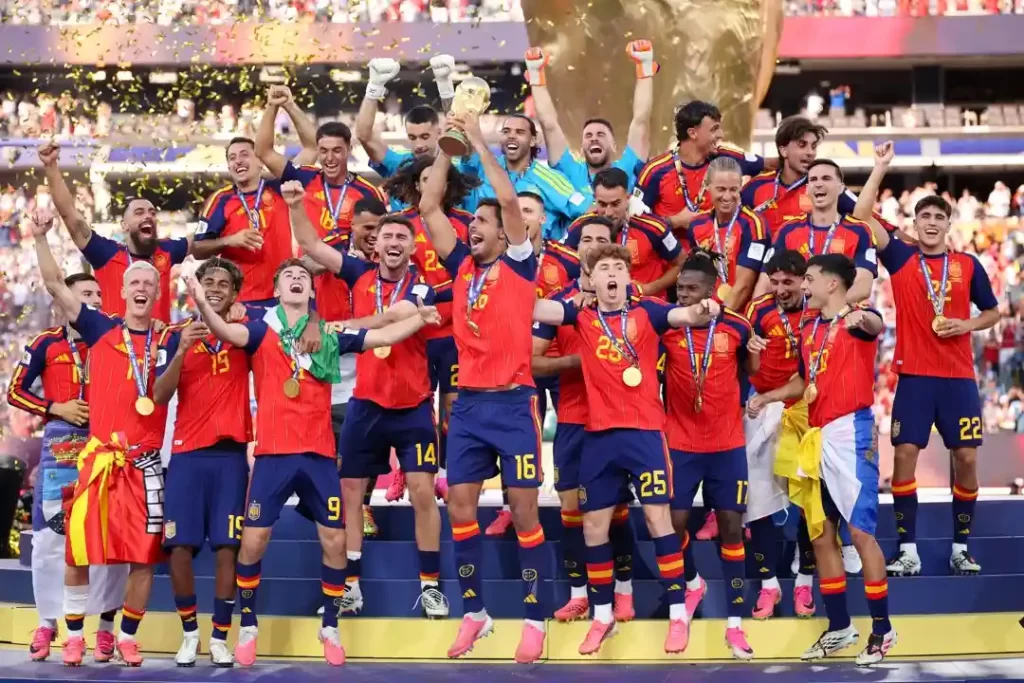
The FIFA World Cup 2026 final between Spain and Argentina delivered everything a title match should offer: elite tactical tension, high emotion, a late decisive goal, and a closing chapter that will be discussed for years. Spain won 1-0 after extra time at New York New Jersey Stadium, capping a tournament that began with 48 teams across 16 host cities and ended in a final that felt both historic and deeply human.What made the match so compelling was not only the quality on the pitch, but the contrast between the two finalists. Spain arrived as the kings of Europe, built on control, structure, and composure, while Argentina, led by Lionel Messi, came into the final riding a surge of drama and belief after a bruising knockout run.A final worthy of the stageThe match itself unfolded like a classic World Cup final: tense, carefully balanced, and decided by fine margins rather than chaos for most of its duration. Spain’s 1-0 extra-time win came through Ferran Torres, and the result was enough to deny Argentina a second consecutive world title.Spain’s performance reflected a team that knew how to manage pressure in a final. Argentina, meanwhile, were pushed into a reactive role after the momentum shifted late in the contest, especially once Enzo Fernandez was sent off in the second half, leaving Lionel Scaloni’s side to finish with 10 players. The emotional weight of defeatFor Argentina, the loss was especially painful because the team had entered the final with a sense of destiny. Messi’s presence made the occasion even heavier, since every late run, missed chance, and defensive scramble seemed to carry the emotional burden of an entire era.Enzo Fernandez spoke publicly after the defeat and described how the group’s effort mattered more than the result itself, a reminder that World Cup finals are often measured not only by the scoreline but by the meaning attached to them. In Argentina’s case, the disappointment was real, but so was the pride in having gone so far. The post-match breakdownThe closing whistle did not end the drama. Reports say that tensions exploded into a post-match melee involving players and staff from both sides, with Leandro Paredes, Nahuel Molina, Thiago Almada, Roberto Ayala, Rodri, Gavi, and Eric Garcia among those drawn into the altercation.FIFA has since opened disciplinary proceedings and appointed a disciplinary and ethics prosecutor to investigate the incident under its code. The governing body is treating the matter seriously, and sanctions could range from fines to suspensions depending on what the prosecutor concludes about the conduct and who is found responsible.Why FIFA is involvedThe key issue for FIFA is not just violence, but whether the behavior violated the principles of decent conduct and brought the sport into disrepute. That is a broader standard than a simple on-field red card, which means the disciplinary process can examine the entire context of the post-match incident, including the actions of staff and the atmosphere around the celebration.Argentina’s situation is complicated further by the fact that FIFA was already reviewing conduct linked to the semifinal celebration involving a banner reading “Las Malvinas son Argentinas.” That means the federation is not dealing with a single isolated issue, but with a pattern that FIFA may view as politically or disciplinarily problematic.Argentina’s wider disciplinary riskThe likely outcome is that individual bans, if any, will be targeted rather than sweeping, but FIFA has shown in past cases that it can impose meaningful penalties when it believes conduct crosses the line. The investigation process can take time, and the governing body has not set a public deadline for its decision.There is also precedent for FIFA and other governing bodies using disciplinary tools for conduct that goes beyond the normal boundaries of competition. That is why this case matters: it is not simply about one ugly moment after a final, but about how football’s institutions respond when emotion spills into behavior that the sport considers unacceptable.The tournament’s larger storyEven with the controversy at the end, the 2026 World Cup will be remembered as a landmark event. It was the first tournament to feature 48 teams, spread across three host countries and 16 host cities, and it produced a mix of new contenders, familiar giants, dramatic upsets, and memorable individual performances.The visual memory of the tournament will be rich as well: fans packed into stadiums, giant public screenings, legends like Messi and Mbappé on the global stage, and emerging stories that gave the competition depth beyond the final itself. That broader texture is part of what makes the World Cup such a singular event in world sport.What Spain’s win meansFor Spain, the victory confirms a return to the top of world football and a style of play that once again proved effective under the highest pressure. Their success was built on midfield control, defensive stability, and the ability to stay composed when the stakes were at their peak.A World Cup final is rarely only about who scores the goal. It is about who can absorb tension, make the fewest mistakes, and hold the shape of the game when everyone else in the stadium is being pulled by emotion. Spain did that better on the night, and that is why they left with the trophy.Closing perspectiveThe 2026 final had all the ingredients of a defining football moment: a heavyweight matchup, a dramatic outcome, emotional aftermath, and a disciplinary storyline that will continue after the celebrations fade. Spain earned the title on the field, but the scenes afterward ensured that the match will be remembered for more than the scoreline.In that sense, the final captured what the World Cup often does best and worst at once: it delivers beauty, pressure, and national pride, but it can also expose how thin the line is between competitive passion and conduct that football’s authorities cannot ignore.
FIFA World Cup 2026 in Crisis: Wars, Cartels, and Trade Fights Threaten Historic Tournament
The 2026 FIFA World Cup will be the biggest ever, with 48 teams, 104 matches from June 11 to July 19 across 16 cities in the US, Canada, and Mexico. But today, just months away, it’s facing huge problems. Wars in the Middle East, killings by drug gangs in Mexico, fights between the host countries, and even a funny award to US President Donald Trump are making things very hard. Let’s break it all down in simple terms.Trump’s Peace Prize and the Wars That FollowedIn December 2025, at the World Cup group draw, FIFA President Gianni Infantino gave Trump the first-ever FIFA Peace Prize. They called him a “dynamic leader” for talks that brought “dialogue, de-escalation, and stability.” A video praised him for four minutes. Trump put on the medal happily.But three months later, Trump started big wars. He and Israel launched airstrikes on Iran called Operation Epic Fury, killing Iran’s top leader, Ayatollah Khamenei. Iran fired missiles at Israel, Qatar, Saudi Arabia, and Iraq. Trump also hit ISIS in Nigeria on Christmas, sent troops to Venezuela to catch President Nicolás Maduro, threatened to take Greenland from Denmark, and joked about making Canada the 51st US state by calling PM Mark Carney “governor.”Now, FIFA’s peace award looks bad. The World Cup could be ruined if the war in the Middle East escalates. Iran qualified first from Asia and plans a base in Arizona, but now they’re at war with the US. Iran Soccer Federation president Mehdi Taj said: “We can’t hope for the World Cup after these attacks.”FIFA has not said anything about the prize or wars.Mexico’s Drug War Hits World Cup CitiesMexico hosts the opening match in Mexico City (Mexico vs South Africa) and games in Guadalajara and Monterrey. But violence exploded near Guadalajara. Mexican forces killed “El Mencho,” boss of the Jalisco New Generation cartel, with US help from Trump. At least 70 people died.Trump pushed Mexico’s President Claudia Sheinbaum to fight cartels. Now, Monterrey has inter-confederation playoffs on March 31: Iraq vs winner of Bolivia vs Suriname (semifinal March 26). Guadalajara hosts another playoff with New Caledonia, Jamaica, and DR Congo.FIFA’s Infantino said, “Mexico is great. Governments and police will keep it safe.” Some talk moved matches to Qatar’s Lusail stadium (the last final site), but Iran attacked Qatar too—their jets shot down Iranian planes.Iraq Wants Playoffs Delayed Because of WarIraq coach Graham Arnold asked FIFA to postpone the Monterrey game. Iran’s war closed Iraqi airspace; no players or staff can fly out. “It won’t be our best team. Iraq hasn’t been to the World Cup since 1986. This is our big dream,” he said from the UAE.Arnold suggests: Bolivia vs Suriname now; winner vs Iraq in the US a week before the World Cup. Iraq president Adnan Dirjal works non-stop. FIFA has no answer yet.Host Countries Fighting Over Trade—USMCA Ends Mid-TournamentThe “United Bid” was sold as three friends together, like old NAFTA. But the USMCA trade deal ends July 1, right in the middle of the World Cup. Trump calls it “irrelevant” and might let it die. He pressures Mexico on cartels (even military help), backs Canada’s Alberta to break away (vote October), and Canada PM Carney promises to “stand up to Trump.”Leaders met once at the draw: Trump, Sheinbaum, and Carney. Trump met FIFA boss Infantino 8 times. Money problems too:US: Cities pay alone, no big federal help. Shutdown stops FEMA grants. No big fan fests in Jersey City or Seattle.Mexico: Tax breaks for World Cup cities.Canada: Over $300M federal money, mostly to Toronto/Vancouver cities.FIFA has 1,000 staff in three countries (4,000 during the event) for security and plans. They train local teams.How the United Bid Started, and Why It’s BreakingIn 2016, US Soccer boss Sunil Gulati said: Join forces, US gets 75% games, win sure. Canada/Mexico agreed. Pitch: “Neighbors unite for inclusive World Cup.” Won in 2018 vs Morocco.What Happens Next for the World Cup?Playoffs: March 26-31 in Mexico, will they move?Iran/Iraq teams: Travel bans? Boycotts?Security: Cartels, wars, and drones worry US cities.Fans: 39 days, millions travel, flights, borders tense.FIFA says it’s one tournament, three cultures. But glue is thin. Soccer unites the world, or will wars win?World Cup 2026 tests if football beats real fights. Fans wait, pray for goals over bombs.