


Modi’s Historic Slovakia Visit: India’s Strategic Pivot to Central Europe
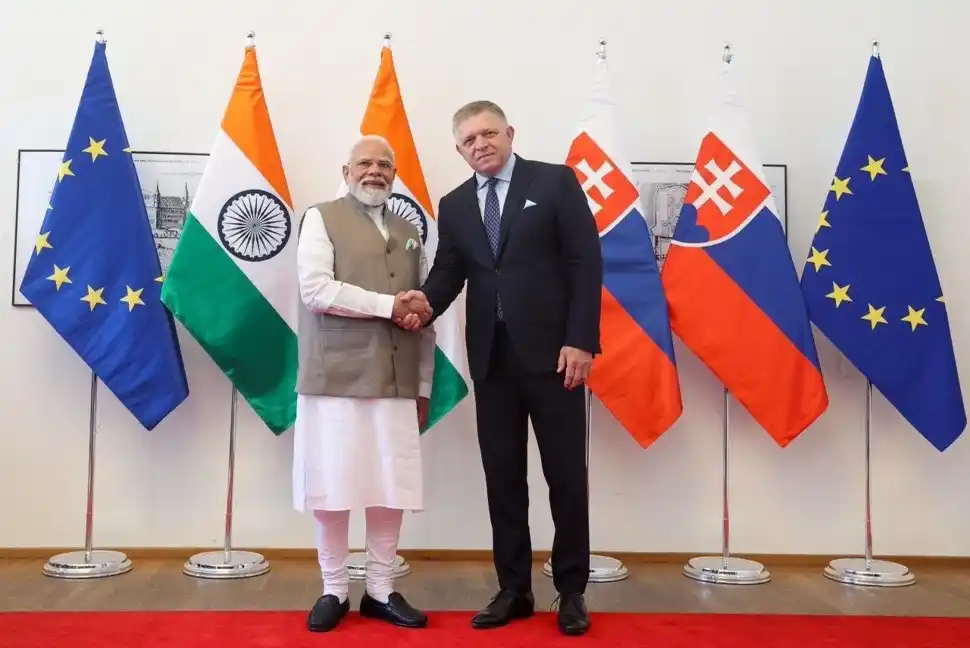
When Prime Minister Narendra Modi stepped off the plane in Bratislava on Sunday evening, June 14, 2026, the occasion transcended routine diplomatic pleasantries. It marked a vision of India quietly but purposefully embedding itself into European geopolitics, not through headline-grabbing rhetoric, but through building frameworks, forging alliances, and finding common ground. This was the first-ever visit by an Indian Prime Minister to Slovakia since its independence in 1993, transforming three decades of polite but unremarkable relations into a purposeful partnership with far-reaching strategic implications.Receiving Modi with the traditional Slovak ceremony of offering bread and salt, Slovak officials welcomed him to a three-day State Visit that fundamentally transformed India-Slovakia dynamics. The visit follows President Droupadi Murmu’s State Visit to Slovakia in April 2025 and Slovak President Peter Pellegrini’s visit to India for the AI Impact Summit in February 2026, demonstrating accelerating bilateral engagement. What Bratislava achieved was replacing polite distance with purposeful proximity, upgrading India-Slovakia ties to a “Comprehensive Partnership.”From Polite Distance to Purposeful ProximityFor three decades after Slovakia’s 1993 independence, the two countries maintained a perfectly pleasant but entirely unremarkable relationship. The Bratislava summit fundamentally transformed this dynamic. The breadth of agreements signed reveals the story: defence cooperation, counter-terrorism, artificial intelligence, semiconductors, digital infrastructure, energy, and labour migration emerged as core pillars.The decision to establish an ICCR Chair in Artificial Intelligence at the Technical University of Košice, the first such initiative anywhere in the world, signals that this partnership is built with eyes firmly on tomorrow. This timing matters enormously, as the visit came on the heels of the landmark India-EU trade deal, with both sides candid about capitalising on it. Modi acknowledged working towards the agreement’s “earliest implementation.”Automotive manufacturing, electronics, and advanced manufacturing were identified as sectors ripe for collaboration, reflecting Slovakia’s industrial capacity aligning perfectly with India’s economic priorities. The visit reaffirms India’s commitment to strengthening bilateral relations in trade, investment, and automobile and railway manufacturing.Defence, AI, and Semiconductors: Strategic PillarsDefence cooperation took centre stage alongside emerging technology sectors defining the next generation of global competition. The ICCR Chair at the Technical University of Košice demonstrates both nations positioning themselves at technological innovation’s forefront while building academic partnerships yielding long-term benefits.Counter-terrorism cooperation emerged as another critical pillar, with both sides recognizing that joint condemnation builds international consensus around India’s security concerns. This aligns with India’s emerging foreign policy, where every relationship adds to a larger ambition: India is not a supplicant but an independent, confident country charting its own course. Slovakia’s reiteration of support for India’s permanent UN Security Council membership and Nuclear Suppliers Group membership reflects the multilateral solidarity India needs to build systematically.Digital infrastructure and semiconductors emerged as priority areas, reflecting growing importance in national security and economic competitiveness. Energy and labour migration figured prominently, demonstrating that cooperation extends beyond traditional defence and trade into areas affecting everyday citizens.Diversification as Strategic NecessityFor too long, India’s economic and strategic calculus concentrated around a narrow cluster: the United States, China, the Gulf, and Russia, each carrying vulnerabilities compounded by trade wars, geopolitical rivalry, and weaponised supply chains. Diversification is no longer a strategic luxury; it is a structural necessity requiring India to build relationships across multiple regions.Europe offers a compelling opportunity as the continent reconfigures militarily, economically, and politically. Central and Eastern European nations like Slovakia are increasingly assertive EU members with growing industrial capacity, technological expertise, and political influence, complementing India’s development priorities.Modi’s European tour underscores a calculated pattern: positioning India as a pivotal power refusing capture by any single camp while building relationships advancing national interests without compromising strategic autonomy. Joint terrorism condemnation builds international consensus around India’s security concerns.The Broader European TourModi’s visit represents an integrated strategic approach, with Slovakia forming part of a broader European tour including France and the G7 Summit. At French President Emmanuel Macron’s invitation, Modi undertook an official visit to France from June 13-14 in Nice for bilateral meetings, reviewing the India-France relationship elevated to Special Global Strategic Partnership earlier this year.In Nice, both leaders jointly inaugurated ‘Bharat Innovates,’ bringing together top innovation startups and Venture Capital funds from India, France, and other countries during the India-France Year of Innovation. This reinforces the vibrant innovation partnership, spotlighting India as a global hub for innovation, digital transformation, and entrepreneurship.On the third leg, Modi participated in the G7 Summit in Evian, France, on June 16-17, exchanging views with G7 leaders on “Forging New Partnerships and Rebuilding International Solidarity,” “Reviving Balanced, Shared and Sustainable Economic Growth,” and “Ensuring Safe, Rapid and Efficient AI Rollout.” His presence reflects India’s standing as a leading Global South voice addressing global challenges.On the final leg, Modi visited Paris on June 18 for bilateral engagements and attended VivaTech Summit, Europe’s largest technology and startup event, while addressing the Indian community in Paris.Automotive and Railway ManufacturingAutomotive manufacturing emerged as a key sector, reflecting Slovakia’s position as one of Europe’s leading automotive producers and India’s growing capabilities in vehicle manufacturing and electric mobility. The sector represents natural synergy between Slovakia’s industrial expertise and India’s market size and manufacturing capabilities.Railway manufacturing also figured prominently, with both sides exploring cooperation critical for India’s infrastructure development and Slovakia’s engineering capabilities. Trade and investment emerged as overarching priorities driving the comprehensive partnership forward, with the India-EU trade deal providing additional momentum.Conclusion: A Strategic Signal of Expanding Global FootprintModi’s historic visit to Slovakia signals India’s engagement growing wider, deeper, and considerably more purposeful, marking a transformation from three decades of unremarkable relations to a comprehensive partnership with strategic depth. The first Prime Ministerial visit since 1993 demonstrates India expanding its diplomatic footprint beyond traditional power centers into emerging markets sharing common interests while respecting India’s strategic autonomy.The comprehensive partnership upgrade, ICCR Chair in Artificial Intelligence, defence cooperation, counter-terrorism collaboration, and focus on automotive and railway manufacturing signal this partnership built with eyes on tomorrow. Slovakia’s support for India’s UN Security Council and Nuclear Suppliers Group membership reflects the multilateral solidarity India needs systematically.Modi’s European tour, combining France’s Special Global Strategic Partnership, Slovakia’s historic visit,