


Sarvam AI: India’s Sovereign Multilingual Powerhouse Outshines Global Giants
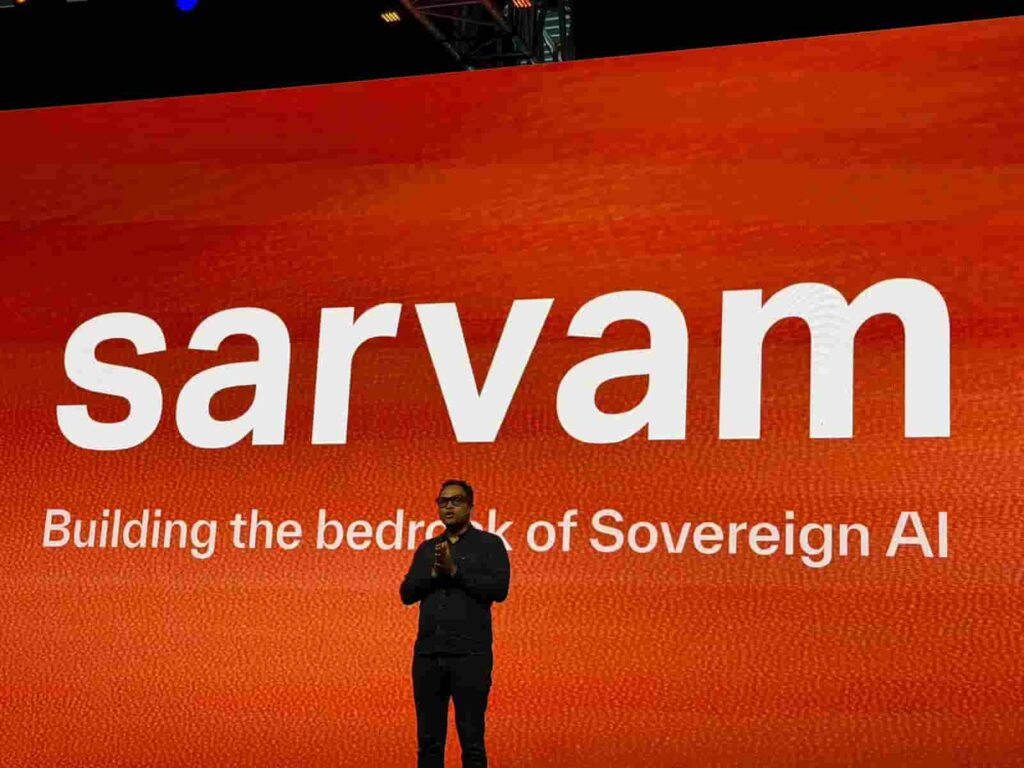
India emerges as an AI powerhouse with Sarvam AI’s indigenous models, earning praise from global tech leaders and government backing. Selected under the IndiaAI Mission with ₹246.72 crore support, Sarvam AI is building sovereign, multilingual AI tailored for India’s diverse linguistic and governance needs.Homegrown AI for Viksit BharatSarvam AI, founded in August 2023 by Vivek Raghavan and Pratyush Kumar, develops full-stack AI platforms entirely in India, from compute infrastructure to applications. At the India AI Impact Summit 2026, Union Minister Amit Shah lauded it as exemplifying why “the future belongs to India,” advancing Viksit Bharat through inclusive tech reaching every citizen.Google CEO Sundar Pichai highlighted Sarvam’s developer energy, stating their local models for Indian languages face “no impediments” and are “very well positioned.” The startup’s Sarvam Vision model achieved 84.3% accuracy on olmOCR-Bench (English subset), outperforming Google’s Gemini 3 Pro and OpenAI’s ChatGPT in document understanding.Core Foundational ModelsSarvam’s models prioritize India’s 22 scheduled languages, code-mixed speech, and mixed scripts:Bulbul (Text-to-Speech): 11 Indian languages, 39 distinct voices for natural, culturally fluent output.Saaras (Speech-to-Text): All 22 scheduled languages, 8kHz telephony audio, handles code-mixed inputs.Vision (Document Understanding): 22+ languages, including handwritten/historical texts; excels in OCR, image captioning, and chart/table interpretation.These enable multimodal tasks like visual analysis across languages, surpassing global rivals in Indic benchmarks with the new Sarvam Indic OCR Bench.Full-Stack Sovereign EcosystemSarvam’s integrated AI stack spans conversations, work, content, and edge deployment:PlatformKey CapabilitiesImpactSarvam for ConversationsHuman-like voices in 11 languages; 100M+ interactions, <500ms latency, 10x ROIEnterprise-scale voice AI, deploys in <24 hoursSarvam for WorkAI-assisted build-debug-optimize; open/modular integrationAccelerates enterprise value across models/dataSarvam for ContentMultilingual video dubbing (voice cloning, lip-sync), document translation preserving layout/toneContent creation with quality review toolsSarvam for EdgeLow-latency multimodal AI for on-device NLP, real-time translation/summarizationEdge-cloud hybrid for assistantsStrategic Partnerships Driving ScaleSarvam embeds AI in public services and enterprises:UIDAI: GenAI stack for Aadhaar, voice interaction, fraud detection, and real-time enrollment feedback in 10 languages (on-premise).Odisha Govt: 50MW Sovereign AI Hub for mining safety, industrial use, Odia skilling.Tamil Nadu & IIT Madras: Digital Sangam—India’s first Sovereign AI Research Park with 20MW data center for compute, research, startups.SBI Life Insurance: Samvaad/Arya for 8 crore customers—voice policy servicing (11 languages), multilingual claims bot, agent co-pilot; nationwide rollout by August 2026.Path to Digital SovereigntyBy reducing foreign AI dependence, Sarvam fosters open-source innovation across startups, academia, and industry. Free Document Intelligence API (February 2026) invites developers to build at scale. As Pichai noted India’s thriving entrepreneurship, Sarvam positions the nation as a global AI contender, rooted in linguistic diversity, governed locally, and scaled for population-level impact.
Bharatiya GPT: India’s Push Towards Indigenous AI Models
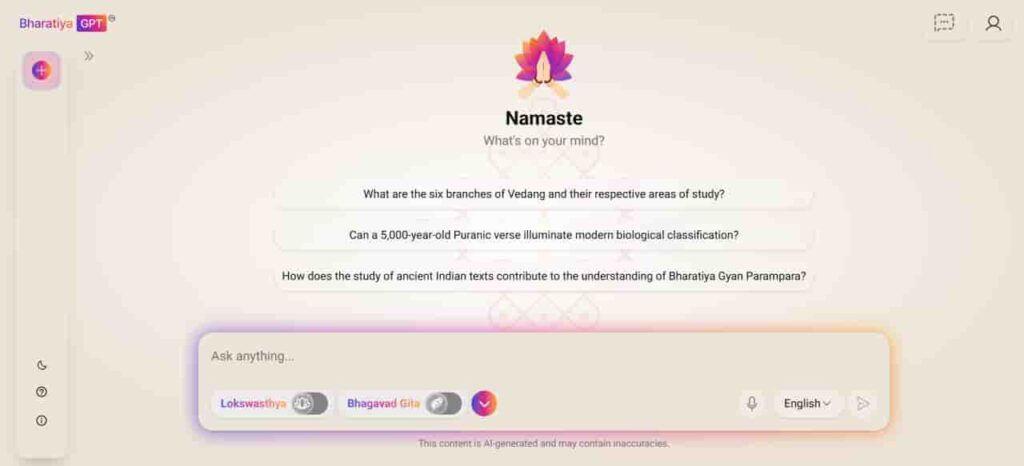
As artificial intelligence continues to reshape industries globally, India has been steadily moving towards building its own large language models (LLMs), often referred to in public discourse as “Bharatiya GPT.” The term does not denote a single product, but rather represents a broader effort to develop India-focused AI systems that understand the country’s languages, cultural context, and governance needs.At the centre of this movement are government-backed initiatives, academic collaborations, and private sector innovations aimed at reducing dependence on global AI platforms.The Need for an India-Centric AI ModelMost globally dominant AI systems, including those developed by OpenAI and Google, are primarily trained on English-heavy datasets and Western contexts. While they perform well globally, their understanding of India’s linguistic diversity and socio-cultural nuances remains limited.India, with over 20 officially recognised languages and hundreds of dialects, requires AI systems that can:Understand and generate regional languages accuratelyInterpret local context, idioms, and governance frameworksServe sectors like agriculture, healthcare, and public administration at scale“Bharatiya GPT” is therefore envisioned as a solution tailored specifically to these needs.Government-Led Initiatives and Policy PushThe Indian government has played a key role in advancing indigenous AI capabilities. Under its broader digital transformation agenda, several initiatives have been launched to support AI research and deployment.One of the central efforts is the IndiaAI Mission, which focuses on:Building domestic AI infrastructureSupporting startups and research institutionsCreating datasets in Indian languagesAdditionally, institutions like Indian Institute of Technology Madras and Indian Institute of Technology Bombay have been actively involved in AI research, contributing to language models and speech technologies tailored for Indian users.Rise of Indigenous AI ModelsIndia has already seen the emergence of several homegrown AI models that align with the idea of “Bharatiya GPT.”Key Developments:AI4BharatA research initiative focused on building open-source datasets and models for Indian languages. It has played a significant role in enabling multilingual AI capabilities.KrutrimDeveloped by Ola, Krutrim is one of India’s first large language models designed specifically for Indian users, supporting multiple regional languages.Reliance Jio AI initiativesIn collaboration with global technology partners, Jio has been working on AI platforms aimed at large-scale deployment across its digital ecosystem.These developments indicate a growing ecosystem where both public and private players are contributing to India’s AI ambitions.Challenges in Building Bharatiya GPTDespite strong momentum, developing a fully indigenous AI model comes with several challenges:1. Data AvailabilityHigh-quality datasets in Indian languages are limited compared to English, making training complex.2. Computing InfrastructureTraining large AI models requires massive computational resources, an area where global players still have an advantage.3. Linguistic ComplexityIndia’s linguistic diversity adds layers of difficulty in ensuring accuracy, consistency, and contextual understanding.4. Funding and ScaleBuilding and maintaining LLMs is capital-intensive, requiring sustained investment.Strategic Importance for IndiaThe push for Bharatiya GPT is not just technological—it is also strategic.Key Benefits:Digital SovereigntyReduces dependence on foreign AI systemsInclusionEnables access to AI in regional languages, especially in rural areasEconomic GrowthSupports startups, innovation, and job creationGovernance EfficiencyHelps in citizen services, policy implementation, and digital governanceGlobal Context and CompetitionIndia’s efforts mirror a broader global trend, where countries are developing their own AI models to maintain technological independence. Nations like China and the European Union have already invested heavily in localized AI systems.In this context, Bharatiya GPT represents India’s attempt to establish itself as a serious player in the global AI ecosystem, rather than just a consumer of foreign technology.The Road AheadIndia’s journey towards building a fully functional “Bharatiya GPT” is still evolving. Future developments are expected to focus on:Expanding multilingual capabilitiesImproving accuracy and contextual understandingScaling infrastructure through public-private partnershipsIntegrating AI into everyday governance and business use casesConclusion“Bharatiya GPT” is not a single product but a national vision for AI self-reliance. It reflects India’s ambition to create technology that is not only globally competitive but also deeply rooted in its own linguistic and cultural landscape.As development continues, the success of this initiative will depend on how effectively India can balance innovation, inclusivity, and scale—while building AI systems that truly understand and serve its diverse population.