


How The CJP Protest Forced India’s Education Minister to Resign.
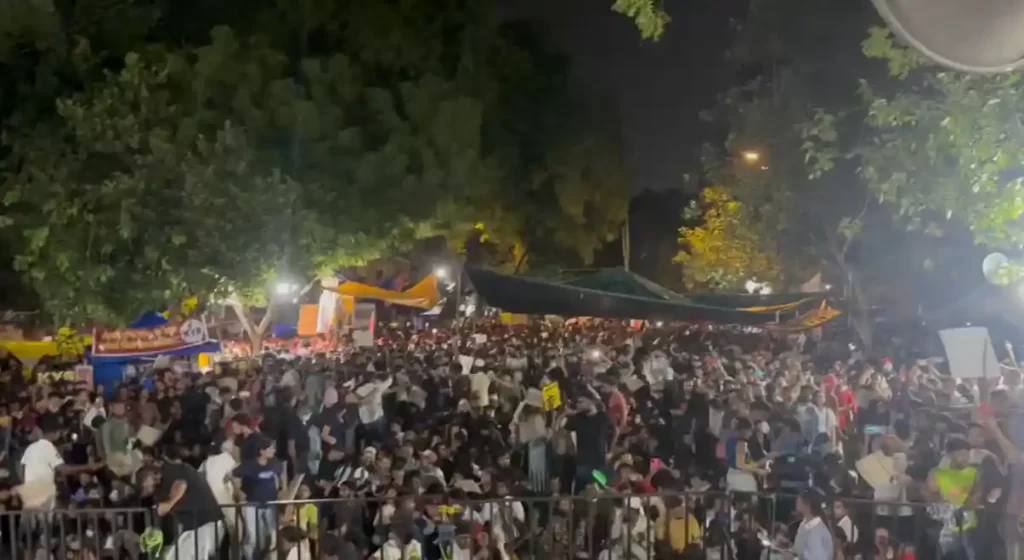
Thirty-six days. That is all it took.Thirty-six days of tear gas and lathi charges, of students sleeping on Parliament Street in the Delhi summer heat, of a 59-year-old activist slowly starving himself in a hospital bed, of a satirical party named after an insult becoming the most feared political force in the capital.On July 25, 2026, Union Education Minister Dharmendra Pradhan resigned. India’s youth had demanded it. And for once, India’s government listened.The Exam That Stole a Dream From 2.27 Million PeopleTo understand what happened at Jantar Mantar, you need to understand what NEET means in India.It is not just an entrance test. It is the single examination that decides whether you become a doctor. One paper. One day. One chance — for which families mortgage homes, students give up their teenage years, and coaching institutes in Kota charge fees that consume entire life savings.On May 3 and May 7, 2026, over 2.27 million students sat for NEET-UG. Then the NTA cancelled both dates. The paper had leaked. Not rumoured to have leaked. Not allegedly leaked. Pradhan stood in front of cameras on May 15 and admitted it himself: “We were confirmed that, under the guise of a guess paper, the actual examination questions had indeed been leaked.”Two months of preparation, wiped out. Families told to wait for a re-exam. And somewhere, the people who had bought the paper in advance — who had already known every answer before they sat down — were untouched.Students began dying by suicide.That is when the streets started filling up.The Party Born From an InsultThe Cockroach Janta Party already existed when NEET collapsed. It had been born in May from a Supreme Court judge’s courtroom remark that compared unemployed youth to cockroaches and parasites of society. Abhijeet Dipke, a student in Boston, had turned that insult into a party name, a manifesto, and an Instagram account that hit 22 million followers in under two weeks.The government’s response was to block it. Under Section 69A of the IT Act, on national security grounds.Nothing radicalises a generation faster than being called a parasite and then being silenced for objecting.When the NEET leak broke, CJP shifted its entire focus. The demands became specific: a transparent investigation, accountability for student suicides, and the resignation of Dharmendra Pradhan. The movement that had started as satire now had a body count behind it. Nobody was laughing anymore.Day 22: The Day Students Tried to March Into ParliamentJuly 20 was chosen deliberately. It was the first day of Parliament’s Monsoon Session. The CJP organised a ‘Chalo Sansad’ march — thousands of students walking from Jantar Mantar toward Parliament, carrying one demand: Pradhan must go.Delhi Police had other ideas. Barricades were erected. When the crowd pushed through, the response was immediate and brutal. Lathi-charges. Tear gas. Water cannons. Students who had come to knock on their Parliament’s door were beaten back from its gates.ThePrint’s entire reporting team came back with eyes burning from tear gas. Some took blows.Inside Parliament — the same building students were being stopped from reaching — the Opposition brought the NEET issue to both Houses. Adjournments followed. Speeches were made. And outside, the students lay on the road, coughing, bleeding, and refusing to leave.Sonam Wangchuk was arrested and taken to hospital that evening. He had been fasting for 22 days.The Hunger Strike Nobody Could IgnoreSince June 28, Wangchuk had been on an indefinite fast at Jantar Mantar alongside six students from the All India Students Association. He is 59 years old. He is famous — the engineer-activist who inspired the film 3 Idiots. He had no political affiliation that the government could use to dismiss him.That was precisely why he mattered. He brought legitimacy to a protest that the ruling party wanted to paint as anti-national. His face on the news each evening made it impossible for ordinary people to look away.By week three, celebrities were speaking up. By week four, the government had no clean options left.On July 23, after 26 days, Wangchuk ended his fast — but only after the government gave written assurances: no cases against peaceful protesters, parliamentary debate on education reform, and compensation for the families of students who died by suicide.Pradhan’s resignation was not in that deal. The CJP rejected it as insufficient.The protest continued.July 25: A Minister FallsThat morning, police were once again firing tear gas at Jantar Mantar.Then Pradhan opened X.”Considering the situation that has arisen at Jantar Mantar and across the country, so that antinational forces do not take advantage of this situation… I have sent my resignation letter to Prime Minister Modi,” he wrote. “I deeply respect the aspirations, feelings, and legitimate expectations of the country’s youth.”At Jantar Mantar, Abhijeet Dipke grabbed a microphone.”We have done it, we have done it,” he screamed.Around him, students who had been gassed and beaten and called anti-national for 36 days began to cry, to dance, to hold each other. Nineteen-year-old Lavanya Bharti, her voice shaking, told reporters: “They called us lazy and unemployed. We are lazy enough to sleep on Parliament Street for days. We have erased the fear that Modi spent years building. Cockroaches are crawling all over you, Modi.”Hours later, CJP spokesperson Ashutosh Ranka walked out of the Constitution Club of India having shaken hands with JP Nadda and Jitendra Singh. “All our demands have been accepted,” he said. “We request the protesters to withdraw immediately and return home peacefully.”It was over. All three demands — Pradhan’s resignation, compensation for families of students lost to suicide, no action against peaceful protesters — accepted.What This Was Really AboutEvery one of the 2.27 million students who appeared for NEET 2026 has a family. Say six people per family — parents, siblings, grandparents. That is roughly 14 million people directly affected by what happened on May 3 and May 7.India has produced paper leaks before. What it had not produced before was a generation angry enough, organised enough, and digitally fluent enough to refuse to absorb the humiliation quietly.AAP leader Manish Sisodia
NEET Examination Controversy: The Crisis That Shook India’s Education System
IntroductionFor millions of students across India, the National Eligibility-cum-Entrance Test (NEET) is not merely an entrance examination—it is the gateway to a career in medicine. Every year, more than 24 lakh aspirants compete for a limited number of MBBS, BDS and other undergraduate medical seats, making NEET one of the most competitive and high-stakes examinations in the country. For many students, years of rigorous preparation, financial investment and personal sacrifice culminate in a single examination that determines their future.In 2024, however, the credibility of India’s premier medical entrance examination came under unprecedented scrutiny. Allegations of question paper leaks, irregularities in the declaration of results, the awarding of grace marks, and reports of organised examination fraud triggered one of the biggest education controversies in the country’s recent history. What initially began as concerns raised by a handful of students soon escalated into a nationwide issue involving protests across several states, political debates, multiple court petitions, a Supreme Court hearing, and a nationwide investigation by the Central Bureau of Investigation (CBI).The controversy shook public confidence in the examination process and raised larger questions about the transparency, security and accountability of India’s competitive examination system. More importantly, it highlighted the immense emotional and psychological pressure faced by lakhs of students whose academic futures depend on a single examination.Understanding the Importance of NEETIntroduced in 2013, NEET serves as the single national entrance examination for admission to undergraduate medical and dental courses in government and private institutions across India. Conducted by the National Testing Agency (NTA), the examination replaced multiple state and institutional medical entrance tests with the objective of creating a uniform and transparent admission process.Over the years, competition has intensified significantly. Every year, lakhs of students compete for a comparatively limited number of medical seats, making the examination one of the toughest in the country. Success in NEET often requires years of preparation, with many students enrolling in coaching institutes and dedicating considerable financial and emotional resources to achieving a high rank.Given its significance, any question regarding the fairness of the examination inevitably affects not only individual candidates but also the credibility of India’s entire medical admission system.When the Results Raised QuestionsThe controversy began shortly after the declaration of the NEET-UG 2024 results. Students, parents and education experts noticed several unusual patterns that immediately sparked concern.One of the first issues involved an unexpectedly high number of students securing top ranks. Alongside this, several candidates were awarded scores of 718 and 719 out of 720, marks that appeared mathematically impossible under NEET’s standard marking scheme.The National Testing Agency later clarified that these scores resulted from the award of grace marks to candidates who had reportedly lost examination time due to delays at certain examination centres. According to the agency, the compensation formula had been adopted following principles used in previous competitive examinations.However, the explanation failed to satisfy many students and experts. Questions were raised regarding the transparency of the process, the methodology used for awarding grace marks, and whether such decisions had compromised fairness for other candidates.The unusually high number of perfect scores further intensified public suspicion, turning what initially appeared to be isolated concerns into a nationwide controversy.Allegations of Paper LeakAs debates over the results continued, another development dramatically changed the course of the controversy.Reports began emerging from Bihar alleging that the NEET question paper had been leaked before the examination. Initial investigations by state police pointed towards an organised network involving middlemen who allegedly obtained confidential examination material and distributed it to selected candidates in exchange for substantial sums of money.Subsequent investigations uncovered evidence suggesting that the leak was not the work of isolated individuals but part of a larger organised racket involving brokers, candidates and others connected with examination logistics.As more arrests were made across multiple states, the controversy shifted from concerns about result irregularities to allegations of criminal conspiracy.The revelations significantly undermined public trust in the examination process, with many students questioning whether merit alone had determined the final rankings.Student Protests Across the CountryThe allegations triggered widespread protests by students and parents across India.Candidates who had spent years preparing for NEET demanded greater transparency from the authorities and called for an impartial investigation into the alleged irregularities. Demonstrations were organised in several cities, while students used social media platforms to share their concerns and demand accountability.Hashtags related to the examination dominated online discussions for several weeks, turning NEET into one of the country’s most debated issues.Many aspirants argued that the controversy had created uncertainty regarding admissions and left genuine candidates mentally exhausted after months of preparation and waiting.For students whose future depended entirely on their examination performance, the delay in resolving the issue added to already significant emotional stress.Political Debate and National AttentionAs public pressure mounted, the controversy moved beyond the education sector and entered the political arena.Opposition parties criticised the government over alleged lapses in conducting one of India’s most important entrance examinations. The issue was raised repeatedly in Parliament, where lawmakers demanded accountability from the National Testing Agency and sought explanations regarding the alleged paper leak.The controversy also reignited broader discussions about the functioning of the National Testing Agency, which is responsible for conducting several major national examinations, including NEET, JEE Main and CUET.Questions were raised regarding examination security, digital infrastructure, centre management and the mechanisms available to detect organised malpractice.Government Response and CBI InvestigationIn response to growing public outrage, the Union Government ordered a comprehensive investigation into the allegations.The case was subsequently handed over to the Central Bureau of Investigation (CBI), which launched a nationwide probe into the suspected paper leak and related irregularities.The investigation led to multiple arrests across different states. Authorities examined financial transactions, questioned suspects and seized electronic devices believed to have been used during the alleged leak.Investigators concluded that organised criminal networks had attempted to manipulate the examination process by illegally accessing confidential question papers and facilitating unfair means for selected candidates.Meanwhile, the National Testing Agency announced that the grace marks awarded to affected candidates would be withdrawn. Students who had received