


Ravi Tamta: The Almora Innovator Behind India’s New Flying Vehicle Prototype
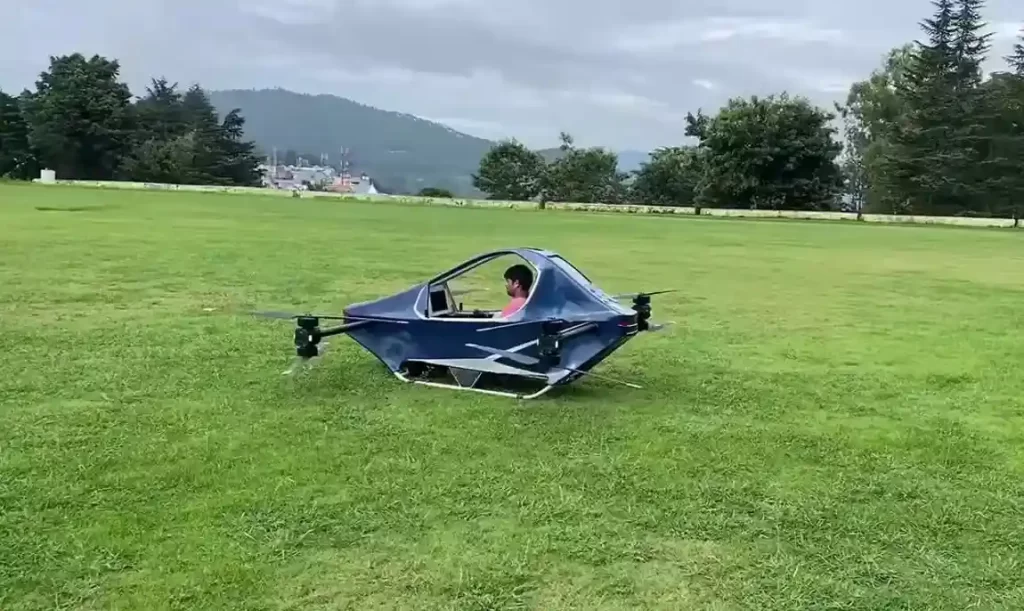
For years, the idea of a flying car has existed somewhere between science fiction and engineering ambition. In India, that idea has now taken an unusual turn in the hills of Uttarakhand.Ravi Tamta, an innovator from Almora, has developed and test-flown a single-seater electric flying vehicle prototype called HAPIDA SKYNeX. The prototype, developed under his venture Hapida Sky, has attracted attention after videos of its test flight in Almora surfaced online.The achievement is particularly striking because Tamta’s work has emerged from Kaflikhan village in Almora, rather than from a large aerospace company or a major metropolitan technology hub. His journey reflects a growing interest in grassroots innovation in India’s smaller towns and hilly regions.At the same time, the vehicle is still a prototype. It is not a commercially available flying car, and its development should not be confused with the large-scale electric vertical take-off and landing aircraft programmes being pursued by established aerospace companies around the world.What makes the story interesting is the attempt itself: using electric propulsion and modified drone technology to explore personal air mobility in a region where terrain can make conventional transportation difficult.Who Is Ravi Tamta?Ravi Tamta is a young entrepreneur and innovator based in Almora, Uttarakhand. His company, Hapida, describes him as its founder and says his work focuses on developing technology and products suited to hilly areas and village life. His earlier work has included several unconventional inventions. Hapida’s website lists products and projects ranging from a smart bamboo stick and mobile-chargeable shoes to an electrolyte pump that the company describes as an electric vehicle charging technology. This background is important to understanding Tamta’s latest project.His work has consistently focused on using relatively accessible technology to address problems associated with difficult terrain, mobility and everyday life in hill regions.The flying vehicle is an extension of that approach, although on a considerably more ambitious scale.HAPIDA SKYNeX: What Has Been Developed?The vehicle developed by Tamta is known as HAPIDA SKYNeX.It is described as a single-seater electric personal flying vehicle prototype. Unlike the conventional image of a flying car that can drive on roads and then take off, SKYNeX is better understood at its current stage as a compact electric vertical-flight vehicle.The prototype uses multiple electric motors and propellers to generate lift and manoeuvre through the air. Its design draws on principles used in multirotor drones, allowing the vehicle to take off vertically rather than requiring a conventional runway.The recent test flight in Almora demonstrated that the prototype could become airborne with a person onboard. Reports said the test was conducted in an open field in the Almora region.That distinction matters.SKYNeX is currently a flying vehicle prototype, not a road-going car that can seamlessly switch between driving and flying.Calling it a “flying car” is useful for describing the broader idea behind the project, but the technology demonstrated so far is closer to a personal electric aerial vehicle.The Almora Test FlightThe test flight became the moment when Tamta’s project moved from an experimental concept to something that could be seen operating in the real world.The prototype was flown in an open area in Almora, with Tamta demonstrating its ability to lift off and remain airborne.The test attracted attention because of the location.Almora is part of Uttarakhand’s mountainous Kumaon region, where steep slopes, winding roads and difficult terrain can make road connectivity time-consuming.For such regions, the concept of short-distance aerial mobility has obvious appeal.A journey that requires considerable time by road could theoretically be shortened dramatically if a small electric aircraft could travel directly from one point to another.Reports surrounding the prototype have cited the possibility of reducing journeys that could take around 90 minutes by road to roughly 10 minutes through the air. These figures represent the potential being discussed around the concept, rather than an established commercial service. Why Build a Flying Vehicle in the Hills?The geography of Uttarakhand provides an interesting context for the project.Mountainous terrain makes transportation fundamentally different from transportation across plains.Roads often have to follow the contours of mountains rather than taking a straight route between two locations. Building new roads can involve tunnels, bridges, land acquisition and significant construction costs.Air travel, in principle, can bypass some of these geographical constraints.This is one reason small electric aircraft and vertical-flight technologies are attracting interest globally.For a state such as Uttarakhand, potential applications could extend beyond personal transportation.Such aircraft could eventually have applications in emergency response, medical transportation, tourism, logistics and connectivity to remote areas.However, turning that potential into a safe and economically viable transportation system would require considerably more development.From Drone Technology to Personal Air MobilityThe basic technology behind SKYNeX draws on the rapid development of electric drone systems.Multirotor drones have demonstrated that multiple electronically controlled propellers can provide vertical lift and directional movement without the need for conventional aircraft wings or runways.The challenge becomes much greater when the system has to carry a human being.A passenger-carrying aircraft needs considerably higher levels of reliability, redundancy, structural strength, battery capacity, flight control and safety.A drone that weighs a few kilograms can tolerate design limitations that a vehicle carrying a person cannot.That is why a successful prototype flight is only an early stage in the development process.The Biggest Challenge: SafetyThe most important question surrounding any passenger-carrying flying vehicle is not whether it can take off.It is whether it can take off safely, remain controllable and land safely under a wide range of conditions.A human-carrying electric aircraft must account for motor failures, battery problems, electronic failures, weather conditions, loss of control, emergency landings and structural stresses.It also needs systems capable of preventing a single component failure from immediately becoming a catastrophic event.For commercial deployment, aviation regulators would also need to establish appropriate certification and operating requirements.Therefore, the successful flight of SKYNeX should be seen as a demonstration of a prototype’s capability, not as proof that the vehicle is ready for public transportation.The Battery ProblemElectric propulsion offers an important advantage because electric motors are mechanically simpler than conventional combustion engines and can produce power efficiently.But batteries remain one of the