


Modi at G7 Summit 2026: Maritime Security, Global Solidarity, and International Relations
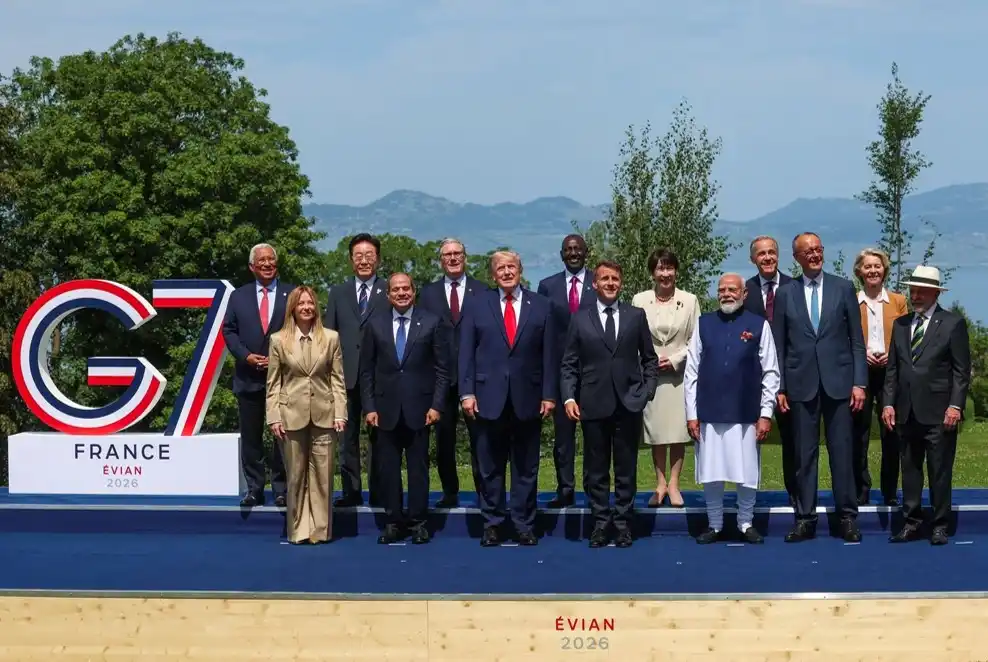
Prime Minister Narendra Modi delivered a powerful address at the 52nd G7 Summit in Evian-les-Bains, France, on Tuesday, June 16, 2026, voicing India’s firm concern over disruptions to maritime trade through the Strait of Hormuz and highlighting that several Indian civilians lost their lives during the West Asia conflict. Speaking at the outreach session on “Forging New Partnerships and Rebuilding International Solidarity,” Modi emphasized that lasting solutions to conflicts can only be achieved through dialogue, diplomacy, and international cooperation, while calling for the safety of seafarers who connect all nations through global maritime trade.The summit, held from June 15 to 17 on the shores of Lake Geneva, brings together leaders of France, Britain, Canada, Germany, Italy, Japan, and the United States alongside the European Union, with India invited as a partner country for its 13th participation and PM Modi’s 7th consecutive attendance. During his extensive diplomatic outreach on the sidelines, Modi held bilateral meetings with Canadian Prime Minister Mark Carney, British Prime Minister Keir Starmer, UAE President Sheikh Mohamed bin Zayed Al Nahyan, Kenyan President William Ruto, Egyptian President Abdel Fattah El-Sisi, Japanese Prime Minister Sanae Takaichi, and South Korean President Lee Jae-myung, while also exchanging greetings with U.S. President Donald Trump ahead of their scheduled bilateral meeting.Maritime Security and the Strait of Hormuz: India’s Core ConcernPM Modi’s remarks on the need to protect seafarers came amid growing anger in India over the deaths of three Indian crew members in a U.S. military attack on a merchant vessel off the coast of Oman last week. The U.S. Central Command said it had taken action against three vessels, Marivex on June 8, Settebello on June 9, and Jalveer on June 11, alleging that they were attempting to violate the U.S. blockade of Iranian ports. Modi raised this issue a day before his bilateral talks with President Trump, underscoring how conflicts in West Asia have disrupted global trade and caused loss of life.“We welcome the progress made in peace efforts in West Asia. This conflict has caused loss of life and property in our friendly countries in the region. Disruptions to maritime trade through the Strait of Hormuz have affected the global economy. Several Indian civilians have also lost their lives,” Modi said during his address. “It is our responsibility to ensure the safety of the seafarers who connect all nations through global maritime trade. We must ensure that maritime routes remain secure and that seafarers can perform their duties without fear,” he added.Modi’s concerns reflect India’s strategic dependence on the Strait of Hormuz, one of the world’s most critical maritime chokepoints for oil shipments and global commerce. As a major importer of energy and a nation with significant maritime trade volumes, disruptions in Hormuz directly impact India’s economic security, energy prices, and the safety of its nationals working in global shipping. The deaths of three Indian mariners in the U.S. strike have heightened domestic pressure on the government to address maritime security and protect Indian citizens abroad.Trust as the Ultimate Strategic Asset: Modi’s Vision for International RelationsIn his address, Modi underscored the importance of trust in international relations, saying that confidence among nations has become a more valuable strategic asset than minerals, technology, or markets. He argued that in an increasingly interconnected world, where energy, food, health, cyber, and economic security are closely linked, stronger international partnerships are essential for humanity’s progress and prosperity. Warning that trade and technology were being used to pursue narrow interests, Modi said such practices had contributed to a growing trust deficit in the international system.Modi wrote in an X post: “Shared my thoughts at the Outreach Session on ‘Forging New Partnerships and Rebuilding International Solidarity’ at the G7 Summit in Evian. In a world that is getting more interconnected and interdependent than ever before, this subject becomes all the more vital.” His emphasis on trust reflects India’s diplomatic philosophy that international cooperation must be founded on mutual respect, reciprocity, and shared interests rather than coercion or unilateralism.The trust deficit Modi highlighted is particularly relevant in the current global context, where geopolitical tensions, trade restrictions, technology bans, and security concerns have led nations to prioritize national interests over collective action. As the G7 discusses issues ranging from AI access to critical minerals supply chains, India’s call for trust-based partnerships offers an alternative framework that emphasizes inclusivity, cooperation, and shared prosperity for all nations, not just the wealthy few.Bilateral Outreach: Strengthening India’s Strategic PartnershipsIndia-Canada: Forward-Looking Strategic PartnershipDuring his meeting with Canadian Prime Minister Mark Carney, PM Modi and his counterpart welcomed the positive momentum in India-Canada relations and reaffirmed their commitment to building a forward-looking strategic partnership. The two leaders reviewed progress in economic cooperation, including commercial arrangements relating to Liquefied Natural Gas (LNG), Liquefied Petroleum Gas (LPG), and metallurgical coal. They expressed satisfaction over ongoing negotiations for a Comprehensive Economic Partnership Agreement, with both sides aiming to conclude the pact this year.The leaders also welcomed growing cooperation in science and technology, defence, finance, and migration. To further strengthen defence and security ties, the two countries agreed to launch negotiations on a General Security of Information Agreement. PM Modi expressed India’s support for Canada becoming a Dialogue Partner of the Indian Ocean Rim Association, and both leaders announced the establishment of Raisina Americas as a platform to enhance dialogue and cooperation.India-UK: Vision 2035 and Comprehensive Economic PartnershipDuring his meeting with British Prime Minister Keir Starmer, PM Modi reviewed progress in India-UK relations under Vision 2035. The two leaders welcomed cooperation across trade, defence, technology, education, and people-to-people ties, looking forward to the early implementation of the Comprehensive Economic and Trade Agreement. They expressed satisfaction over the strong education partnership, noting recent progress in establishing campuses of British universities in India, including the University of Liverpool in Bengaluru and the Universities of York and Bristol in Mumbai.The leaders exchanged views on regional and global developments and reaffirmed their commitment to further strengthening the India-UK Comprehensive Strategic Partnership, demonstrating how both nations are working to deepen their bilateral
South Korean President Lee Jae Myung Ushers in New Era of India–ROK Partnership
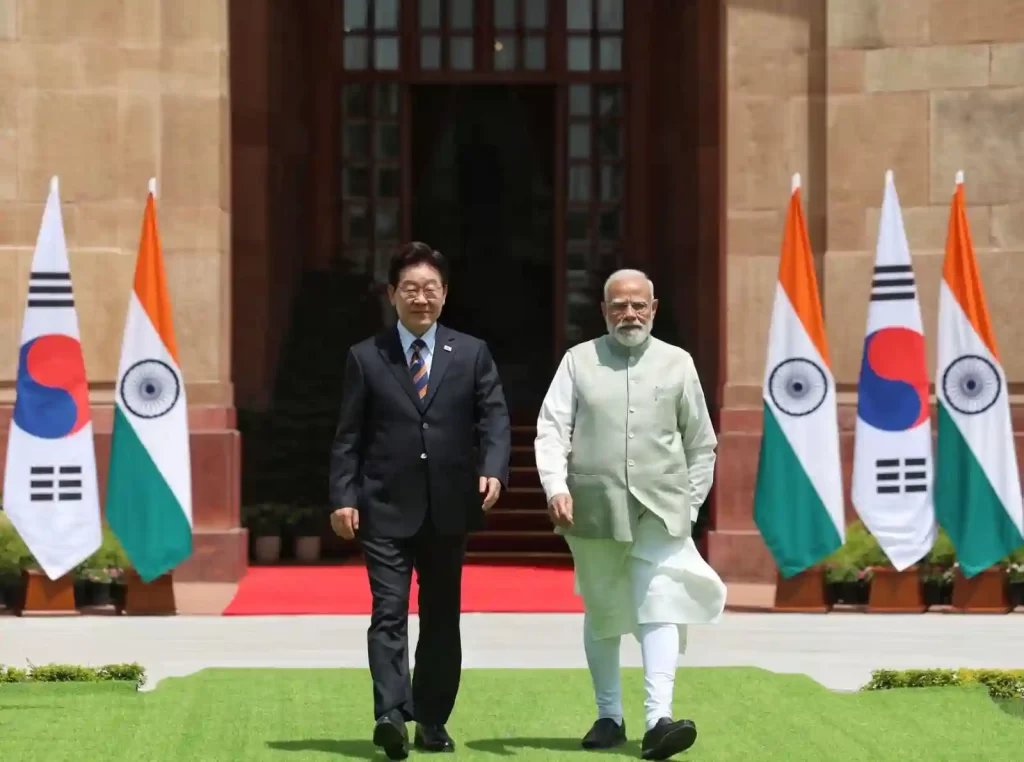
South Korean President Lee Jae Myung arrived in New Delhi on April 19, 2026, for a historic three-day state visit marking the first time a South Korean head of state has visited India in eight years. At Prime Minister Narendra Modi’s invitation, President Lee traveled with First Lady Kim Hea Kyung and nearly 200 business executives, including chairs of Samsung, Hyundai, LG, POSCO, and HD Hyundai. The visit centers on elevating the India–ROK Special Strategic Partnership across trade, technology, defense, and maritime cooperation. Both leaders agreed to nearly double bilateral trade from $27 billion to $50 billion by 2030 while launching a comprehensive five-year strategic roadmap for 2026–2030.President Lee described India as no longer just a consumer market but a key country driving global production. He called this visit a turning point, transforming a trusted partnership into a futuristic one spanning chips, ships, talent, technology, entertainment, and energy. The outcome includes 25 substantive agreements anchored in a Joint Strategic Vision that institutionalizes annual summits and creates structured cooperation mechanisms.The Preface: Economic Cooperation Economic cooperation forms the heart of the visit, with both countries setting an ambitious target of nearly doubling bilateral trade from $27 billion to $50 billion by 2030. At the joint press conference, President Lee stated that they aim to increase annual trade volume to around $50 billion within four years. Both sides agreed to fast-track an upgrade of the Comprehensive Economic Partnership Agreement (CEPA) to address non-tariff barriers and boost services exports.Modi announced the establishment of a Korean Industrial Township to ease market entry for Korean small and medium enterprises. President Lee expressed surprise that only 700 Korean companies are currently present in India, suggesting this figure could realistically be ten times higher. Both sides launched the India–Korea Financial Forum and an Economic Security Dialogue to support these goals, facilitating cross-border investment and supply chain resilience.Shipbuilding Emerges as Flagship CooperationShipbuilding emerged as the most significant flagship area with both sides adopting a Comprehensive Framework for Partnership on Shipbuilding, Shipping, and Maritime Logistics. In the headline commercial agreement, HD Korea Shipbuilding and Offshore Engineering, supported by India’s Maritime Development Fund, will develop a large greenfield shipyard in southern India. This facility will focus on block fabrication and construct a new dry dock for large specialized vessels.The partnership combines India’s labor, land, and strategic location with South Korea’s advanced technology and design expertise. Together, they can compete with Chinese shipyards dominating global orders. The shipyard will create thousands of jobs while building India’s capacity to construct vessels for defense, commercial, and research purposes. Technology transfer will enable Indian yards to move from repair work to complex vessel construction.Technology and Defense Cooperation DeepenBoth leaders launched the India–Korea Digital Bridge, combining India’s AI and engineering talent with South Korea’s semiconductor fabrication and precision manufacturing. NPCI International and the Korea Financial Telecommunications and Clearings Institute signed an MoU for the phased integration of digital payment systems, enabling seamless cross-border payments between India’s UPI and South Korea’s digital infrastructure.On defense, both sides reinvigorated the 2020 MoU on Defence Industry Cooperation with the K9-Vajra howitzer joint venture serving as a model. A Korea–India Defence Accelerator (KIND-X) was launched to connect businesses, incubators, investors, defense startups, and universities. ISRO and the Korea Aerospace Administration (KASA) agreed to form a Joint Working Group and held an India–ROK Space Day in Bengaluru, discussing satellite development and launch services.Indo-Pacific Strategic Convergence Strengthens SecurityBoth countries reaffirmed their commitment to a free, open, and rules-based Indo-Pacific. South Korea joined the India-led Indo-Pacific Oceans Initiative (IPOI), signaling growing strategic engagement beyond economic interests. Both sides agreed to hold the inaugural Defence and Foreign Affairs 2+2 Dialogue at the vice-ministerial level to coordinate security policies.President Lee described the two nations as the most ideal partners for comprehensive cooperation, promoting mutual growth and innovation in an era of uncertainty. Modi added that in this period of global tensions, India and Korea together convey a message of peace and stability. This strategic convergence addresses shared concerns about North Korea’s nuclear program, China’s maritime assertiveness, and supply chain vulnerabilities.Five-Year Roadmap Provides Clear DirectionThe visit produced 25 outcomes anchored in the Joint Strategic Vision for 2026–2030. Both sides launched an Industrial Cooperation Committee, chaired by respective industry ministers, to monitor implementation and resolve bottlenecks. Ministerial dialogues will expand across finance, science, technology, energy, and environment sectors.The roadmap includes specific targets for trade, investment, and technology transfer. Both countries are committed to increasing two-way investment to $20 billion by 2030. Student exchange programs will increase to 10,000 annually by 2030. The 2028–29 Year of India–Korea Friendship will celebrate shared heritage while promoting modern connections through film festivals, art exhibitions, and sports tournaments.Partnership Positions as Asia’s Consequential Middle-Power AlliancePresident Lee’s visit establishes a clear five-year direction integrating economic scale, industrial capability, and strategic coordination. With a structured roadmap, $50 billion trade target, and deepened cooperation across shipbuilding, semiconductors, and defense, the relationship ranks among Asia’s most consequential middle-power partnerships. This partnership demonstrates how democracies can cooperate effectively without formal alliances.The structured outcomes ensure accountability and measurable progress. Annual summits provide opportunities to review achievements while ministerial committees maintain momentum between leadership visits. The India–Korea partnership now has institutional depth that withstands political changes in either country, attracting long-term investment and facilitating multi-year projects.As Asia’s economic center of gravity shifts, India and South Korea position themselves as complementary powers driving innovation and growth. Their partnership combines India’s demographic strength and digital capabilities with South Korea’s technological mastery and industrial efficiency. Together they represent a model of South–South cooperation benefiting both nations while contributing to global stability. The visit marks not just a diplomatic event but a turning point shaping Asia’s future for generations.