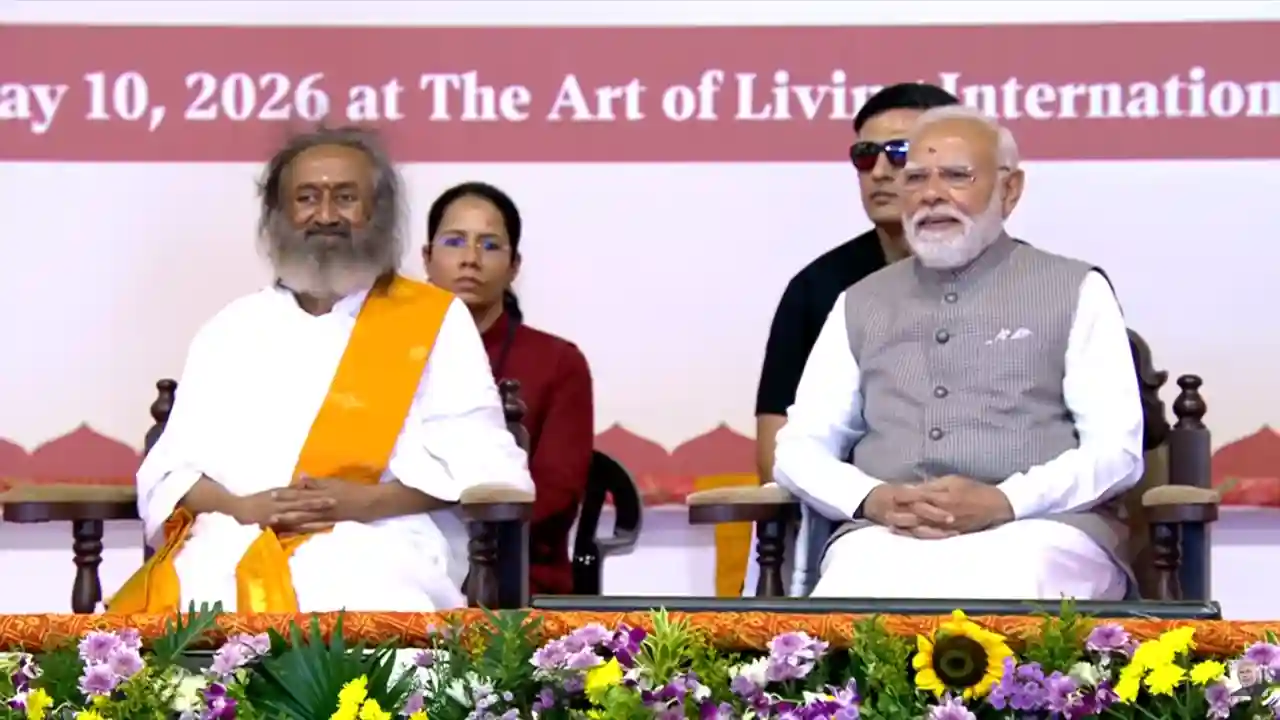
Prime Minister Narendra Modi participated in the 45th Anniversary Celebrations of The Art of Living Foundation in Bengaluru on May 10, 2026, simultaneously marking the 70th birthday of founder Gurudev Sri Sri Ravi Shankar. The Prime Minister inaugurated the newly constructed Dhyan Mandir, a grand Meditation Temple, at the Art of Living International Centre, describing it as a sanctuary of peace and healing for future generations. As Vedic mantras chanted by children filled the atmosphere alongside the darshan of Lord Ganesha, the event showcased Bengaluru’s unique dual identity: a city known worldwide for software and services that has also taken India’s cultural identity, spirituality, and spiritual consciousness to new heights.
Reflecting on the auspicious occasion, Modi described these moments as unforgettable: the convergence of Vedic welcome, sacred darshan, Sri Sri Ravi Shankar’s 70th year, and Art of Living’s 45th anniversary. “When resolve is clear and work is done with the spirit of service, then every effort yields pleasant results,” the Prime Minister asserted during the Meditation Temple inauguration. Tracing yoga, meditation, and pranayama as integral parts of India’s values, he noted how people across the world are influenced by India’s spiritual heritage, with many institutions drawing inspiration from these ancient values.
Seva Paramo Dharma: Service as India’s Unifying Force
Prime Minister Modi recalled how Sri Sri Ravi Shankar sowed the seed of Art of Living 45 years ago, which has now grown into a huge banyan tree whose thousands of branches touch countless lives globally. Highlighting India’s diversity in languages, traditions, and customs, he posed what binds these together: “The answer is living not for oneself but for others.” Quoting ancient Purana wisdom, Modi emphasized that serving others is a virtue while causing pain is a sin. “Seva Paramo Dharma is the natural character of our society,” he affirmed, recognizing how Art of Living’s volunteer network has consistently channeled society’s strength through tree-planting campaigns, rural smart village centers, women’s and tribal empowerment, and mental health programs for incarcerated individuals.
Gurudev Sri Sri Ravi Shankar reflected on the foundation’s journey, stating, “The sign of a healthy society is to see a smile on every face. That is the goal we have been working toward for 45 years.” He recalled the organization’s inclusive foundations, noting former Chief Justices Justice P.N. Bhagwati and Justice V.R. Krishna Iyer among its first trustees.
Society’s Power Beyond Politics: The Swachh Bharat Model
Stressing that societal engagement is essential for mission success, Modi emphasized that awakening social strength is fundamental to achieving important goals. “No government can succeed unless society itself actively participates in nation-building,” he said, citing Swachh Bharat as exemplary. “Our Swachh Bharat Abhiyan is not just a government programme, but it has become a natural part of people’s lives; now, it is advancing driven by the strength of society,” Modi observed, demonstrating how the sanitation mission transformed from a government programme into a grassroots movement.
Viksit Bharat Through Mentally Peaceful, Socially Responsible Youth
Commending youth empowerment, Modi emphasized its urgency given rapid global transformations driven by scientific advancement. He observed that India is not merely participating but leading in digital payments, infrastructure, startups, and space technology. “India is not just participating in this change; it is also leading in many areas,” he asserted. Acknowledging technology’s power to connect distant individuals, Modi stressed the parallel necessity of strengthening people’s ability to connect with themselves. “A Viksit Bharat will be built through such youth, mentally peaceful, socially responsible, and sensitive toward society,” he asserted, connecting spiritual practices to national development.
The realization of Viksit Bharat will only be possible through youth who are mentally calm, socially responsible, and sensitive towards society, Modi emphasized, linking yoga, meditation, and pranayama to national progress.
Natural Farming and Mission LiFE: Art of Living Extended
Modi urged Art of Living to connect farmers with natural farming practices, framing sustainable agriculture as an expression of the philosophy. “Adopting natural farming and saving Mother Earth from chemicals, this too is the Art of Living,” he affirmed.
He encouraged expanding the “Ek Ped Maa Ke Naam” campaign, improving water management through “Per Drop, More Crop,” and promoting electricity conservation, elimination of single-use plastics, and locally produced goods under Mission LiFE. “Protecting the environment is also Art of Living,” and “Saving every drop of water is also Art of Living,” he stated, connecting environmental stewardship to spiritual practice.
Conclusion: A Collective Journey to Developed India
The 45th anniversary, coinciding with Sri Sri Ravi Shankar’s 70th birthday, reaffirms India’s wisdom that Seva Paramo Dharma, service is supreme duty, and that Viksit Bharat will be built by mentally peaceful, socially responsible youth. As Art of Living’s thousands of branches touch lives globally, its journey from seed to banyan tree exemplifies how spiritual movements create sustainable transformation through service.
In Bengaluru, where software meets spirituality, Modi’s participation sent a powerful message about comprehensive development encompassing material progress and inner well-being. As India moves toward Viksit Bharat 2047, Art of Living offers a model for how spiritual institutions contribute through service, environmental stewardship, youth empowerment, and cultivating responsible citizens, building a happier, healthier, peaceful society.