


V.D. Satheesan Sworn In as Kerala’s 13th Chief Minister, Leading Congress-Led UDF to Landslide Victory
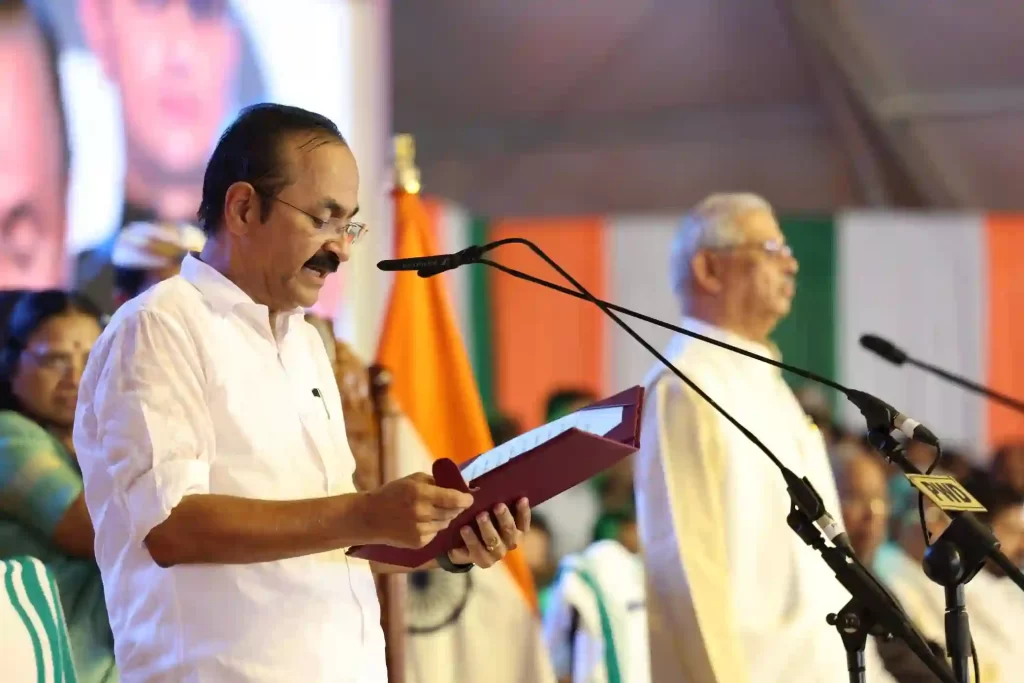
V.D. Satheesan was sworn in as the 13th Chief Minister of Kerala on May 18, 2026, at a grand ceremony held at the packed Central Stadium in Thiruvananthapuram. Governor Rajendra Vishwanath Arlekar administered the oath of office and secrecy to Satheesan and his 20-member council of ministers over a one-hour ceremony that commenced around 10:15 a.m. The Congress-led United Democratic Front (UDF) scripted a landslide victory over the CPI(M)-led Left Democratic Front in the April 9 Assembly elections, winning 102 of the 140 seats in the State Assembly, ending a decade of LDF rule and marking the UDF’s return to power.Satheesan, 61, who served as Leader of the Opposition during 2021–2026, became the first to be sworn in. The ceremony concluded around 11:30 a.m. with the recital of Vande Mataram followed by the National Anthem. Congress president Mallikarjun Kharge, senior leaders Rahul Gandhi and Priyanka Gandhi Vadra, along with several leaders from Congress-ruled states, including Karnataka Chief Minister Siddaramaiah, Telangana Chief Minister Revanth Reddy, and Himachal Pradesh Chief Minister Sukhvinder Singh Sukhu, attended the event. Outgoing Chief Minister Pinarayi Vijayan, who is set to become Kerala’s new Opposition Leader, was also present on stage along with BJP State president Rajeev Chandrasekhar.From Student Politics to Chief Minister: A Five-Decade JourneyV.D. Satheesan was born on May 31, 1964, at Nettoor in Ernakulam district (Maradu Municipality) as the fourth son of Vadassery Damodara Menon and Smt. V. Vilasini Amma. He entered public life through the Kerala Students Union (KSU), the student wing of the Indian National Congress, during his college days and rose to leadership ranks through student politics in Kerala. He served as University Union Councillor at Rajagiri College, Kalamassery, and later as Chairman of the Mahatma Gandhi University Union during 1986–1987. He was also actively associated as a Union Councillor in both Mahatma Gandhi University and the University of Kerala.Satheesan completed his primary education at Nettoor S.V.U.P School and passed SSLC from Panangad High School. He completed his Pre-Degree and Degree studies from Sacred Heart College, Thevara, and later obtained an MSW degree from Rajagiri College, Kalamassery. He earned his LL.B degree from Thiruvananthapuram Law Academy and obtained a Master’s Degree in Law from Government Law College. Alongside political activities, Satheesan practiced as an advocate in the Kerala High Court for nearly ten years and held leadership positions in several trade unions affiliated with the Indian National Trade Union Congress (INTUC).Historic Distinction: Sixth Leader to Become CM Without Prior Ministerial ExperienceSatheesan was first elected to the Kerala Legislative Assembly in 2001 from the Paravur Assembly Constituency and has been continuously re-elected in the Assembly elections held in 2006, 2011, 2016, 2021, and 2026. He holds the distinction of being the sixth political leader in Kerala to assume the office of Chief Minister without previously serving as a Minister in the State Cabinet. He is also the first Congress Chief Minister from Ernakulam district, representing a significant shift in the party’s leadership geography.In the 12th Kerala Legislative Assembly in 2006, he served as the Chief Whip of the Indian National Congress. In 2013, he was appointed as the AICC Secretary in charge of Tamil Nadu, and in 2014, he was appointed Vice President of the Kerala Pradesh Congress Committee (KPCC). Satheesan has emerged as a prominent public leader through his active involvement in student politics, the legal profession, organizational activities, and legislative responsibilities. Through his commitment to democratic values, social justice, and people-oriented development, he has secured a significant place in the public life of Kerala.A Complete Cabinet After 60 Years with Focus on AusteritySatheesan announced that a “complete Cabinet” was being sworn in at one go for the first time in 60 years. The Cabinet includes two women and two ministers from the Scheduled Castes, reflecting a commitment to social representation. The Congress has 12 members in the Cabinet, including the Chief Minister. The Indian Union Muslim League (IUML) has five Ministers, while Kerala Congress (Joseph), Kerala Congress (Jacob), RSP, and CMP have one each. As many as 14 members of the cabinet are new faces, bringing fresh energy to the government.Senior Congress figures in the cabinet include Ramesh Chennithala, K Muraleedharan, and Kerala Pradesh Congress Congress chief Sunny Joseph. The IUML ministers include P.K. Kunhalikutty, K.M. Shaji, P.K. Basheer, N. Shamsudheen, and V.E. Abdul Gafoor. Other ministers include Mons Joseph, Shibu Baby John (Revolutionary Socialist Party), Anoop Jacob (Kerala Congress-Jacob), C.P. John (Communist Marxist Party), A.P. Anil Kumar, P.C. Vishnunadh, Roji M. John, Bindu Krishna, M. Liju, T. Siddique, K.A. Thulasi, and O.J. Janeesh. All except Shibu Baby John and C.P. John took the oath in the name of God, with the two making solemn affirmation of their commitment.In keeping with austerity measures for the state, Satheesan has ordered that there be no convoys, security vehicles, or ambulances. He has also said he would not require a new vehicle, setting an example of frugal governance. The portfolios of the Chief Minister and Ministers were made public later on Monday, with Thiruvanchoor Radhakrishnan announced as Speaker and Shanimol Usman as Deputy Speaker.Building Puthuyuga Keralam: Vision for a New EraSatheesan stated that the UDF government was committed to working towards building a “Puthuyuga Keralam” (New Era Kerala). Following the declaration of election results on May 4, the Congress party took ten days to pick Satheesan over Ramesh Chennithala and AICC General Secretary K.C. Venugopal as the Congress Legislative Party leader and CM-designate. After that, the entire focus shifted to Cabinet formation, with discussions stretching into Sunday afternoon before Satheesan presented the list of ministers to the Governor on May 17 evening.The swearing-in ceremony witnessed huge crowds gathering at Central Stadium since early morning. Extensive arrangements, including traffic regulations, were in place across the State capital. Among those present were AICC General Secretaries K.C. Venugopal and Deepa Dasmunshi, CPI State secretary Binoy Viswam, and numerous other dignitaries. Rahul Gandhi greeted the new Chief Minister with a warm hug after Satheesan repeated the oath and signed the oath books.Satheesan’s Rise Reshapes Kerala Political
Assembly Election Results 2026: Five States, Four Verdicts, One Seismic Political Shift
IntroductionThe verdict is in. The five simultaneous assembly elections held across India in April 2026 — in Assam, Kerala, Tamil Nadu, West Bengal, and the Union Territory of Puducherry — delivered their final results on counting day, May 4, 2026, and the political map of India looks meaningfully different today from what it did a month ago.Three of the five contests produced changes of government. Two of the three changes were historic by any measure. In West Bengal, 15 years of Trinamool Congress rule ended as the BJP swept to a majority of 206 seats in one of the most dramatic transfers of power any Indian state has witnessed since the early 1980s. In Tamil Nadu, a film star’s two-year-old party destroyed the 59-year dominance of the Dravidian duopoly, producing the state’s first-ever hung assembly. In Kerala, the Congress-led United Democratic Front routed a two-term Left government and returned to power with its best result since 1977. Assam and Puducherry returned their incumbents with comfortable margins.Together, the five results carry consequences for Indian politics that will be felt well beyond state boundaries, with the 2029 general election now firmly in view.West Bengal: The Fall of a 15-Year FortressThe ResultThe BJP won 206 seats in the 294-member West Bengal Legislative Assembly, clearing the 148-seat majority mark by a margin of 58 seats. The Trinamool Congress, which had governed the state continuously since 2011, was reduced to 76 seats — a collapse from the 213 seats it had won in 2021. Congress and the Left together won the remaining seats.The Election Commission ordered a repoll in the Falta constituency due to EVM tampering, scheduled for May 21, with results on May 24. One seat, Falta in South 24 Parganas, has results pending.What HappenedMamata Banerjee won her own Bhabanipur constituency, surviving a challenge from Suvendu Adhikari in a closely watched count that saw multiple lead reversals through the day before she eventually held on by a margin of 7,184 votes. Adhir Ranjan Chowdhury, the veteran Congress leader, lost from his traditional Baharampur stronghold, one of the starkest individual reversals of the day.The voter turnout was a record 92.6 percent across both phases. That extraordinary participation figure produced a result that defied most pre-election predictions of a close contest. The BJP crossed the majority mark in early counting and never looked back.The BJP’s Salt Lake headquarters in Kolkata broke into celebrations well before the afternoon counts were completed. The Election Commission, anticipating violence, banned all victory processions and rallies across the state following the result. Despite that ban, incidents of unrest were reported in multiple districts, with a TMC office vandalized and set alight in the Barabani constituency as counting trends turned heavily against the ruling party.A VVPAT slip controversy had emerged the night before counting, when hundreds of printed slips were found discarded near a roadside in the Subhashnagar area of Madhyamgram, from booth number 29 of the Noapara constituency. The incident prompted demands for an inquiry but did not delay counting.Why It HappenedAnti-incumbency after 15 years in power was the structural force underlying the result. Several compounding factors sharpened its impact. A recruitment scandal in government examinations, concerns about law and order, and questions about job creation had eroded public confidence during the incumbent government’s final two years. The Special Intensive Revision of electoral rolls, which resulted in the deletion of 91 lakh voters from West Bengal’s rolls, became the most politically charged controversy of the campaign, with the TMC accusing the BJP of engineering the exercise and the BJP counter-alleging that the TMC’s opposition to SIR was motivated by its dependence on undocumented voters. The controversy turned citizenship and identity into the dominant electoral themes, replacing the governance record debate that the TMC had wanted to fight on.Why It MattersWest Bengal holds 42 Lok Sabha seats. It is one of the largest states in India by parliamentary representation, and the BJP has historically underperformed in its Lok Sabha tally relative to its assembly vote share in the state. A government in Kolkata changes that structural equation ahead of 2029 in a way nothing else could.Tamil Nadu: The End of a 59-Year Dynasty — and a Hung AssemblyThe ResultTamil Nadu produced the most extraordinary result of the five elections. The final seat count in the 234-member assembly was:Tamilaga Vettri Kazhagam (TVK): 108 seatsDMK-led Secular Progressive Alliance (SPA): 73 seats (DMK: 59, INC: 5, others: 9)NDA led by AIADMK: 53 seats (AIADMK: 47, BJP: 1, others: 5)The majority mark is 118. No party or alliance crossed it. Tamil Nadu produced a hung assembly for the first time in its history.TVK, a party formed in February 2024 and contesting its first election, emerged as the single largest party. It beat both the DMK and AIADMK alliances in seat count but fell 10 seats short of forming a government on its own.Government FormationFollowing the declaration of results, Vijay invited the Indian National Congress to join a coalition government. Congress, which had won only 5 seats as part of the DMK-led SPA, accepted the invitation and formally left the DMK-led Secular Progressive Alliance, entering a new TVK-INC alliance. On May 6, 2026, Vijay met the Governor of Tamil Nadu, Rajendra Vishwanath Arlekar, and staked claim to form the government. He is expected to be sworn in as Chief Minister in the coming days.The Individual StoryThe personal stories from the counting day deserve particular mention. Vijay himself won both constituencies he contested, Perambur and Tiruchirappalli East, making him the clear face of government formation. Outgoing Chief Minister M. K. Stalin lost his Kolathur seat, which he had won three times consecutively. Deputy CM Udhayanidhi Stalin also lost his constituency. Fifteen ministers from the outgoing DMK cabinet were defeated. AIADMK general secretary Edappadi K. Palaniswami, however, retained his Edappadi seat with the widest winning margin in the state.Why It HappenedAnalysts identified several factors. TVK successfully targeted the youth vote, women voters, urban voters, and first-time voters across caste and religious lines. Anti-incumbency against the DMK government, widely
Four Stars of Destiny: The Autobiography of General Manoj Mukund Naravane
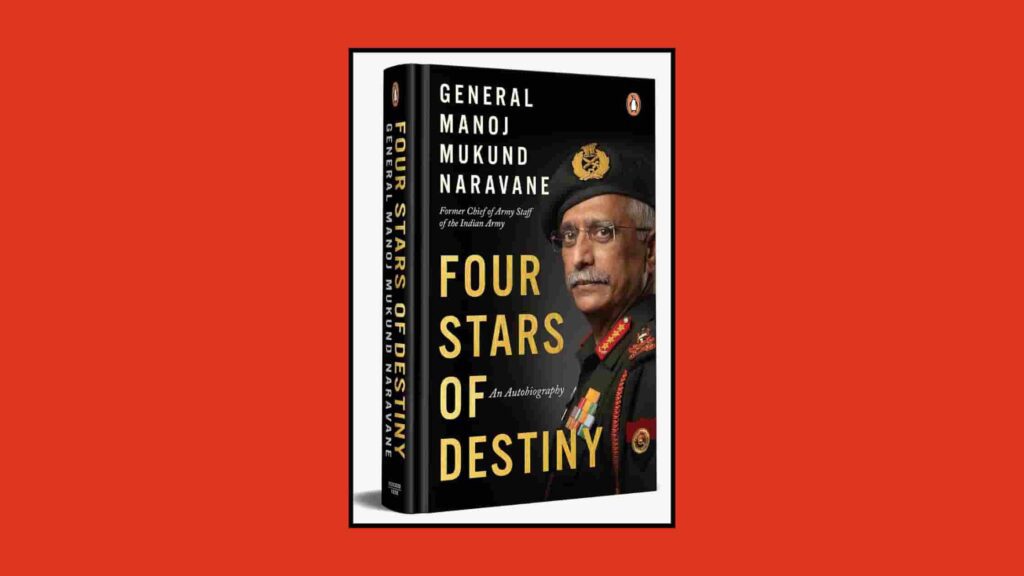
Four Stars of Destiny is the autobiography of Manoj Mukund Naravane, the former Chief of the Indian Army. The book offers a detailed account of Naravane’s personal life, military career, leadership experiences, and the strategic challenges he faced during his decades of service in the armed forces. The memoir traces his journey from his early years and training as a young cadet to eventually becoming the 28th Chief of the Indian Army, a position he held from December 2019 to April 2022.The book is considered an important narrative of modern Indian military leadership, providing readers with insights into the functioning of the Indian Army, strategic decision-making at the highest levels, and the complexities of managing national security challenges in the twenty-first century.About the AuthorGeneral Manoj Mukund Naravane was born on 22 April 1960 in Pune, Maharashtra. He comes from a family with a background in public service—his father served as an officer in the Indian Air Force while his mother worked with All India Radio. Naravane received his education in Pune before joining the National Defence Academy and later the Indian Military Academy, where he began his professional military journey.He was commissioned into the 7th Battalion of the Sikh Light Infantry in June 1980, beginning a career that would span more than four decades. Over the years, he served in a wide range of operational, command, and staff roles across India and abroad. His service included counter-insurgency operations in Jammu and Kashmir and the Northeast, as well as participation in the Indian Peace Keeping Force in Sri Lanka.These experiences shaped his leadership style and strategic understanding, themes that are extensively discussed in his autobiography.Journey from Cadet to Army ChiefA central theme of Four Stars of Destiny is Naravane’s professional journey through the ranks of the Indian Army. The memoir describes how discipline, training, and operational experience helped shape his character and leadership philosophy.The book recounts his early days as a young officer and his exposure to challenging military environments. It highlights how officers are trained to make difficult decisions under pressure while maintaining responsibility for the lives of their soldiers.Naravane gradually rose through the ranks, commanding various units and formations and holding several senior positions in the Indian Army. His leadership roles included command of an infantry brigade, senior operational responsibilities in counter-insurgency areas, and high-level appointments in the defence establishment.Eventually, he rose to become the Chief of the Army Staff, the highest position in the Indian Army. His tenure as army chief coincided with several significant national security developments and military challenges.Insights into Military LeadershipOne of the key aspects of the memoir is its discussion of leadership and decision-making in the armed forces. Naravane reflects on the values of discipline, professionalism, and responsibility that define military leadership.Through personal anecdotes and experiences, he explains how officers must balance strategic planning with ground-level realities. The book also explores the importance of teamwork, trust within the chain of command, and the ethical responsibilities associated with leadership in the military.The memoir also offers lessons on management and leadership that extend beyond the armed forces, showing how military principles such as preparedness, resilience, and clarity of command can be applied in other professional fields as well.Key Military Events Discussed in the BookFour Stars of Destiny also provides an insider’s perspective on several important security developments that took place during Naravane’s career.Among the most significant is the India-China military standoff in eastern Ladakh in 2020, one of the most serious confrontations between the two countries since the 1962 war. The memoir discusses the strategic decisions taken by the Indian military leadership during the crisis and the measures implemented to manage tensions along the Line of Actual Control (LAC).The book also touches upon other policy and organisational changes within the armed forces, including reforms related to recruitment and military preparedness.Publication and ControversyAlthough the memoir was originally scheduled for publication in 2024 by Penguin Random House India, its release has been delayed due to the review process required for books written by former senior military officials.In India, manuscripts written by senior defence personnel often undergo scrutiny by the Ministry of Defence before publication to ensure that sensitive information related to national security is not disclosed.The book also became the subject of political debate in Parliament after excerpts from the manuscript were cited during discussions on national security issues. This controversy brought renewed public attention to the memoir even before its official release.Significance of the MemoirDespite the publication delays, Four Stars of Destiny has generated considerable interest among readers, military analysts, and policymakers. The memoir is expected to provide valuable insights into the workings of India’s military leadership and the challenges faced by the armed forces in an evolving geopolitical environment.More than just a record of personal achievements, the book is also seen as a reflection on the values and responsibilities associated with serving in the armed forces. It highlights how decades of dedication, discipline, and leadership can shape both an individual career and the broader institution of the military.ConclusionFour Stars of Destiny stands as an important account of the life and career of General Manoj Mukund Naravane. By narrating his journey from a young cadet to the head of the Indian Army, the autobiography provides readers with a deeper understanding of military service, leadership, and national security.The memoir not only documents a distinguished military career but also offers lessons on perseverance, duty, and leadership—qualities that remain central to the ethos of the Indian armed forces.