
Prambanan Temple is one of Indonesia’s most remarkable historical treasures, a soaring 9th-century Hindu complex near Yogyakarta that still feels powerful even in ruins, not because it is perfectly preserved, but because it carries the grandeur of an ancient civilization in every carved stone and rising spire. As the largest Hindu temple complex in Indonesia and one of the most important in Southeast Asia, it stands today not only as a UNESCO World Heritage Site, but also as a symbol of the long cultural conversation between India and Indonesia.
The recent visit by Indian Prime Minister Narendra Modi to Prambanan, alongside Indonesian President Prabowo Subianto, gave the temple renewed international attention, especially after the two leaders marked the beginning of India’s archaeological conservation and restoration project for the site. That gesture matters because Prambanan is more than a monument; it is a shared civilizational memory, built in stone and preserved through diplomacy, scholarship, and devotion.
A Monument With Deep Roots
Prambanan was built during the 9th and 10th centuries under the Sanjaya dynasty of the ancient Mataram Kingdom, at a time when Hinduism and Buddhism both shaped life on Java’s fertile plains. The temple was dedicated to the Hindu Trimurti, Shiva, Vishnu, and Brahma, and was designed as a sacred landscape rather than a single isolated shrine.
What makes its origin story so fascinating is the way it reflects the cosmopolitan character of ancient Southeast Asia. Java was not a peripheral outpost of Indic culture; it was a place where Hindu ideas were absorbed, adapted, and given local artistic expression, creating a monument that feels both familiar and distinctly Indonesian. In that sense, Prambanan is not simply an import from India’s religious world, but a mature regional interpretation of it.
Scale and Structure
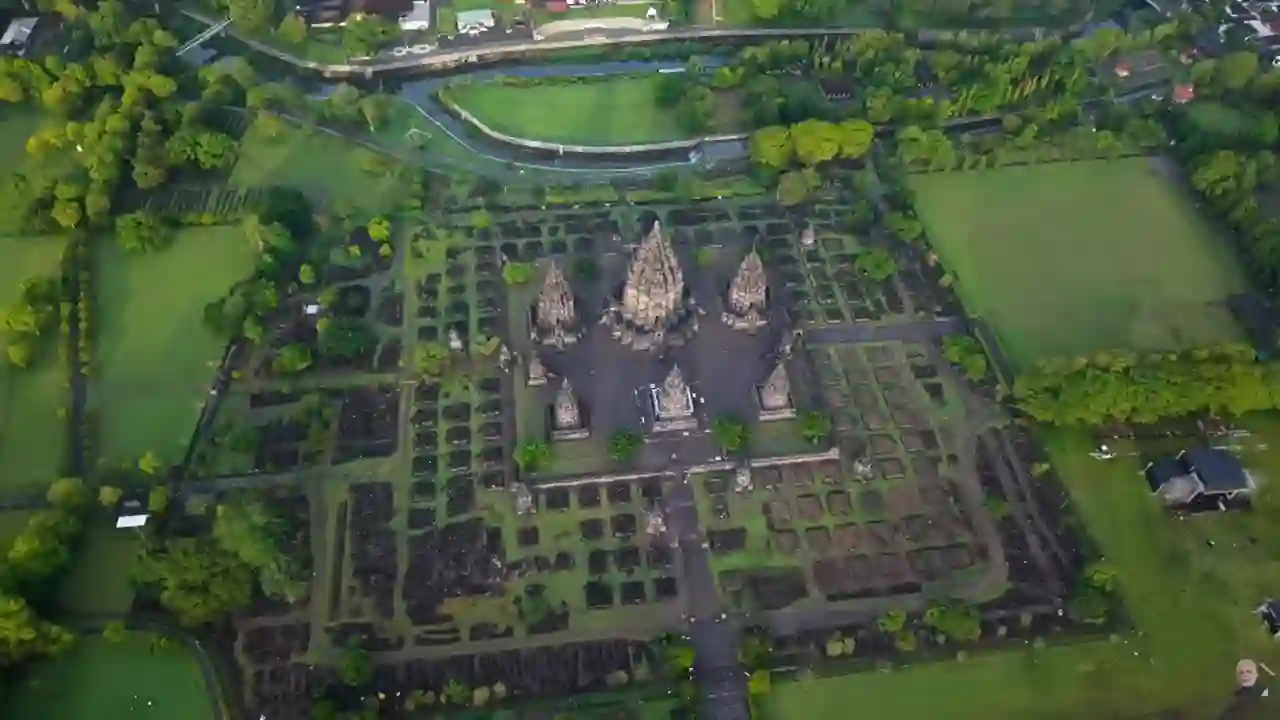
The Prambanan Temple Compound is made up of several groups of buildings, including the main Prambanan temple complex as well as Sewu, Bubrah, and Lumbung temples. At the heart of the site once stood roughly 240 temples, large and small, spread across a landscape of nearly 40 hectares, making it one of the grandest religious complexes ever built in ancient Java.
The central shrine arrangement is especially striking. Three main temples honor Shiva, Vishnu, and Brahma, with Shiva’s temple rising highest at around 47 metres and dominating the skyline with a verticality that immediately sets Prambanan apart from many other temple traditions in Asia. That upward sweep creates a sense of aspiration and sacred hierarchy, as if the entire complex is trying to lift the visitor’s gaze toward the divine.
The Architecture & Carvings That Speak
The first impression Prambanan gives is one of dramatic elegance. Unlike sprawling temple compounds that spread horizontally across a broad footprint, Prambanan rises sharply and symmetrically, with stone towers that create a powerful silhouette against the Javanese sky. This vertical design is not just beautiful; it reflects Hindu cosmology and the idea of sacred order expressed through geometry, elevation, and alignment.
Inside the Shiva temple are chambers that house statues of Shiva, Durga, Ganesha, and the sage Agastya, reinforcing the temple’s theological depth and ritual purpose. Around the central shrines, rows of smaller pervara shrines once created a dense sacred field, and although many are now in ruins, their remains still help convey the scale and ambition of the original complex.
One of Prambanan’s greatest artistic achievements is its relief sculpture. The temple galleries are decorated with finely carved bas-reliefs depicting episodes from the Ramayana, allowing visitors to move around the structure almost as if they are reading a sacred story in stone. That narrative quality gives the site a remarkable human texture. The carvings are not merely decorative; they function as theological instruction, cultural memory, and visual storytelling, connecting architecture to epic literature in a way that turns the temple into a living manuscript. Visitors traditionally walk clockwise around the corridors, following the sequence of scenes, which turns movement itself into an act of contemplation.
Prambanan and Borobudur
Prambanan is often discussed alongside Borobudur, the great Buddhist monument nearby, and the pairing is one of the most compelling features of Java’s cultural landscape. Where Borobudur represents the island’s Buddhist heritage, Prambanan reveals its Hindu legacy, and together they show that ancient Java was home to overlapping traditions rather than a single religious identity.
That coexistence is historically important because it reminds us that Southeast Asian civilizations were deeply plural, creative, and interconnected. The two monuments, standing in the same broader region, make a powerful case for understanding heritage not as a fixed label, but as a layered record of exchange, adaptation, and local genius.
UNESCO Recognition and Preservation
Prambanan was designated a UNESCO World Heritage Site in 1991, a recognition that underlined both its architectural importance and its vulnerability. Like many ancient monuments, it has faced damage from age, weathering, and seismic events, which is why conservation has been central to its survival.
India’s involvement in the current restoration effort is especially notable because the Archaeological Survey of India has a long history of heritage conservation in Southeast Asia, including documentation work at the Borobudur temple compounds. The Prambanan project is therefore part of a broader effort to preserve not just a structure, but a shared historical vocabulary that connects South and Southeast Asia across centuries.
Why Prambanan Still Matters
Prambanan matters today because it speaks to more than religion or tourism. It is a reminder that civilizations travel through architecture, that faith can become form, and that cultural influence often survives longest in stone. For Indonesia, it is a monument to the Hindu past that helped shape its early history; for India, it is a reminder of how widely Indic traditions once flowed and how deeply they were transformed abroad.
It also matters because heritage diplomacy is not abstract. When leaders jointly restore a temple, they are not only protecting old walls; they are affirming a relationship between histories, publics, and identities. The plaque unveiled by Modi and Prabowo at Prambanan therefore carries meaning well beyond ceremony, because it ties preservation to friendship, scholarship, and mutual respect.
Conclusion
Prambanan Temple is one of Southeast Asia’s great cultural masterpieces, a place where towering architecture, epic storytelling, and spiritual symbolism come together in a way that still feels vivid after more than a thousand years. Built as a Hindu sacred complex in ancient Java and now honored as a UNESCO World Heritage Site, it remains a stunning testament to the sophistication of the Mataram Kingdom and to the enduring ties between Indonesia and India.
As restoration begins with Indian support, Prambanan enters a new chapter, one that is not about rebuilding the past for nostalgia’s sake, but about safeguarding a living inheritance for the future. In a world where cultural memory is often fragile, Prambanan endures as proof that great monuments can still connect nations, centuries, and civilizations with extraordinary force.
Video: YT/@NaMo