
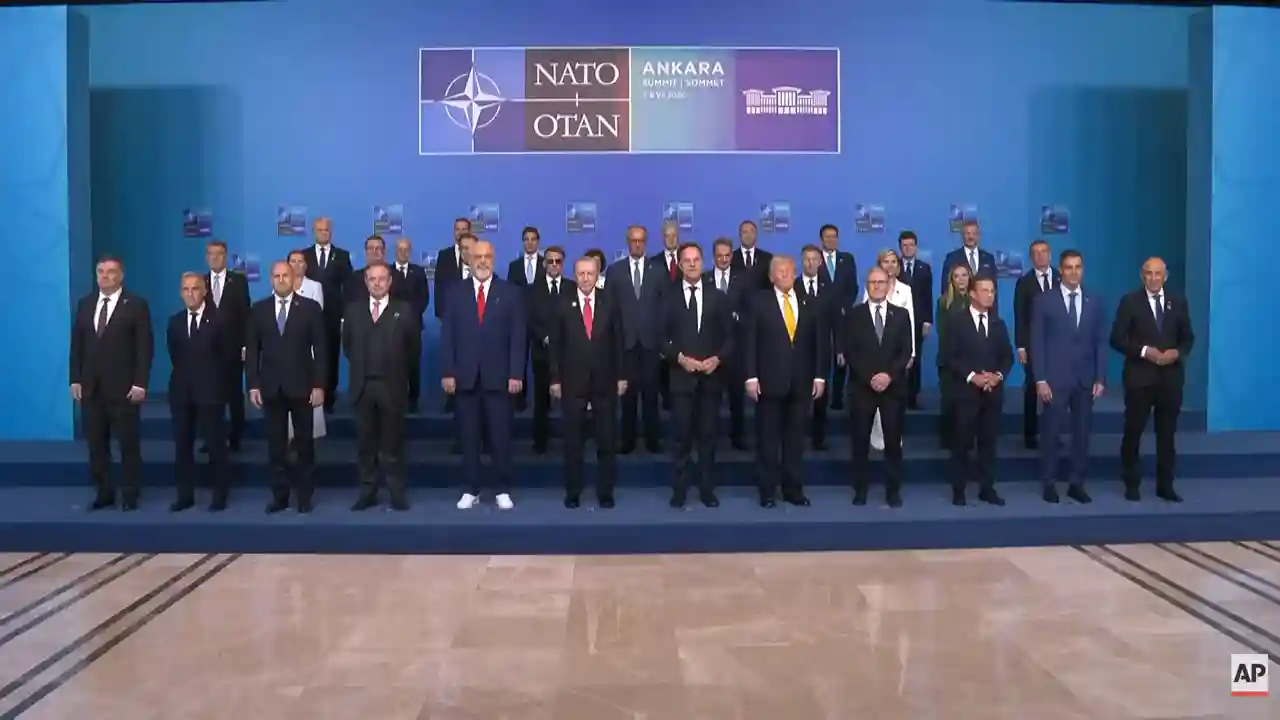
The NATO Summit in Ankara on 7–8 July 2026 arrived with the kind of tension that tends to follow every major alliance gathering in an era of war, spending disputes, and uncertain US commitment, yet the final outcome was defined less by dramatic rupture than by cautious continuity. Allied leaders managed to preserve unity on the core questions, even as disagreements over Ukraine’s membership path, burden-sharing, Turkey’s F-35 ambitions, and Europe’s broader security posture remained unresolved beneath the surface.
Why Ankara Mattered
This summit was not just another annual diplomatic event; it was a review point for how far NATO had advanced since the 2025 summit in The Hague and a chance to set the next phase of the alliance’s roadmap. The timing was especially sensitive because allies entered Ankara amid uncertainty over US engagement, frustration about defense-spending delivery, and competing views on how far NATO should go in backing Ukraine and responding to wider geopolitical shocks, including the Iran war.
Ankara also carried symbolic weight because NATO summits are increasingly used not only to manage crises but to signal strategic direction. In that sense, the 2026 gathering became a test of whether the alliance could still produce consensus in a more fractured world, and the answer, at least for now, was yes, though only by shelving some of the hardest issues for later.
Ukraine Gains Support, But Not Membership
Ukraine’s President Volodymyr Zelenskyy was one of the summit’s most consequential guests, delivering a short but emotionally charged address that earned a standing ovation on the opening day. The alliance also delivered a tangible military commitment, with allies pledging €70 billion in military equipment and training support and promising to sustain assistance at least through 2027 at equivalent levels.
Even so, the long-running question of NATO membership remained largely unchanged. Zelenskyy pressed allies to consider whether it was fair to leave a country with such strong defensive capability outside the alliance, but the summit produced no breakthrough on accession, leaving Ukraine with strong support but no formal movement on membership status. The final declaration did use stronger language than the 2025 Hague statement, describing Kyiv as a contributor to “transatlantic security” and reaffirming unwavering support for its freedom, sovereignty, and territorial integrity.
That distinction matters. NATO is increasingly treating Ukraine not just as a beneficiary of support but as a security contributor, yet allies remain divided over how quickly that political recognition should translate into membership. Swedish Defense Minister Pal Jonson captured the direction of travel when he said the alliance was moving toward seeing Kyiv as a “security provider,” while also arguing that the sooner Ukraine becomes a member, the better.
A New Defense Finance Architecture
One of the summit’s most significant structural developments was the announcement of the Canada-led Defense, Security and Resilience Bank. Backed initially by Canada, Albania, Belgium, Ukraine, Greece, Latvia, Luxembourg, Romania, and Turkey, the new institution is designed to provide low-interest loans for defense projects and help governments and small and medium-sized enterprises close financing gaps.
The ambition behind the bank is substantial. Ottawa said the goal is to mobilize $134 billion of capital and have the institution operating by 2027, which would make it one of the most notable financial innovations in the alliance’s recent history. The idea reflects a broader recognition that deterrence is not only about weapons and troops; it is also about industrial capacity, procurement financing, and the ability to sustain long-term defense investment in a more dangerous era.
Turkey, Trump, and the F-35 Question
The summit also highlighted Turkey’s unresolved place inside the alliance’s most advanced defense ecosystems. Despite positive signals from Donald Trump that sanctions could be lifted, Ankara did not secure formal re-entry into the F-35 program, from which it was removed in 2019 after purchasing Russian air defense systems.
Trump’s remarks suggested the issue remains alive, saying that bringing Turkey back into the fifth-generation fighter program was “something certainly we’d consider,” but no agreement was formalized. That left Turkey with a familiar combination of diplomatic encouragement and practical uncertainty, even as Turkish defense thinking appears to be shifting toward greater emphasis on the indigenous KAAN fighter rather than relying solely on a return to the American program.
Big Defense Deals on the Sidelines
Beyond the summit hall, the defense industry used Ankara as a launchpad for major announcements. NATO allies backed the planned procurement of up to 10 Swedish GlobalEye surveillance aircraft to replace aging E-3 planes, marking a notable turn toward a European solution after earlier plans had pointed to Boeing’s E-7 Wedgetail.
The summit also saw partner nations sign letters of intent for the Crewed Airborne Early Warning High Visibility Project, involving Denmark, Finland, France, Germany, Poland, Spain, Sweden, and Turkey. At the same time, a broader coalition led by the UK committed $50 billion over the next decade to deepen long-range strike capabilities, including systems able to hit targets hundreds and, in some cases, thousands of kilometers away with precision.
This wave of initiatives matters because it shows NATO’s center of gravity shifting from abstract strategic debate to concrete capability building. Air surveillance, early warning, long-range strike, and industrial financing are becoming the material language of allied deterrence.
Trump’s Tone and the Alliance Mood
Donald Trump’s presence cast a long shadow over the summit, especially given his tendency to criticize allies sharply. Yet by the end of the meeting, he was speaking of his “tremendous love” for Western leaders, and even said there was “a lot of love in that room” after his bilateral meeting with Zelenskyy.
That softer tone likely reassured Secretary General Mark Rutte, whose diplomatic style during this NATO cycle has leaned heavily on keeping Washington engaged and the alliance unified. Still, the summit also featured a reminder that alliance management remains complicated, with Trump renewing his call to take control of Greenland, a remark that prompted Danish Prime Minister Mette Frederiksen to restate that the island is not for sale.
What the Declaration Achieved
The final declaration renewed NATO’s Article 5 collective-defense commitment, a crucial signal to European and Canadian allies worried about what might happen if Russia tests the alliance directly. In practical terms, that commitment remains the bedrock of NATO credibility, and reaffirming it in Ankara was perhaps the clearest message of continuity the summit could deliver.
The declaration, together with the defense-spending and defense-production agenda advanced since The Hague in 2025, showed that NATO is still capable of adapting without splintering. It did not solve every dispute, but it did confirm that the alliance remains oriented toward deterrence, support for Ukraine, and long-term military modernization.
Conclusion
The NATO Summit 2026 in Ankara was less a dramatic turning point than a disciplined effort to keep a difficult alliance moving in the same direction. Ukraine won more weapons, more training, and stronger diplomatic language, but not membership; Turkey won renewed attention but not the F-35 breakthrough; and allies collectively advanced new defense-finance and procurement initiatives that could matter for years.
In that sense, the summit’s real achievement was not spectacle but steadiness. In a year marked by geopolitical strain, NATO leaders managed to preserve unity, renew deterrence commitments, and leave Ankara with a roadmap that is imperfect but still functional, which, for the alliance in 2026, may be the most important outcome of all.