Few vehicles have enjoyed the kind of emotional connect that the Tata Sierra has among Indian automobile enthusiasts. First introduced in 1991, the Sierra was India's first indigenously developed lifestyle SUV and became instantly recognisable for its distinctive three-door design and panoramic rear-side glass windows. Although production ended in the early 2000s, the Sierra continued to hold a special place in Indian automotive history, symbolising an era when Tata Motors was beginning to establish itself as a passenger vehicle manufacturer.
More than two decades later, Tata Motors has revived the iconic nameplate in an entirely new form. The Tata Sierra EV, launched in 2026, combines the nostalgic appeal of the original Sierra with a modern electric powertrain, advanced technology and premium features. Rather than recreating the original SUV, Tata has reimagined it for a new generation of buyers while retaining design elements that pay tribute to the classic model.
The launch of the Sierra EV is significant not only because it marks the return of one of India's most iconic SUVs, but also because it reflects Tata Motors' broader strategy of strengthening its leadership in the country's fast-growing electric vehicle (EV) market. Built on the company's latest Acti.ev architecture, the Sierra EV is positioned as a premium electric SUV designed to compete in one of India's most competitive automobile segments.
The Legacy of the Original Tata Sierra
The Tata Sierra occupies a unique place in the history of India's automotive industry. Launched in 1991, it was among the country's earliest home-grown SUVs and stood apart with its bold styling, elevated driving position and large wraparound rear windows. At a time when the Indian passenger vehicle market offered limited choices, the Sierra appealed to customers looking for a lifestyle-oriented vehicle rather than a conventional utility vehicle.
Although it was discontinued in 2003, the Sierra remained a cult favourite among enthusiasts. Over the years, its distinctive design became one of the most recognisable in Indian automotive history, leading to repeated speculation about a possible revival. Tata Motors first showcased a modern Sierra EV concept at Auto Expo 2020 before unveiling an updated production-ready version in subsequent years, signalling its intention to bring the iconic nameplate back as part of its electric mobility strategy.
Launch of the Tata Sierra EV
After years of anticipation, Tata Motors officially launched the Sierra EV in India in June 2026. The electric SUV entered the market with an introductory ex-showroom starting price of $18.79 lakh, while bookings opened immediately after the launch and customer deliveries commenced in July 2026. The vehicle is available in multiple variants and battery configurations, allowing buyers to choose between different performance and range options.
The Sierra EV sits in Tata Motors' electric SUV portfolio above the Curvv EV and below the Harrier EV, strengthening the company's premium EV lineup. It is aimed at customers seeking a spacious family SUV that combines long driving range, advanced technology and modern design.
Design: Blending Heritage with Modern Styling
One of the Sierra EV's defining characteristics is its ability to retain the identity of the original Sierra while embracing contemporary SUV styling.
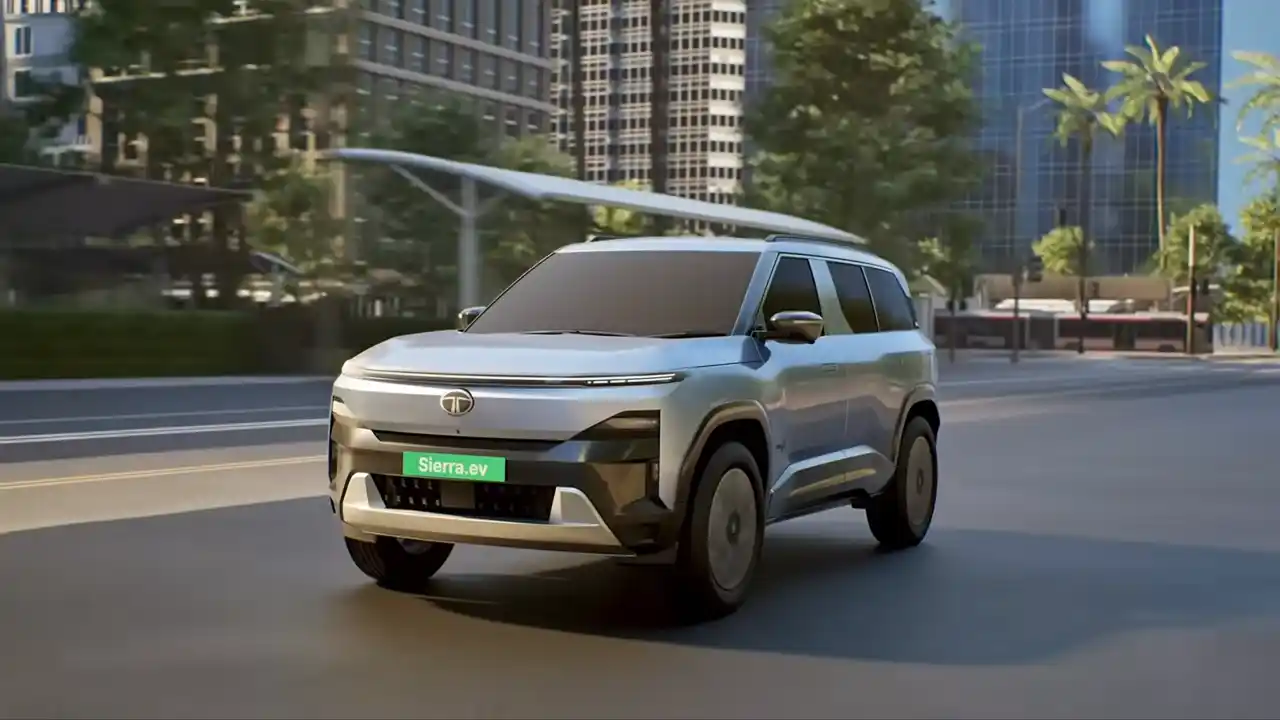
The vehicle preserves the signature wraparound rear-quarter glass, a design element that made the original Sierra instantly recognisable. However, the overall body has evolved into a modern five-door SUV with proportions suited to present-day family buyers.
The front fascia features Tata's latest EV design language with connected LED daytime running lights, sleek headlamps and a closed grille typical of electric vehicles. Flush door handles, aerodynamic alloy wheels and clean body lines contribute to improved efficiency while giving the SUV a premium appearance.
The rear design includes connected LED tail lamps and sculpted surfaces that maintain visual continuity with the front. Although inspired by its predecessor, the new Sierra EV is unmistakably a contemporary electric SUV.
Interior and Technology
The Sierra EV represents one of Tata Motors' most technologically advanced interiors to date.
The cabin adopts a minimalist design centred around a triple-screen dashboard, integrating the digital instrument cluster, infotainment display and passenger-side screen into a single panoramic layout. Premium upholstery, ambient lighting and a spacious cabin contribute to an upmarket experience.
The SUV also features a panoramic sunroof, connected car technology, wireless smartphone integration, multiple USB charging options, premium audio, ventilated seats and a comprehensive suite of comfort features designed for long-distance travel.
The emphasis on digital interfaces reflects broader trends within the global automotive industry, where software and connectivity increasingly influence customer experience alongside traditional mechanical performance.
Powertrain and Performance
The Sierra EV is built on Tata Motors' dedicated Acti.ev platform, which has been developed specifically for electric vehicles. This architecture supports multiple battery sizes, advanced electronics and future software upgrades.
Customers can choose between 63 kWh and 75 kWh battery packs depending on the selected variant. Tata Motors also offers both rear-wheel-drive (RWD) and quad-wheel-drive (QWD) dual-motor configurations, with the latter providing enhanced traction and performance.
The larger battery variant delivers a claimed driving range of up to 665 kilometres (MIDC Part 1+2), making the Sierra EV one of the longest-range electric SUVs offered by an Indian manufacturer. The dual-motor version also introduces a dedicated Boost Mode, enabling quicker acceleration and improved driving dynamics.
Charging Capabilities
Charging convenience remains one of the most important considerations for electric vehicle buyers, and Tata Motors has equipped the Sierra EV with support for both AC and DC charging.
Using a compatible 120 kW DC fast charger, the battery can be charged from 20% to 80% in approximately 26 minutes, making it suitable for long-distance travel. For home charging, Tata offers a 7.2 kW AC charger, allowing overnight charging for daily usage. The company also provides a 15-year battery warranty, underlining its confidence in the long-term durability of the battery system.
Safety and Driver Assistance
Safety has become a key focus for Tata Motors in recent years, and the Sierra EV continues that approach with a comprehensive package of active and passive safety technologies.
The SUV is equipped with Level 2+ Advanced Driver Assistance Systems (ADAS), including features such as adaptive cruise control, lane keeping assistance, traffic sign recognition and autonomous emergency braking. Additional technologies include a 540-degree surround-view camera, automatic parking assistance, multiple airbags, electronic stability control, hill descent control and a head-up display.
These systems are designed to improve driver awareness and reduce the likelihood of accidents while enhancing overall driving convenience.
Tata Motors' EV Strategy
The Sierra EV forms part of Tata Motors' broader strategy to strengthen its leadership in India's electric passenger vehicle market.
Over the past several years, the company has introduced a wide range of electric vehicles, including the Tiago EV, Tigor EV, Nexon EV, Punch EV, Curvv EV and Harrier EV. This diversified portfolio enables Tata to address multiple customer segments, from entry-level hatchbacks to premium SUVs.
The Sierra EV further expands this portfolio by targeting customers seeking larger family vehicles with higher performance and greater driving range. It also reflects Tata's increasing emphasis on indigenous EV technology, software-defined vehicles and locally developed electric platforms.
Competition in the Premium EV SUV Segment
The Sierra EV enters one of India's fastest-growing automobile segments.
It competes with electric SUVs from both domestic and international manufacturers, including Mahindra, MG Motor, Hyundai, BYD and emerging global brands entering the Indian EV market.
Its key differentiators include its iconic heritage, long claimed driving range, multiple drivetrain options, advanced safety technologies and Tata Motors' extensive nationwide sales and service network.
The company's established presence in India's EV ecosystem—including charging partnerships, after-sales support and software integration—also provides an important competitive advantage.
Why the Sierra EV Matters
Beyond being another electric SUV, the Sierra EV represents a broader shift within India's automotive industry.
It demonstrates how legacy Indian automobile brands are reinventing themselves for the electric era while preserving their heritage. Rather than relying solely on nostalgia, Tata Motors has used the Sierra nameplate to showcase its latest engineering capabilities, software integration and electric mobility technologies.
The vehicle also reflects changing consumer preferences. Today's buyers increasingly expect vehicles to combine sustainability with digital technology, connectivity, advanced safety systems and premium comfort. The Sierra EV has been designed to address these evolving expectations while strengthening Tata Motors' position in the country's rapidly expanding EV market.
Looking Ahead
India's electric vehicle market is expected to witness significant growth over the coming decade as charging infrastructure expands, battery technology improves and government policies continue to encourage cleaner mobility.
Within this evolving landscape, the Sierra EV is expected to play an important role in Tata Motors' premium electric portfolio. Its combination of heritage-inspired design, modern technology and long-range capability positions it as a key product for buyers transitioning from conventional SUVs to electric mobility.
The success of the Sierra EV could also influence how other manufacturers revive iconic models, demonstrating that heritage can coexist with innovation when supported by modern engineering and changing consumer expectations.
Conclusion
The Tata Sierra EV marks the successful return of one of India's most iconic automotive nameplates in a form that reflects the future of personal mobility. While it pays tribute to the original Sierra through its distinctive styling, the new model is fundamentally a modern electric SUV built around advanced technology, high levels of safety and contemporary design.
For Tata Motors, the Sierra EV is more than just another addition to its electric vehicle lineup. It represents the company's continued commitment to innovation, indigenous engineering and sustainable transportation while reinforcing its leadership in India's rapidly evolving EV market. As the country accelerates its transition towards electric mobility, the Sierra EV stands as an example of how iconic brands can be reimagined to meet the demands of a new generation of consumers.
Video: Tata.ev
Video: Tata.ev