
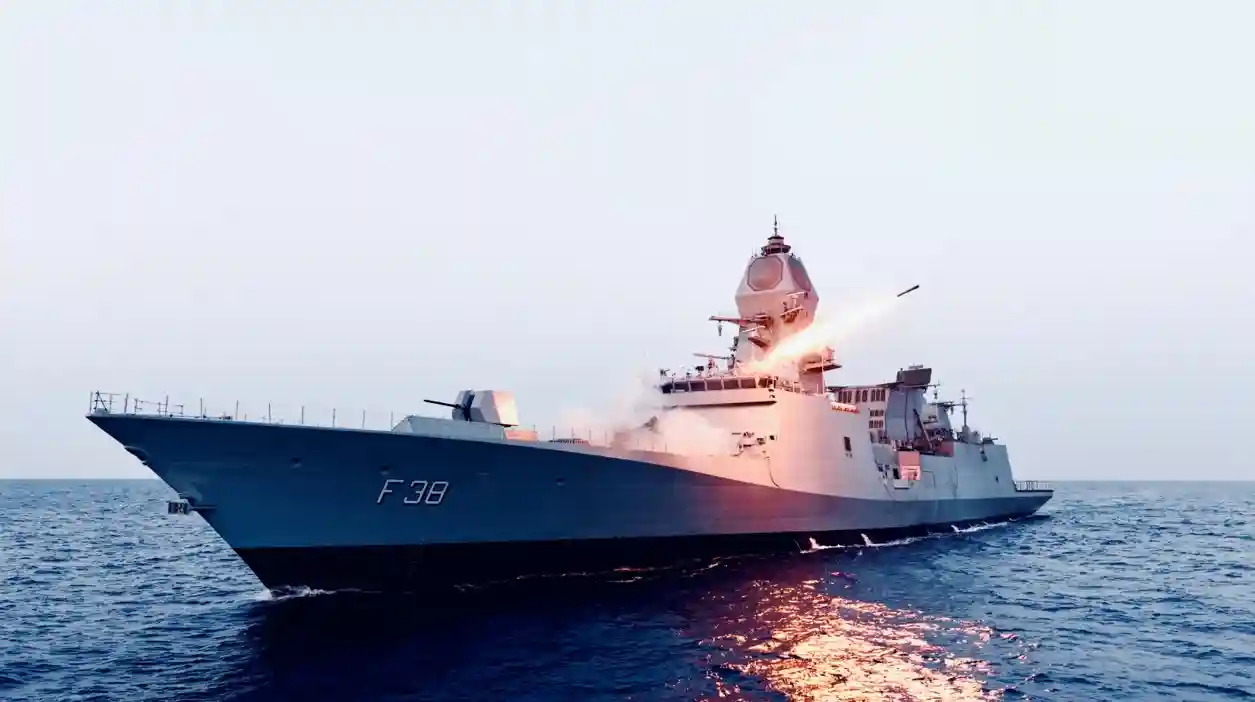
INS Mahendragiri represents a major step forward in India’s indigenous naval power, combining stealth design, advanced weapons, high indigenous content, and faster project execution into one frontline warship. Commissioned at Visakhapatnam in the presence of Defence Minister Rajnath Singh, it is the sixth Project 17A frigate to join the Indian Navy and a strong symbol of Aatmanirbhar Bharat at sea.
For India, this is not just the induction of another warship; it is a statement that the country’s shipbuilding ecosystem can now design, build, test, and deliver sophisticated combat platforms that are ready for modern maritime warfare. The ship’s commissioning also strengthens India’s ability to operate across the Indian Ocean Region and the wider Indo-Pacific, where naval presence, deterrence, and rapid response now matter more than ever.
A Warship Built for the New Maritime Era
INS Mahendragiri belongs to the Nilgiri-class or Project 17A family, which has been developed as a new generation of multi-role stealth frigates for the Indian Navy. Designed by the Navy’s Warship Design Bureau and built by Mazagon Dock Shipbuilders Limited in Mumbai, the vessel has been created to handle a broad operational spectrum, from fleet air defence and anti-surface warfare to anti-submarine warfare, maritime interdiction, surveillance, and humanitarian assistance.
That versatility is one of the ship’s most important strengths. Modern naval warfare rarely involves only one type of threat, and a ship that can defend against aircraft, submarines, and surface combatants while also supporting peacetime missions such as search and rescue must be engineered with exceptional balance. INS Mahendragiri is meant to do exactly that, which is why it is described as a frontline warship rather than a niche platform.
What Makes It Stealthy?
The phrase “stealth frigate” is not just a marketing label; it refers to design and systems that reduce detection and improve survivability in a contested environment. INS Mahendragiri features advanced stealth characteristics, reduced radar signature, modern sensors, and a network-centric combat system that helps it operate more effectively while remaining harder to track.
In practical terms, this means the warship is better positioned to approach hostile areas, survive layered threats, and respond faster in a crisis. Its stealth profile, coupled with its electronic warfare suite and integrated combat systems, gives the Navy a ship that is more difficult to target and more adaptable to modern maritime battle conditions.
Firepower and Mission Systems
INS Mahendragiri is armed for the full spectrum of naval combat, and its weapons fit the role of a highly capable multi-mission frigate. It can be equipped with the BrahMos surface-to-surface missile, widely regarded as one of the world’s fastest and most lethal cruise missiles, and it also carries medium-range surface-to-air missiles, anti-submarine rocket launchers, torpedo launchers, and a close-in weapon system for last-line defence.
Beyond the headline weapons, its value lies in the combination of systems working together. An advanced multifunction radar, anti-submarine defence systems, electronic warfare gear, and an embarked multi-role helicopter create layered offensive and defensive capability, allowing the frigate to detect, classify, engage, and endure across different threat environments.
Indigenous Content and Industrial Depth
One of the most important features of INS Mahendragiri is its more than 75 percent indigenous content. That figure matters because it shows how far India has come in building a defence-industrial base that is no longer dependent solely on foreign supply chains for key platforms and systems.
The ship was built with the contribution of more than 200 Indian industries, including numerous MSMEs, which means its significance goes well beyond naval doctrine. It supports domestic manufacturing, precision engineering, electronics, software, propulsion-related work, logistics, and the wider industrial ecosystem that grows around a major warship programme.
Faster Build, Better Process
The commissioning of Mahendragiri also reflects a major improvement in project execution. According to the details shared at the commissioning ceremony, the time from launch to delivery was cut from 63 months to 31 months, and the overall construction timeline fell from 95 months to 75 months. Even more strikingly, technical analyses were completed in a single sea trial instead of the usual five to seven.
Those numbers matter because they show that India is not only building advanced ships, but learning how to build them more efficiently. In defence manufacturing, speed without quality is a problem, but speed with quality is a strategic advantage, and Mahendragiri appears to represent that kind of maturity.
Why the Name Matters
The ship is named after the Mahendragiri mountain range in the Eastern Ghats, which gives it a sense of rootedness in India’s geography and cultural imagination. The mountain symbolism fits the vessel’s motto, “Mighty, Majestic, Matchless,” and reinforces the idea of endurance, strength, and resolve.
Naming a frontline warship after a mountain range is also fitting because naval power often relies on the same qualities associated with mountains: stability, permanence, and commanding presence. In that sense, the name gives the frigate a character that is both poetic and strategic.
Strategic Role in the Indo-Pacific
INS Mahendragiri arrives at a time when India is increasingly framing maritime security as central to national security, trade resilience, and regional stability. As Rajnath Singh noted in the commissioning address, seas matter not only for defence but also for supply chains, energy flows, commerce, and the country’s wider economic security.
That is why the frigate’s role in the Eastern Fleet is especially important. It strengthens India’s blue-water reach, supports presence missions in the Indian Ocean Region, and contributes to the country’s broader posture as a net security provider and preferred security partner in the Indo-Pacific.
Conventional Power and Future Tech
One of the most interesting themes in the commissioning speech was the insistence that next-generation technologies and conventional platforms are not rivals but complements. Rajnath Singh’s point was that even as warfare evolves through drones, AI, cyber systems, space assets, and unmanned platforms, credible ships, trained crews, and proven military power still remain the foundation of defence.
That argument is important because it places INS Mahendragiri in the real world rather than in a futuristic fantasy. The warship does not represent a rejection of new technology; it represents the idea that advanced technologies become meaningful when they are backed by solid, reliable, conventional platforms capable of carrying them into actual operational use.
A Milestone for Aatmanirbhar Bharat
Perhaps the deepest significance of INS Mahendragiri lies in what it says about India’s long-term defence ambition. It is not simply a ship delivered to the Navy; it is evidence that the country’s design bureaus, shipyards, suppliers, and technical teams can produce world-class maritime hardware at scale.
That is why the ship was presented as a symbol of Aatmanirbhar Bharat and a technologically advanced, combat-ready Navy. It captures a larger national shift in which self-reliance is no longer framed only as an economic goal, but as a strategic necessity in an uncertain world.
Conclusion
INS Mahendragiri is more than the sixth Project 17A frigate; it is a concentrated expression of where Indian naval power is headed. With stealth features, modern weapon systems, high indigenous content, and faster delivery timelines, it stands as a strong example of how India is building not just more ships, but better ones, more efficiently, and with greater domestic depth.
Its commissioning strengthens the Eastern Fleet, expands India’s maritime reach, and adds another capable platform to the Navy’s growing blue-water ambitions. Most importantly, it shows that India’s future at sea will be shaped not only by imported capabilities, but by homegrown design, industrial confidence, and a steadily maturing defence ecosystem.