
Introduction
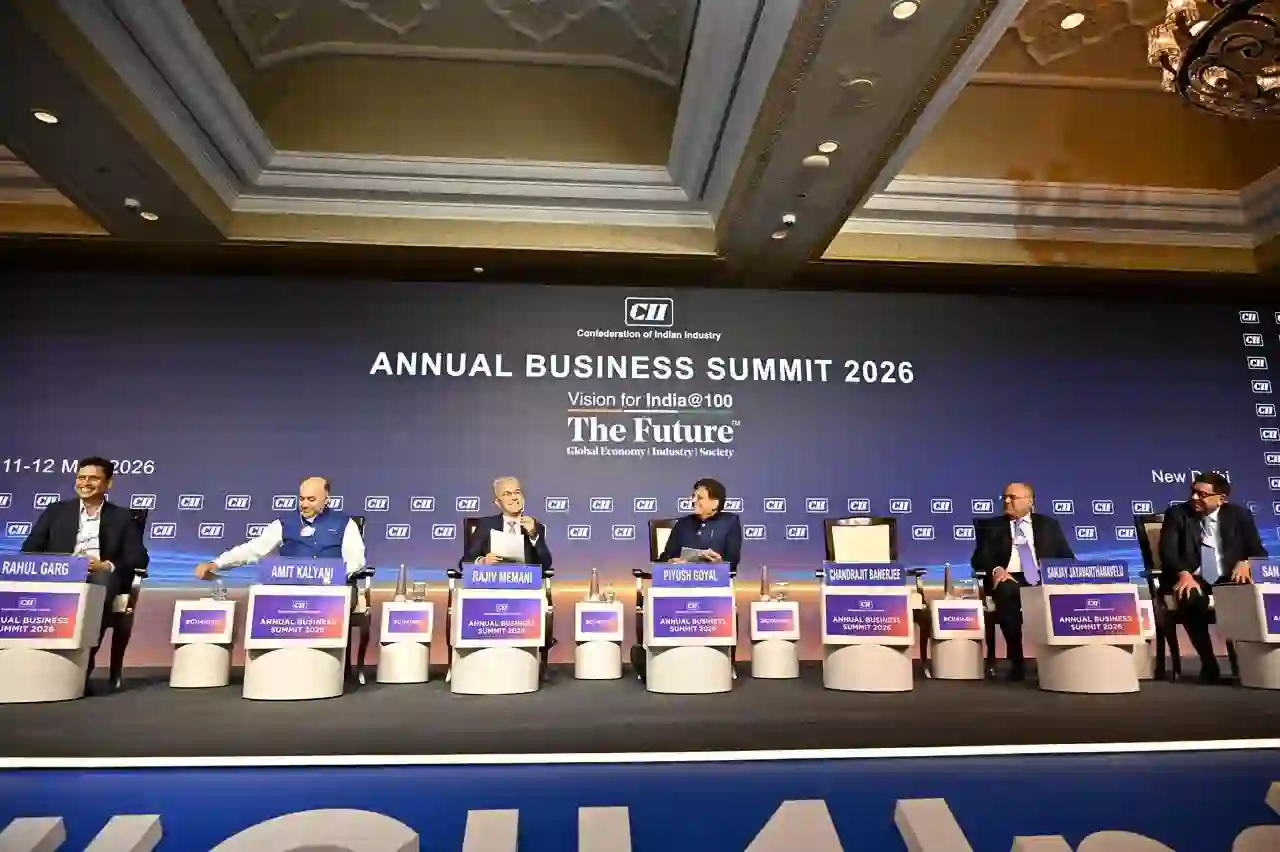
The Confederation of Indian Industry's Annual Business Summit is one of India's most consequential conversations between government and industry — a two-day forum where policy signals are sent, investment narratives are shaped, and the mood of Indian business leadership is read out loud for the entire economy to hear. The 2026 edition, held on May 11 and 12 in New Delhi, arrived at a moment of unusual global pressure: a war blocking the world's most critical energy artery, a trade architecture being rewritten by American tariffs, an AI revolution reshaping every sector simultaneously, and India sitting at the precise intersection of all four.
The CII Annual Business Summit 2026 convened under the theme "The Future | Global Economy, Industry, Society." The focus was on navigating disruption and exercising leadership: aligning policy, industry, and society to translate this moment of inflection into sustained national advantage.
The theme was not chosen casually. At a defining moment of global transformation, multiple forces including geopolitical shifts, technological change, climate urgency, and evolving societal expectations are reshaping the world. In this environment, trust, resilience, and effective governance are becoming central to long-term competitiveness. The challenge is no longer to resist change but to harness it through strong institutions, partnerships, and adaptive capabilities.
About CII: The Institution Behind the Summit
Before the summit's content can be fully appreciated, the institution organising it deserves its own introduction, because CII is not simply a trade body. It is one of India's most influential policy-shaping institutions.
Founded in 1895 as the Engineering and Iron Trades Association, the Confederation of Indian Industry has grown into India's largest apex industry organisation, representing over 9,000 direct member companies and 300,000 companies within its associate and affiliated network through 65 sectoral industry bodies. It operates across 63 offices in India and 10 overseas offices, with institutional partnerships in 119 countries.
CII works to create and sustain an environment conducive to the development of India by partnering industry, government, and civil society through advisory and consultative processes. It has been central to many of India's significant economic policy transitions — from the liberalisation of the 1990s to the ease of doing business reforms of the 2010s to the PLI scheme architecture of the 2020s. When CII speaks, Finance Ministry officials, NITI Aayog planners, and cabinet ministers are typically in the room, listening. The Annual Business Summit is the highest-visibility manifestation of that engagement each year.
The CII Annual General Meeting, which determines the organisation's leadership and strategic direction for the year ahead, was held on May 12, the second day of the summit.
The Context: Why the 2026 Summit Carried Extra Weight
The annual summit always takes place against the backdrop of the economic moment. The 2026 edition was held against a particularly demanding one.
The Strait of Hormuz crisis, which had closed the world's most critical oil transit route since late February, was still unresolved at the time of the summit. India, which imports nearly 85 percent of its crude oil and depends heavily on Hormuz-transiting Gulf supply, had been absorbing a significant cost shock to its energy import bill for months. Oil prices had spiked to record levels in March and remained elevated. The rupee had come under pressure. Inflation in fuel and logistics had fed through into manufacturing input costs and consumer prices.
Simultaneously, the Trump administration's tariff architecture — which had imposed sweeping duties on Indian exports in several categories — was creating both anxiety and opportunity for Indian industry. Anxiety because export competitiveness in affected sectors had been hurt. Opportunity because the same tariffs on Chinese goods were accelerating the global search for alternative manufacturing bases, and India remained the most credible alternative at scale.
India's own macroeconomic position entering the summit was one of relative resilience. The economy had maintained its position as the fastest-growing major economy through 2025-26, with GDP growth continuing to outperform most comparable peers. The Viksit Bharat 2047 agenda — India's aspiration to be a fully developed economy by the centenary of independence — provided the long-term frame within which the short-term disruptions were being absorbed.
As India approaches its centenary, India@100 provides a roadmap for inclusive and sustainable growth. The CII Annual Business Summit 2026 connects this long-term vision with the realities of a rapidly evolving global economy.
The Theme: Three Questions for India's Future
The summit's overarching theme — "The Future | Global Economy, Industry, Society" — was anchored in three interlocking questions that ran across every session of the two-day programme.
Three system enablers were identified as decisive. First, governance must build trust, embed ethics, and sustain institutional legitimacy in an increasingly complex and risk-prone environment. Second, strong state capacity is essential to design coherent policy. Third, robust financial architecture must mobilise long-term capital, manage risk, and support sustained investment. Together, these enablers determine whether transformation becomes credible, resilient, and enduring across sectors, enabling growth that is both competitive and inclusive.
Industry will play a central role in shaping India's future economy as growth increasingly depends on how firms invest, innovate, and engage with society. The shift from shareholder value to broader responsibility calls for alignment with national priorities while remaining globally competitive. Leadership must extend beyond firms to ecosystems, driving R&D, integrating MSMEs, and strengthening trust through ethical governance.
India's energy transition is now a strategic economic advantage, with rapid growth in renewables reshaping cost structures and competitiveness. That last point carries particular weight in the context of the Hormuz crisis: India's accelerating transition to non-fossil energy — non-fossil sources already account for over 50 percent of installed power capacity — is now seen not just as a climate obligation but as a strategic hedge against the kind of energy price shock that the Gulf war has delivered.
Key Sessions and Speakers
Labour Reforms: Government's Commitment
Union Minister Mansukh Mandaviya addressed the session on "Next-Gen Labour Reforms: Driving Industry Growth and Job Creation." He said social security coverage has increased from 29 crore people a decade ago to 94 crore at present. Highlighting the new labour codes, Mandaviya said the reforms are both labour-centric and industry-centric. He added that the government is committed to being pro-poor, pro-farmer, and industry-friendly and stressed the need for industry and labour to move together towards a shared future.
The labour codes — four codes that consolidate 44 central labour laws — have been in preparation for years. Their implementation at the state level has been uneven, and the CII session reflected the industry's continued interest in seeing the codes operationalised uniformly and swiftly. The government's framing of the codes as simultaneously pro-worker and pro-industry was significant: it reflects the political challenge of labour reform in India, where any measure perceived as weakening worker protections faces stiff political opposition, particularly from trade unions with deep ties to opposition parties.
Micro and Small Enterprises: The Backbone Speaks
CII hosted a special session titled "Powering the Future: India's Micro Enterprises" during the summit. The session highlighted the critical role of micro and small enterprises in driving economic resilience, employment generation, and inclusive growth, with discussions focusing on strengthening their integration into domestic and global value chains while enabling them to adapt and scale.
Delivering the keynote address, Dr. V. AnanthaNageswaran, Chief Economic Advisor to the Government of India, addressed the session. AnanthaNageswaran's participation as CEA — the government's top internal economic voice — in a session specifically focused on micro enterprises signalled the policy priority being accorded to the bottom of the enterprise pyramid, not just the corporate top.
The session also provided a platform for entrepreneurs from across the country to present their challenges, aspirations, and growth ambitions directly to government and industry leaders, fostering meaningful dialogue and offering valuable insights into sectoral needs. Col. Joy Choudhury, Founder and Director of We Serve Enterprises and NagaKi Products Pvt Ltd, highlighted that exposure to the CII programme enabled entrepreneurs from remote regions like Nagaland to adopt a more structured and informed approach to business. He emphasised the importance of shifting from informal practices to building awareness around creditworthiness, accessing formal finance, and strengthening entrepreneurial capabilities.
That moment — an entrepreneur from Nagaland speaking about creditworthiness and formal finance at India's most prominent industry forum — captured something important about what the 2026 summit was attempting to do: bring the full geographic and economic width of India's enterprise ecosystem into a conversation that has historically been dominated by large corporates.
Uttar Pradesh: The Investor Pitch
At the CII Annual Business Summit 2026, industry leaders, investors, and corporate representatives praised the leadership of Chief Minister Yogi Adityanath, highlighting Uttar Pradesh's remarkable progress in law and order, infrastructure, and industrial growth. Speakers noted that Uttar Pradesh has emerged as one of India's fastest-growing states, driven by improved governance and investor-friendly policies. CM Yogi Adityanath invited industry leaders to invest in the "New Uttar Pradesh," emphasising the state's vast growth potential. He credited the leadership of Prime Minister Narendra Modi and the support from industry bodies like CII for the transformation of the state's economic landscape. The Chief Minister said that over 18,000 large industries and 96 lakh MSME units have been established in Uttar Pradesh, making it a major hub for employment and production.
UP's presence at the summit reflected a broader trend of state governments using CII's national platform as an investment pitch opportunity. The state's transformation — from one of India's most difficult investment environments to one of its more active recipients of domestic and foreign capital — has been one of the more significant regional economic stories of the past five years, and Adityanath's team used the Delhi platform to consolidate that narrative.
Andhra Pradesh: Innovation and Collaborative Growth
Andhra Pradesh's leadership also addressed the summit. "The future belongs to societies where governments, industry, and academia innovate together, not in isolation. In Andhra Pradesh, we are actively building this collaborative ecosystem," was the message conveyed from the state government's representative at the summit. Andhra Pradesh, seeking to rebuild its investment profile following the bifurcation that created Telangana and the subsequent years of political uncertainty, has been among the more active state-level participants in CII's national forums.
The Broader CII Calendar: Beyond the Annual Summit
The Annual Business Summit is the most prominent but not the only significant event in CII's 2026 calendar.
CII will organise the 31st edition of the CII Partnership Summit 2026 on November 12 and 13 in Visakhapatnam, Andhra Pradesh. Held annually since 1995, the Partnership Summit is organised in association with the Department for Promotion of Industry and Internal Trade (DPIIT), Ministry of Commerce and Industry, Government of India. As trade becomes more data-driven and complex, the summit will focus on how emerging technologies can improve end-to-end efficiency, lowering logistics costs, enabling automated customs processes, strengthening compliance, and improving buyer-seller matchmaking.
CII also organised the 7th CII Datacenter Blueprint Summit 2026 in March at Jio World Convention Centre, BKC, Mumbai, under the theme "Building Sustainable Digital Foundations for Datacenters."
Together, these events trace the breadth of CII's engagement: macro strategy at the Annual Business Summit, investment facilitation at the Partnership Summit, and sector-specific deep dives in between.
What the Summit Signalled: Reading the Subtext
The explicit content of a CII summit is always important. So is what it signals implicitly about the state of the relationship between Indian government and Indian industry.
The 2026 summit took place at a moment when Indian industry was navigating multiple simultaneous uncertainties: the energy cost shock from the Hormuz crisis, the US tariff disruption to export markets, the AI-driven disruption to existing business models, and the climate transition's accelerating demands on capital allocation. The government's participation — through the CEA, Union ministers, and multiple chief ministers — signalled that the policy establishment was willing to engage with these concerns directly rather than simply project confidence from a distance.
The summit's own framing — trust, resilience, governance — was notably different from the typical Davos-style optimism that characterises many business forums. It acknowledged that the global environment had become genuinely more difficult, that India's competitive advantage was not guaranteed but had to be actively built, and that the responsibility for doing so lay with both government and industry rather than with either alone.
That framing, practical and somewhat sober rather than triumphalist, may be the most significant thing the 2026 CII Annual Business Summit communicated: India's business leadership understands that the next decade will be harder than the last, and is preparing accordingly.