
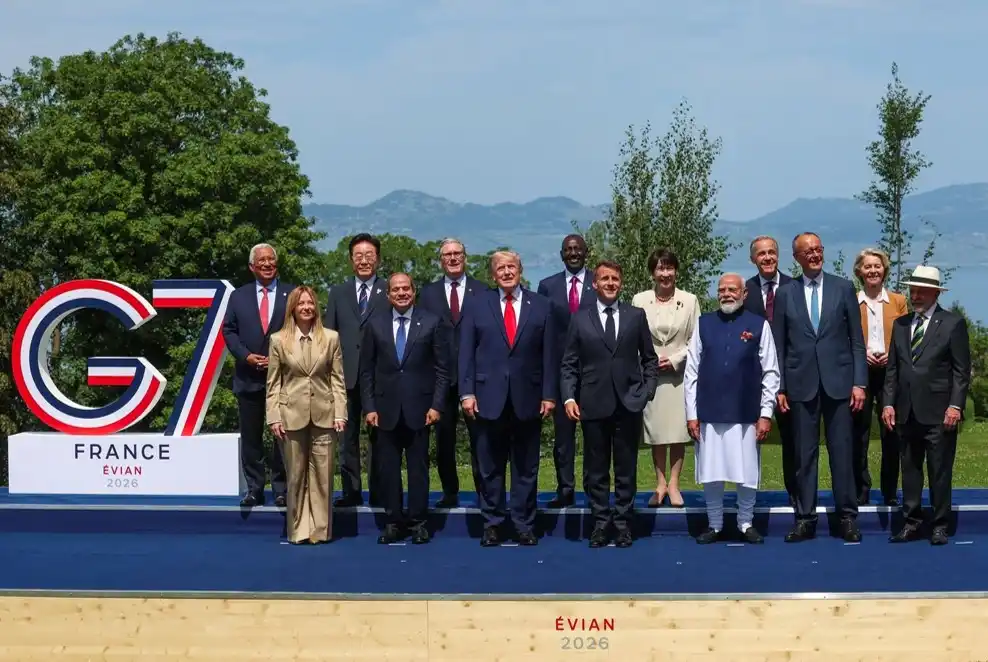
Prime Minister Narendra Modi delivered a powerful address at the 52nd G7 Summit in Evian-les-Bains, France, on Tuesday, June 16, 2026, voicing India’s firm concern over disruptions to maritime trade through the Strait of Hormuz and highlighting that several Indian civilians lost their lives during the West Asia conflict. Speaking at the outreach session on “Forging New Partnerships and Rebuilding International Solidarity,” Modi emphasized that lasting solutions to conflicts can only be achieved through dialogue, diplomacy, and international cooperation, while calling for the safety of seafarers who connect all nations through global maritime trade.
The summit, held from June 15 to 17 on the shores of Lake Geneva, brings together leaders of France, Britain, Canada, Germany, Italy, Japan, and the United States alongside the European Union, with India invited as a partner country for its 13th participation and PM Modi’s 7th consecutive attendance. During his extensive diplomatic outreach on the sidelines, Modi held bilateral meetings with Canadian Prime Minister Mark Carney, British Prime Minister Keir Starmer, UAE President Sheikh Mohamed bin Zayed Al Nahyan, Kenyan President William Ruto, Egyptian President Abdel Fattah El-Sisi, Japanese Prime Minister Sanae Takaichi, and South Korean President Lee Jae-myung, while also exchanging greetings with U.S. President Donald Trump ahead of their scheduled bilateral meeting.
Maritime Security and the Strait of Hormuz: India’s Core Concern
PM Modi’s remarks on the need to protect seafarers came amid growing anger in India over the deaths of three Indian crew members in a U.S. military attack on a merchant vessel off the coast of Oman last week. The U.S. Central Command said it had taken action against three vessels, Marivex on June 8, Settebello on June 9, and Jalveer on June 11, alleging that they were attempting to violate the U.S. blockade of Iranian ports. Modi raised this issue a day before his bilateral talks with President Trump, underscoring how conflicts in West Asia have disrupted global trade and caused loss of life.
“We welcome the progress made in peace efforts in West Asia. This conflict has caused loss of life and property in our friendly countries in the region. Disruptions to maritime trade through the Strait of Hormuz have affected the global economy. Several Indian civilians have also lost their lives,” Modi said during his address. “It is our responsibility to ensure the safety of the seafarers who connect all nations through global maritime trade. We must ensure that maritime routes remain secure and that seafarers can perform their duties without fear,” he added.
Modi’s concerns reflect India’s strategic dependence on the Strait of Hormuz, one of the world’s most critical maritime chokepoints for oil shipments and global commerce. As a major importer of energy and a nation with significant maritime trade volumes, disruptions in Hormuz directly impact India’s economic security, energy prices, and the safety of its nationals working in global shipping. The deaths of three Indian mariners in the U.S. strike have heightened domestic pressure on the government to address maritime security and protect Indian citizens abroad.
Trust as the Ultimate Strategic Asset: Modi’s Vision for International Relations
In his address, Modi underscored the importance of trust in international relations, saying that confidence among nations has become a more valuable strategic asset than minerals, technology, or markets. He argued that in an increasingly interconnected world, where energy, food, health, cyber, and economic security are closely linked, stronger international partnerships are essential for humanity’s progress and prosperity. Warning that trade and technology were being used to pursue narrow interests, Modi said such practices had contributed to a growing trust deficit in the international system.
Modi wrote in an X post: “Shared my thoughts at the Outreach Session on ‘Forging New Partnerships and Rebuilding International Solidarity’ at the G7 Summit in Evian. In a world that is getting more interconnected and interdependent than ever before, this subject becomes all the more vital.” His emphasis on trust reflects India’s diplomatic philosophy that international cooperation must be founded on mutual respect, reciprocity, and shared interests rather than coercion or unilateralism.
The trust deficit Modi highlighted is particularly relevant in the current global context, where geopolitical tensions, trade restrictions, technology bans, and security concerns have led nations to prioritize national interests over collective action. As the G7 discusses issues ranging from AI access to critical minerals supply chains, India’s call for trust-based partnerships offers an alternative framework that emphasizes inclusivity, cooperation, and shared prosperity for all nations, not just the wealthy few.
Bilateral Outreach: Strengthening India’s Strategic Partnerships
India-Canada: Forward-Looking Strategic Partnership
During his meeting with Canadian Prime Minister Mark Carney, PM Modi and his counterpart welcomed the positive momentum in India-Canada relations and reaffirmed their commitment to building a forward-looking strategic partnership. The two leaders reviewed progress in economic cooperation, including commercial arrangements relating to Liquefied Natural Gas (LNG), Liquefied Petroleum Gas (LPG), and metallurgical coal. They expressed satisfaction over ongoing negotiations for a Comprehensive Economic Partnership Agreement, with both sides aiming to conclude the pact this year.
The leaders also welcomed growing cooperation in science and technology, defence, finance, and migration. To further strengthen defence and security ties, the two countries agreed to launch negotiations on a General Security of Information Agreement. PM Modi expressed India’s support for Canada becoming a Dialogue Partner of the Indian Ocean Rim Association, and both leaders announced the establishment of Raisina Americas as a platform to enhance dialogue and cooperation.
India-UK: Vision 2035 and Comprehensive Economic Partnership
During his meeting with British Prime Minister Keir Starmer, PM Modi reviewed progress in India-UK relations under Vision 2035. The two leaders welcomed cooperation across trade, defence, technology, education, and people-to-people ties, looking forward to the early implementation of the Comprehensive Economic and Trade Agreement. They expressed satisfaction over the strong education partnership, noting recent progress in establishing campuses of British universities in India, including the University of Liverpool in Bengaluru and the Universities of York and Bristol in Mumbai.
The leaders exchanged views on regional and global developments and reaffirmed their commitment to further strengthening the India-UK Comprehensive Strategic Partnership, demonstrating how both nations are working to deepen their bilateral relationship across multiple sectors.
India-UAE: Dialogue, Diplomacy, and Regional Stability
PM Modi met UAE President Sheikh Mohamed bin Zayed Al Nahyan on the sidelines of the G7 Summit, underscoring the importance of dialogue, diplomacy, and respect for international law, sovereignty, and territorial integrity in advancing enduring peace, security, and stability in the West Asia region. The two sides called for continued free, safe, and unimpeded navigation, trade, and commerce through the Strait of Hormuz, directly aligning with Modi’s G7 address on maritime security.
They exchanged views on regional and global developments of mutual interest and reviewed progress in bilateral cooperation in technology, trade, investment, energy, and defence, building on momentum generated by President Al Nahyan’s visit to India in January and PM Modi’s visit to the UAE last month. PM Modi conveyed his invitation to President Al Nahyan to attend the BRICS Summit to be hosted by India later this year. This was the third meeting between the two leaders this year, demonstrating the strong bilateral relationship.
India-Kenya and India-Egypt: Global South Partnership
PM Modi met Kenyan President William Ruto, saying India and Kenya share a longstanding partnership anchored in the aspirations of the Global South and reiterating that both countries remain committed to working together for the well-being of their people. He also met Egyptian President Abdel Fattah El-Sisi, reaffirming that India deeply values its longstanding friendship with Egypt. These meetings reflect India’s continued commitment to strengthening relationships with Global South nations and advocating for their interests in international forums.
India-Japan and India-South Korea: Trade, Investment, and Futuristic Sectors
During his meeting with Japanese Prime Minister Sanae Takaichi, PM Modi emphasized that India and Japan will continue to deepen ties across diverse sectors, with trade and investment remaining priority areas. He also met South Korean President Lee Jae-myung, saying both countries are working together in trade, commerce, and several futuristic sectors. These engagements demonstrate India’s commitment to strengthening partnerships with key Asian economies that are critical for technology, supply chains, and economic growth.
G7 Leaders’ Key Decisions: Russia Sanctions, AI Access, Critical Minerals, and Debt Relief
Intensifying Pressure on Russia Over Ukraine
G7 leaders agreed to intensify pressure on Russia to end more than four years of war against Ukraine, with U.S. President Donald Trump saying Moscow should “make a deal.” President Trump said the U.S. will soon be able to reimpose sanctions against Russian oil, while Canadian Prime Minister Mark Carney announced new sanctions targeting Russia’s shadow fleet, energy revenues, defence-industrial sector, and entities linked to disinformation efforts following his meeting with Ukrainian President Volodymyr Zelenskyy alongside the G7 in France.
Trusted Partners Access to Cutting-Edge U.S. AI Models
G7 leaders discussed a plan to grant select “trusted partners” access to advanced AI models from U.S. firms such as Anthropic, potentially opening a path around restrictions on non-American use. This was mainly discussed with U.S. Commerce Secretary Howard Lutnick on the sidelines of the opening G7 summit dinner. The “trusted partners” could be countries or companies, with talks ongoing regarding widening access to advanced AI models.
Anthropic recently disabled access for all users to Fable 5 and Mythos 5, its most advanced AI models, after President Trump ordered the company to block foreign nationals from accessing its most advanced AI models, citing national security concerns. The G7 discussion represents an attempt to balance national security with international cooperation in AI development.
Critical Minerals: Reducing Reliance on China
G7 host France is pushing partners to agree on a statement on critical minerals that could include measures to help the West reduce its reliance on China and shield investors from countermeasures and dumping. The leaders will discuss securing mineral supply chains, a central theme of France’s G7 presidency, alongside a broader effort to remedy global economic imbalances on the final day of the summit. China spooked the global economy last year when some industries nearly ground to a halt after Beijing imposed export curbs on permanent magnets made of rare earths, highlighting how reliant Western supply chains in energy, defence, and technology sectors are on these goods.
Measures under discussion have included price supports, market standards, subsidies, guaranteed purchases, and means to scale up private investment in critical mineral supply chains outside China. However, any measures announced at the G7 are likely to be first steps rather than comprehensive solutions.
Global Debt Vulnerabilities: Supporting Developing Countries
G7 leaders pledged to step up efforts to address high debt burdens among developing countries, including middle-income countries not currently eligible for debt relief initiatives launched by the G20 during the COVID-19 pandemic. In a joint declaration issued after a session that included guest countries Kenya, Egypt, India, Brazil, and South Korea, G7 leaders affirmed their commitment to international cooperation on development while urging reforms and greater emphasis on private investment.
“We will enhance efforts to address escalating global debt vulnerabilities that threaten economic stability and constrain fiscal space for essential public service interventions,” the statement, backed by South Korea and Kenya, said. Leaders also underscored the importance of progress toward a common approach to debt restructurings for vulnerable middle-income countries not eligible for the G20 Common Framework.
India’s Strategic Positioning at the G7: Advocating for the Global South
India’s participation as a partner country at the 52nd G7 Summit represents its 13th participation and PM Modi’s 7th consecutive attendance, demonstrating India’s growing influence in global multilateral forums. At the summit, PM Modi engaged with world leaders on issues of importance to India as well as to the Global South, advocating for inclusive international cooperation that addresses the needs of developing nations.
Modi’s emphasis on trust, maritime security, dialogue, and diplomacy reflects India’s diplomatic philosophy that international relations must be founded on mutual respect rather than coercion. His concerns about the Strait of Hormuz disruptions and the deaths of Indian civilians highlight how global conflicts directly impact India’s economic security and the safety of its nationals. By raising these issues at the G7, Modi ensured that India’s perspectives are represented in discussions among the world’s most powerful economies.
India’s bilateral meetings with Canada, the UK, the UAE, Kenya, Egypt, Japan, and South Korea demonstrate the country’s proactive strategy of strengthening partnerships across multiple regions while advocating for Global South interests. The agreements on economic partnerships, defence cooperation, education collaborations, and regional stability demonstrate how India is building a network of strategic relationships that support its economic development, security interests, and diplomatic objectives.
Conclusion: Modi’s G7 Address Sets the Tone for India’s Global Diplomatic Leadership
PM Modi’s address at the G7 Summit in Evian-les-Bains set a clear tone for India’s global diplomatic leadership, emphasizing trust, maritime security, dialogue, and international solidarity as the foundations for addressing today’s most pressing challenges. His concerns about the Strait of Hormuz disruptions and the deaths of Indian civilians in West Asia conflicts highlighted how global geopolitical tensions directly impact India’s economic security and national interests, while his call for trusted partnerships offered an alternative framework for international cooperation that emphasizes inclusivity and mutual respect.
The extensive bilateral outreach Modi conducted on the sidelines, strengthening partnerships with Canada, the UK, UAE, Kenya, Egypt, Japan, and South Korea, demonstrates India’s proactive diplomatic strategy of building strategic relationships across multiple regions while advocating for Global South interests. As the G7 leaders discussed Russia sanctions, AI access, critical minerals, and debt relief, India’s voice ensured that developing nations’ perspectives are represented in decisions that will shape the global economic and security architecture.
Modi’s emphasis on trust as the ultimate strategic asset, more valuable than minerals, technology, or markets, offers a visionary framework for international relations that recognizes how interconnected challenges require interconnected solutions. As the world faces escalating geopolitical tensions, trade restrictions, technology bans, and security concerns, India’s call for trust-based partnerships provides an alternative path toward global cooperation that prioritizes shared prosperity over narrow national interests. Through his G7 participation, PM Modi has positioned India as a responsible global leader committed to building international solidarity, ensuring maritime security, and advocating for the well-being of all nations, particularly those in the Global South.